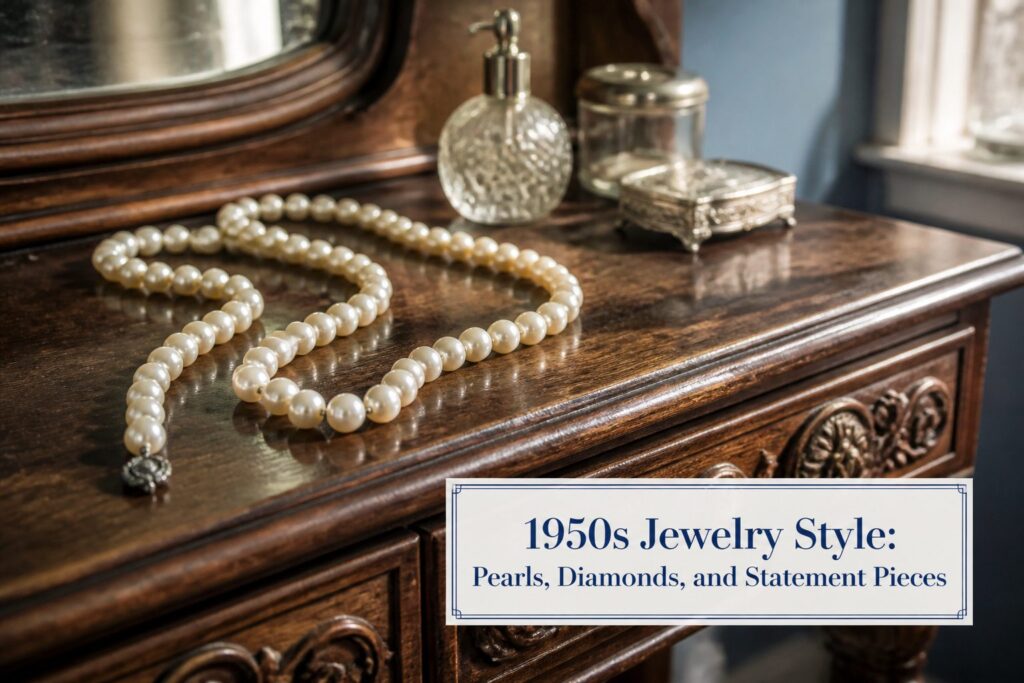
1950s jewelry style was a system of rules as much as a look.
Day meant restraint; night demanded matching diamond sets in platinum, with nothing in between. The decade’s prosperity made this possible, and its conformity made it necessary.
Audrey Hepburn’s pearls and Marilyn Monroe’s borrowed Harry Winston diamonds gave women the template, but the real force was Dior’s New Look, whose wide necklines and nipped waists turned jewelry placement into architecture.
Pearl Jewelry
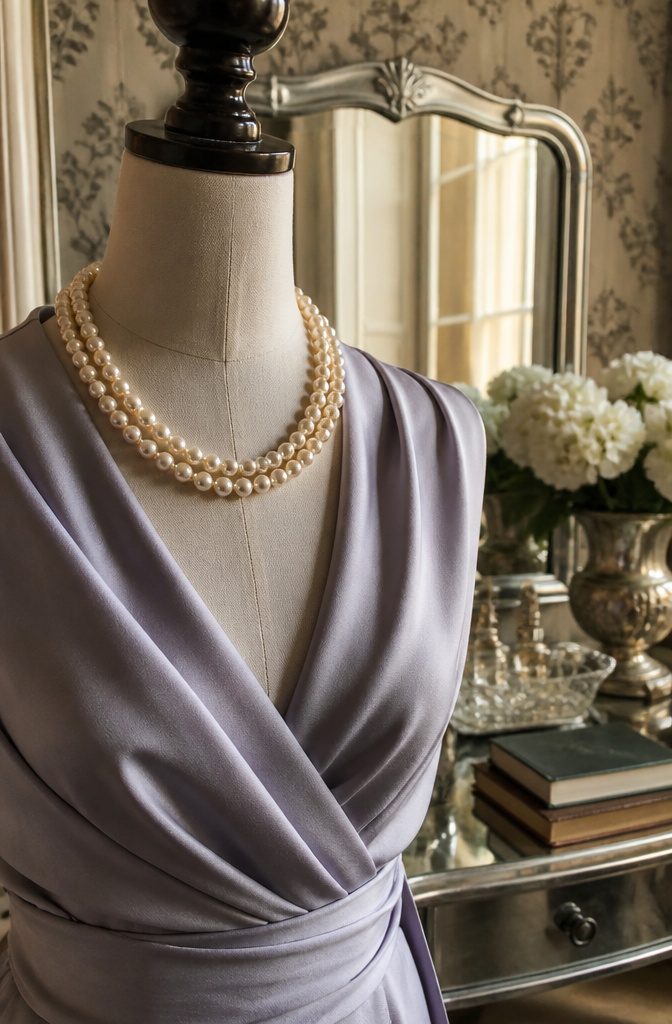
Post-war availability turned pearls from a wartime scarcity back into a daily staple.
By the early 1950s, a single or double strand worn just below the throat had become the uniform of a well-dressed woman out to lunch, at the office, or running errands in a sweater set and cigarette pants.
The strands sat perfectly against the open necklines of Dior’s New Look, whose fitted bodice and nipped waist made pearl placement almost architectural.
Audrey Hepburn and Grace Kelly sealed the association.
Their frequent appearances in pearls, on screen and off, made the look aspirational rather than merely available. Pearl earrings matched the necklaces for daytime, usually a stud or a button with an ornamental surround rather than anything dangling.
Most clipped on, since pierced ears were still uncommon. A double strand at the collarbone felt complete without being formal; it read as put-together effort rather than occasion dressing, which is exactly why it worked from morning into early evening.
Diamond Jewelry
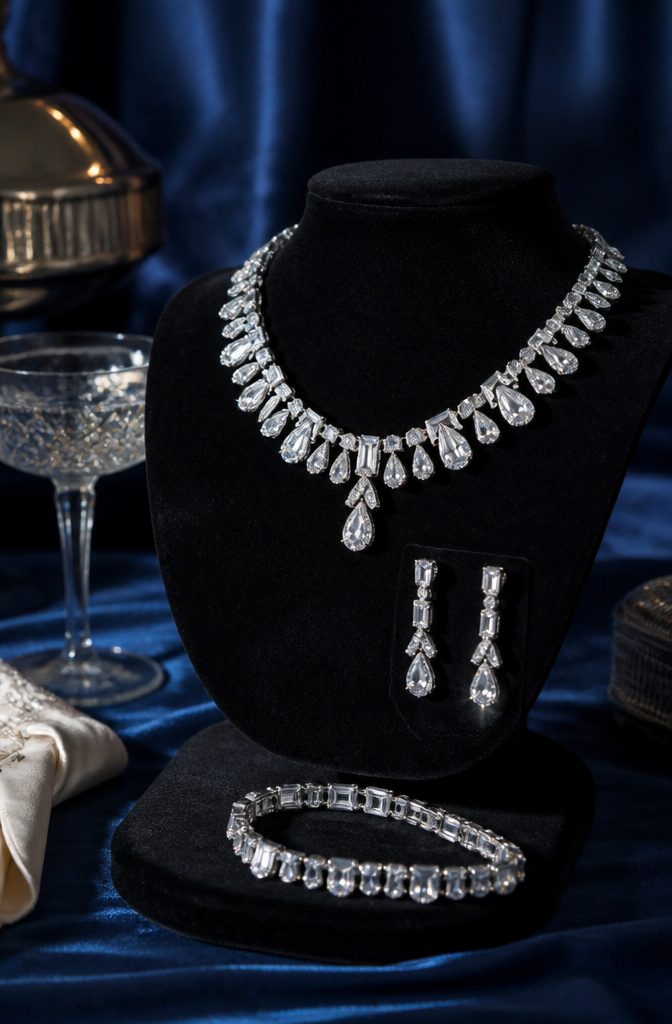
Evening jewelry in the 1950s meant diamond and platinum in matching sets, and the reason is straightforward: nothing else read as formal under artificial light.
Platinum’s cool white sheen kept diamonds looking icy rather than warm, so a necklace, earrings, and bracelet in the same metal formed a unified glow against décolleté necklines.
I tend to think of these as coordinated investments rather than loose collections; a hostess wearing a full set signaled she understood the occasion.
Hollywood drove this preference hard. When Grace Kelly or Audrey Hepburn appeared in diamond suites on screen, audiences saw what evening was supposed to look like.
Marilyn Monroe’s performance of "Diamonds Are a Girl’s Best Friend" in 1953, with Harry Winston jewels on loan, cemented the association between diamonds and sophisticated nightlife.
Women who couldn’t borrow from Winston could still follow the silhouette: the matching set mattered more than the carat weight.
Costume jewelry makers like Monet and Schreiner reproduced these platinum-and-diamond looks in rhinestone and white metal, which let a wider audience participate in the glamour.
The imitation isn’t a footnote to me; it’s evidence that the style itself, that insistence on coordinated sparkle, had become the standard.
Cocktail Rings
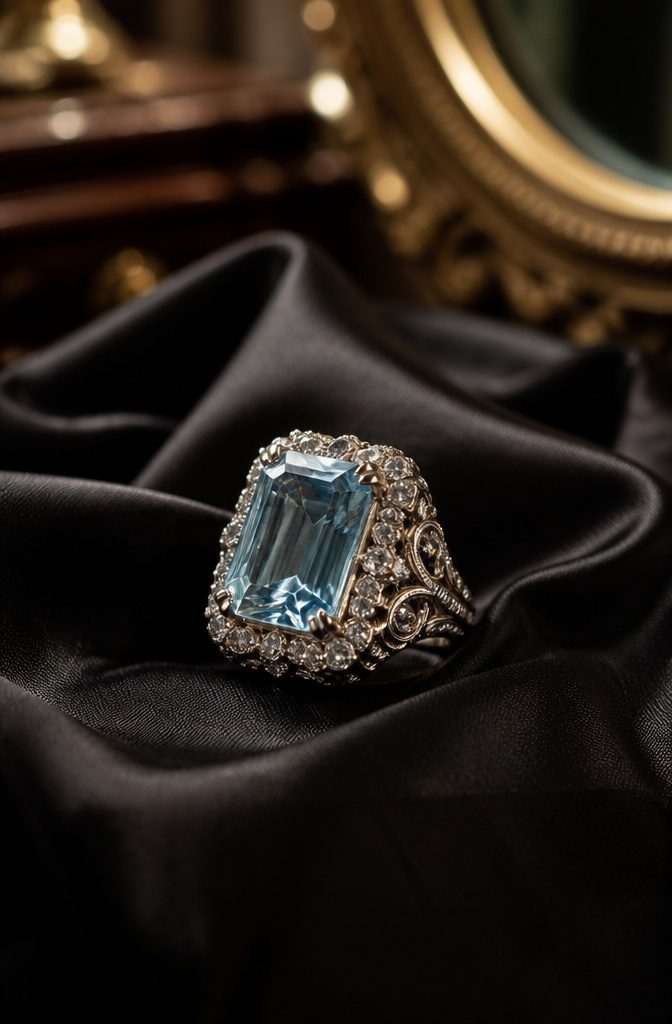
Cocktail rings in the 1950s jewelry style demanded scale that daytime pieces simply could not match.
A proper example sat high off the finger in a bombé or boule form, sometimes spreading scroll, fan, or ribbon motifs across the entire surface.
Pavé or invisible setting pushed bright stones from edge to edge, turning the hand itself into the event.
Post-war prosperity made this possible. Women moved from wartime restraint into evening gatherings where a single oversized ring announced the occasion as clearly as the dress code did.
The Tank ring, peaking in the 1940s and carrying solidly through the 1950s, set diamonds against synthetic rubies in 18-carat gold and established the template: heavy, architectural, impossible to ignore.
A 30-carat emerald-cut aquamarine in 18-karat yellow gold, diamond and sapphire fringe, represented the extreme. Elizabeth Taylor would not have worn it to lunch.
That was exactly the point. The cocktail ring’s job was to catch candlelight across a crowded room, to keep the gesture of raising a glass interesting, to mark the hours after dark as separate from everything practical that came before.
Brooches
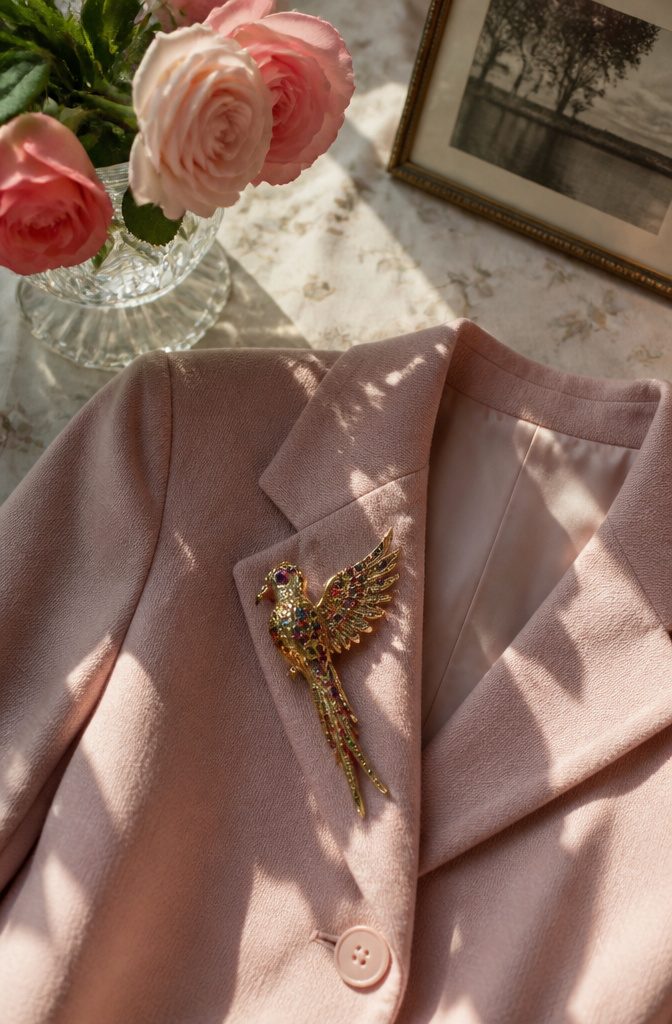
Large decorative pins dominated 1950s jewelry style, with floral and animal motifs scaled big enough to read from across a room. Designers rendered these realistically, articulating petals and feathers in multicolored gold with carefully set gems.
Fabric-inspired shapes like knots, bows, and pleated lace also translated well to metal, giving brooches a soft, wearable drama that worked equally well pinned to a daytime suit or an evening cocktail dress.
The scatter pins trend pushed this versatility further.
Instead of one statement piece, women grouped multiple small brooches together, clustering them at a neckline or scattering them across a shoulder. This approach let the wearer build her own composition and rearrange it at will.
Owners on Reddit mention inheriting these sets from relatives who never pierced their ears, suggesting how brooches functioned as the default personal ornament for women across generations.
Patriotic themes carried subtle postwar weight.
Cartier’s "Bird in a Cage" pin, created during the occupation, was answered by freed bird designs after liberation; Mellerio produced soldier brooches, and Mauboussin’s Jeep de la Libération brooch turned military imagery into jewelry.
These pieces read as fashion first, but the symbolism gave them staying power in a jewelry box.
Charm Bracelets
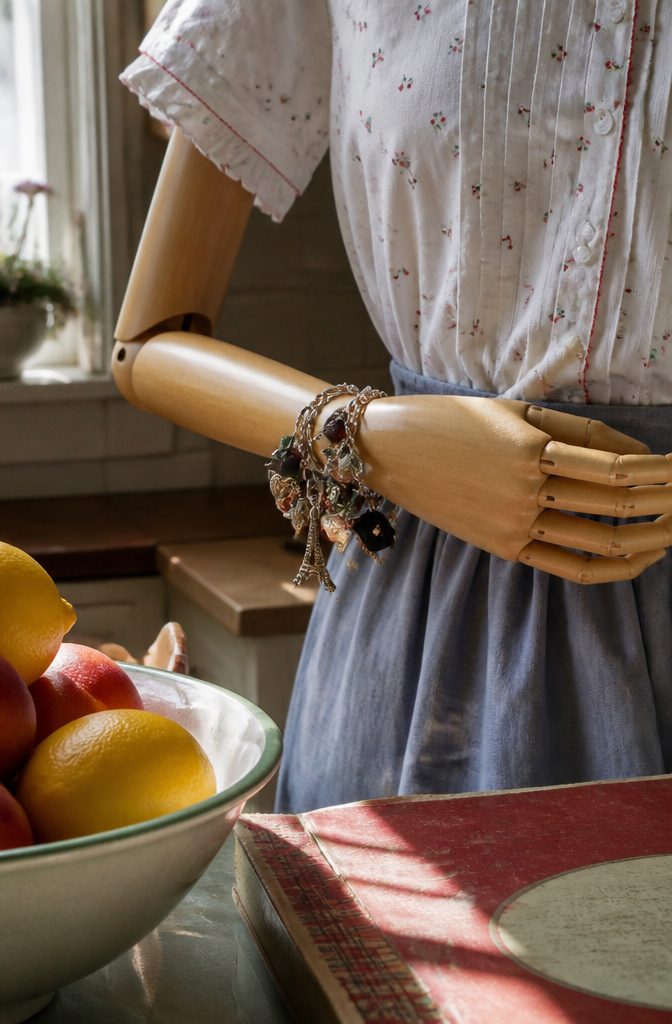
Charm bracelets carried their wartime popularity straight through the 1950s, and the reason is simple: women were already building collections, one small pendant at a time.
A bracelet started in 1943 with a single sterling heart or enameled flag might pick up a telephone, a graduation cap, or a tiny Eiffel Tower by 1955.
Each piece marked an actual event, so the finished bracelet read like a private scrapbook you could wear with a cotton blouse.
The daytime context mattered.
Unlike pearls, which telegraphed effort, a charm bracelet clinked and shifted with casual ease. Women wore them to the grocery store, to parent-teacher conferences, to lunch with a friend.
The metal was almost always sterling silver, occasionally gold-filled if the budget allowed, and the charms themselves came from department store counters, vacation gift shops, and mail-order catalogs.
What I find telling is how little the style changed across the decade.
Designers added movement, a few enamel colors, maybe a tiny mechanical element that opened or spun. But the core idea, a wrist full of personal story, needed no update.
A woman added charms until the bracelet was full, then started another. The collection itself was the point, not any single piece.
Statement Earrings
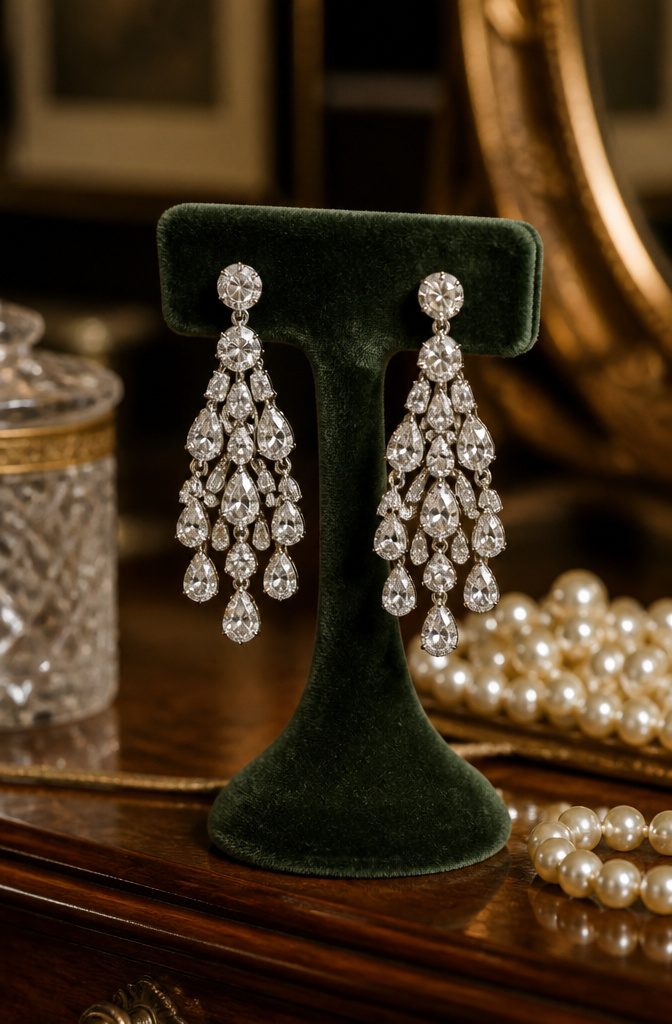
Chandelier and drop earrings were the era’s most theatrical move, built to catch light with every turn of the head.
I see them as framing devices first, jewelry second: their vertical lines drew the eye upward, balancing the decade’s sculpted hairstyles and the wide, open necklines that followed Dior’s influence.
A woman in a strapless gown with a French twist needed that negative space filled, and a swinging drop earring did the work without competing with the dress.
The materials matched the ambition. Diamonds arranged in cascading tiers dominated formal pieces, while costume versions delivered the same silhouette in crystal and plated settings for a fraction of the cost.
The length mattered more than the price point; anything shorter than two inches disappeared against the collarbone, while anything brushing the shoulder risked tangling in the structured waves women spent hours setting.
Hollywood drove the standard. Grace Kelly and Audrey Hepburn wore versions that reached nearly to the jawline, and that became the reference women brought to their jewelers.
The best pairs moved, catching light at different angles as the wearer turned through a room. Static chandeliers, however ornate, read as flat in comparison.
Bangles and Bracelets
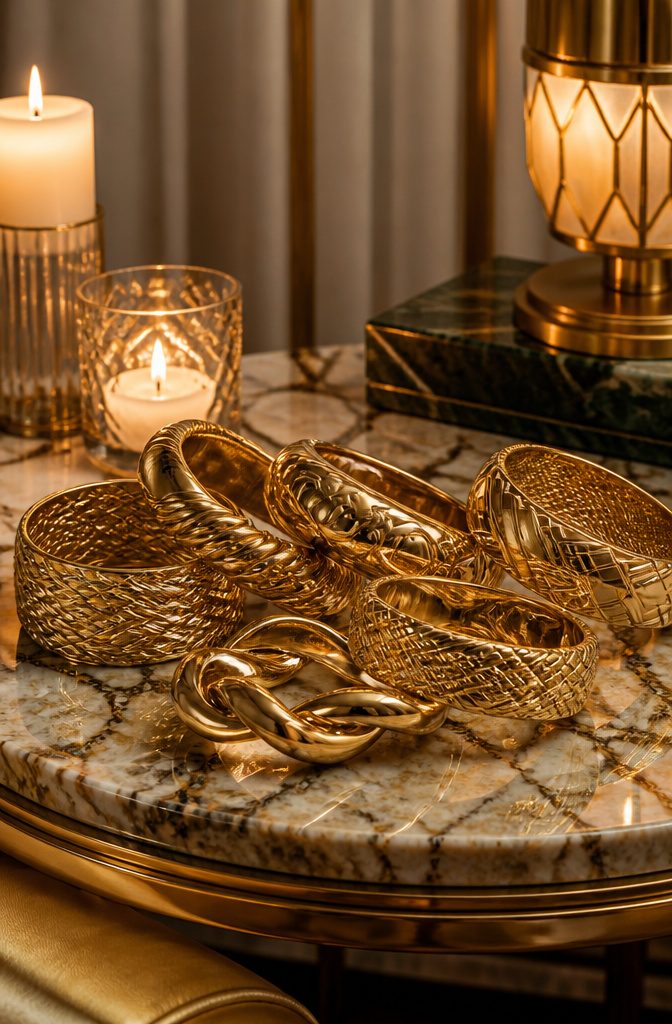
Chunky gold bangles and textured bracelets carried real weight on a 1950s wrist, often worn in stacks of three, four, or more that moved and chimed with every gesture.
These pieces stood in deliberate contrast to the finer chains and small watches women wore for daytime; where office or errand jewelry stayed polite and close to the skin, evening stacks announced themselves from across a room with bicycle-chain links, gas-pipe tubing, or scrolled goldwork studded with gemstones that caught light at every angle.
The physical presence mattered. A single wide cuff in woven or braided gold could read as sculptural, almost architectural, and some incorporated a small watch face so the stack carried function inside its bulk.
I tend to favor the mixed approach myself: one heavy textured piece anchoring the wrist, paired with slimmer bangles above it rather than a uniform wall of gold.
The uniform stack photographs beautifully, but in person it can overwhelm the arm and fight with a cocktail sleeve.
The era’s costume jewelry makers, including Monet with its gold-plated Golden Enchantments line, made these looks accessible well below fine-jewelry prices, so women could build a stack over months without waiting on a single investment piece.
Post-War Prosperity and Consumer Culture
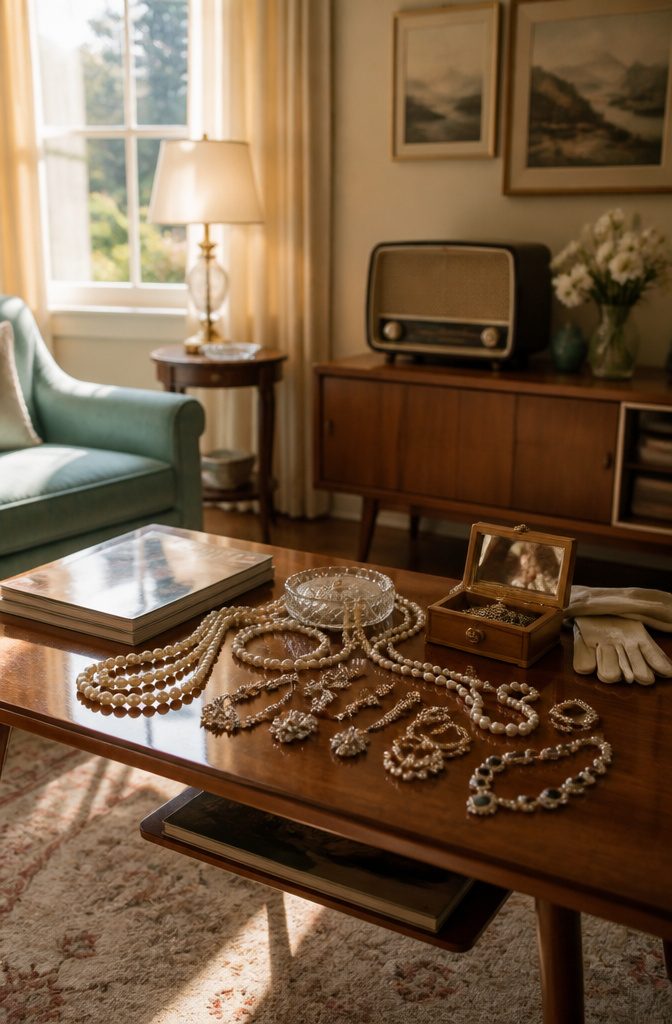
The 1950s opened onto an America where prosperity itself became wearable.
World War II had ended, and the boom years that followed put money into suburban hands, new houses into developments, and televisions into living rooms where families gathered for "I Love Lucy" and "Leave it to Beaver."
I see the jewelry of this decade as less about fashion cycles than about what that prosperity was supposed to look like on a woman.
The culture pushed young marriage and stay-at-home motherhood as the feminine ideal, and jewelry became a marker of domestic success. A husband’s ability to buy his wife pearls or diamonds signaled that the household had arrived.
Pearls returned to the market after wartime shortages and quickly anchored the daytime uniform: a single or double strand falling just below the throat, paired with matching earrings.
Grace Kelly and Audrey Hepburn wore them on screen, which sealed their status as the aspiration.
Formality governed the distinction between day and night. Daytime meant restraint, even when the pieces were large, clip-on earrings stayed close to the ear, and rings beyond wedding bands barely appeared.
Night allowed the sparkle that prosperity made possible. This divide mattered because it let women perform their role with precision, the right jewelry for the right hour proving she understood the social code.
The conformity of the era, the suburban uniformity, the pressure of the Cold War and the Red Scare, all of it channeled into jewelry that celebrated tradition rather than risked standing out.
The pieces were beautiful, but I find their cultural job almost as telling: they made a woman’s place visible, and they made it gleam.
Day Versus Night Jewelry Rules
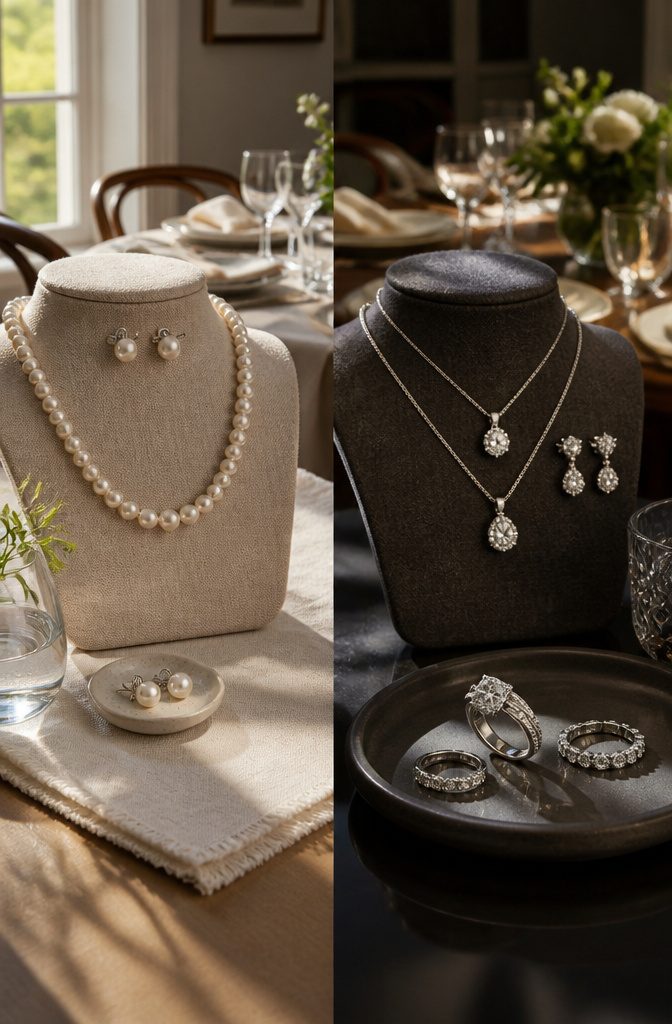
In the 1950s, daytime jewelry obeyed a strict code of restraint. A single or double strand of pearls falling just below the throat, matched with pearl earrings, formed the backbone of a well-dressed woman’s daily uniform.
Three-quarter length sleeves left room for bracelets, pearls and gold mesh among them, though charm bracelets carried over from the 1940s as a more playful option.
Daytime earrings stayed big but close to the ear, often a pearl with an ornamental surround or a simple gold clip-on.
Pierced ears were uncommon, so clip-ons dominated. Rings barely figured into the daytime picture beyond engagement bands and wedding bands.
Evening demanded a complete swap.
Diamond and platinum jewelry arrived in matching sets, with baguettes mixed with marquise and pear-shaped diamonds. Earrings became diamond clusters or cascade styles, a precious stone at the ear with smaller gems dangling around the face and neck.
Hair worn short or swept into a chignon showed them off. Diamond hair clips added more sparkle, while bracelets glittered with diamonds in floral or swirl motifs.
Necklaces grew large and sat close to the throat, sometimes pearls, sometimes diamonds, sometimes colored gemstones, with torsades and their elaborate closures claiming center stage.
The wardrobe itself enforced this division. A woman maintained distinct jewelry collections because the occasion dictated the rules, not the other way around.
I find the clarity of it almost enviable, the way a 1950s woman could reach for her pearls at breakfast knowing exactly what waited for her diamonds after dark.
How Dior’s New Look Shaped What Women Wore
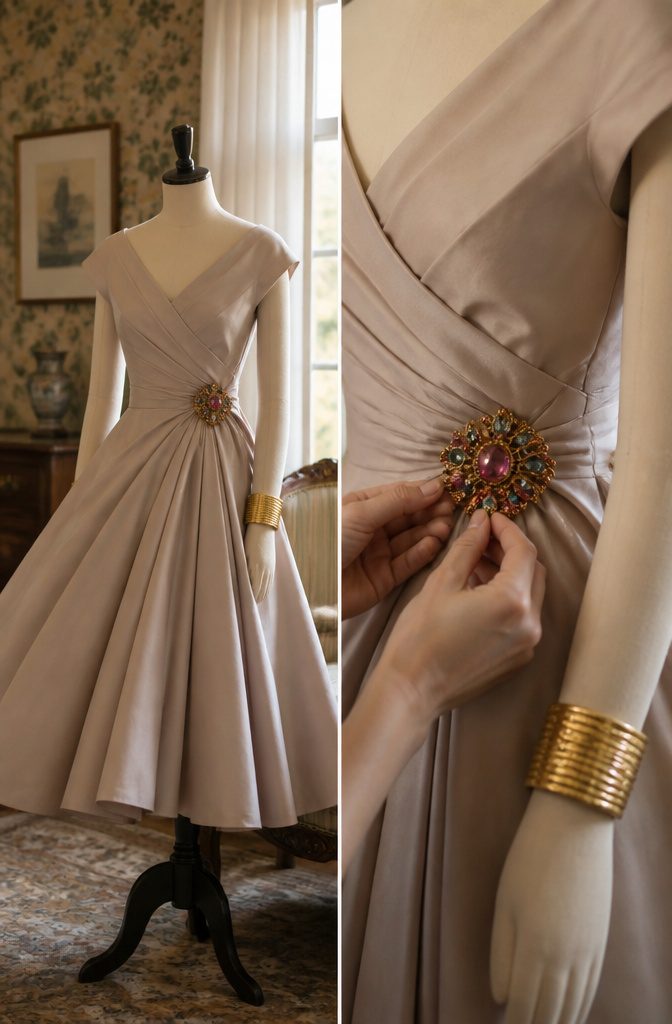
Christian Dior’s 1947 New Look rebuilt the female silhouette around a cinched waist and full skirt, and jewelry placement followed that architecture exactly.
A wide gold-tone bangle or pearl strand at the wrist drew the eye to the narrowest point of the three-quarter sleeve, while a large brooch pinned at the waist repeated the same punctuation lower on the body.
Drop earrings framed the face where the low neckline already directed attention upward.
The scale mattered: a small pin would disappear against yards of fabric, so brooches grew bold and bib necklaces dripped heavy enough to read from across a room.
I think the most telling detail is the parure, that matched set of necklace, bracelet, earrings and brooch worn together.
It treated the body as a single coordinated display rather than a collection of separate accessories, which is exactly what the New Look’s totalizing femininity demanded.
The look read as romantic and deliberate, not incidental, and the jewelry made sure of it.
Gold, Platinum, and the Rise of Costume Jewelry
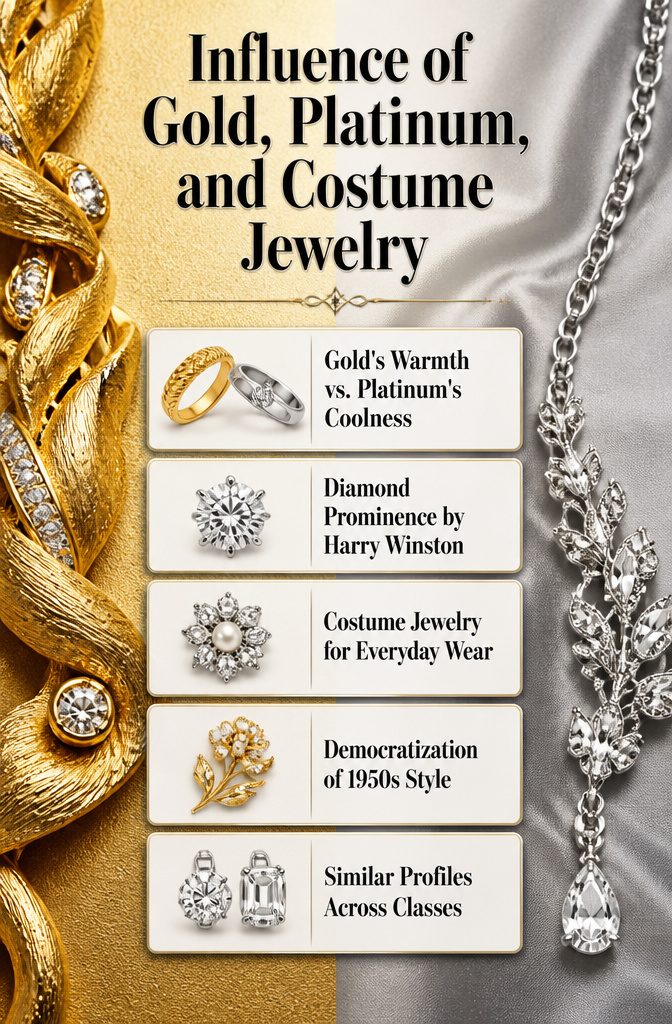
Textured gold and platinum carried the serious pieces of 1950s jewelry style, with cool-toned white metals setting off diamonds and pearls to maximum effect.
Harry Winston built an entire reputation on diamond prominence during these years, and the contrast between his stones and their platinum mounts became the visual shorthand for post-war prosperity.
I prefer the warmth of yellow gold myself, but the decade’s formal occasions clearly favored the chillier gleam.
What changed the era was how thoroughly costume jewelry infiltrated everyday wearing. Designers like Monet and Shreiner engineered pieces that imitated precious stones and high-end construction well enough to satisfy scrutiny at a dinner table, not just across a room.
Brooches, earrings, and necklaces in gold-tone or silver-tone metal let women wear the silhouette of luxury without the capital outlay.
This democratization meant 1950s style reached across social classes in a way earlier decades had not; a secretary and an heiress might wear recognizably similar profiles, differentiated mainly by material weight and closure quality.
Tailored costume pieces without stones served daytime and office wardrobes particularly well, extending the look to hours when diamonds would have signaled the wrong register entirely.
Frequently Asked Questions
What kind of jewelry was popular in the 1950s?
Pearls, diamonds, cocktail rings, brooches, charm bracelets, statement earrings, and stacked gold bangles dominated 1950s jewelry style.
Pieces were scaled boldly, with a strict divide between restrained daytime looks and dramatic evening sparkle. Costume jewelry from makers like Monet and Schreiner let more women access these silhouettes affordably.
How did the 1950s influence modern jewelry styles?
The era established the template for bold, oversized statement pieces and the idea of jewelry as wearable prosperity.
Modern designers still borrow its insistence on matched sets, architectural scale, and the cocktail ring as an evening essential. The democratization of luxury through high-quality costume pieces also began here.
What materials were commonly used in 1950s jewelry?
Platinum and white metals set off diamonds formally, while yellow gold carried daytime and casual pieces.
Pearls returned to abundance after wartime shortages. Sterling silver backed most charm bracelets, and costume makers used rhinestones, white metal, and gold-tone plating to replicate precious looks at lower cost.
Did they wear pearls in the 50s?
Yes, constantly. A single or double strand falling just below the throat became the daily uniform for well-dressed women, matched with pearl stud or button earrings.
Grace Kelly and Audrey Hepburn sealed their status as aspirational rather than merely available. Post-war supply made them accessible again after wartime scarcity.
What was the difference between day and night jewelry in the 1950s?
Daytime meant restraint: pearl strands, clip-on earrings close to the ear, and minimal rings beyond wedding bands.
Evening demanded matching diamond and platinum sets, chandelier earrings, cocktail rings, and stacked bangles that announced themselves from across a room. The occasion dictated the rules, and women maintained separate collections for each.
How did Dior’s New Look change jewelry?
The cinched waist and full skirt of 1947’s New Look made jewelry placement almost architectural. Wide bangles drew eyes to narrow wrists, large brooches pinned at the waist punctuated the silhouette, and drop earrings framed faces above low necklines.
Pieces grew bold enough to read against yards of fabric, and matched parure sets treated the body as a single coordinated display.