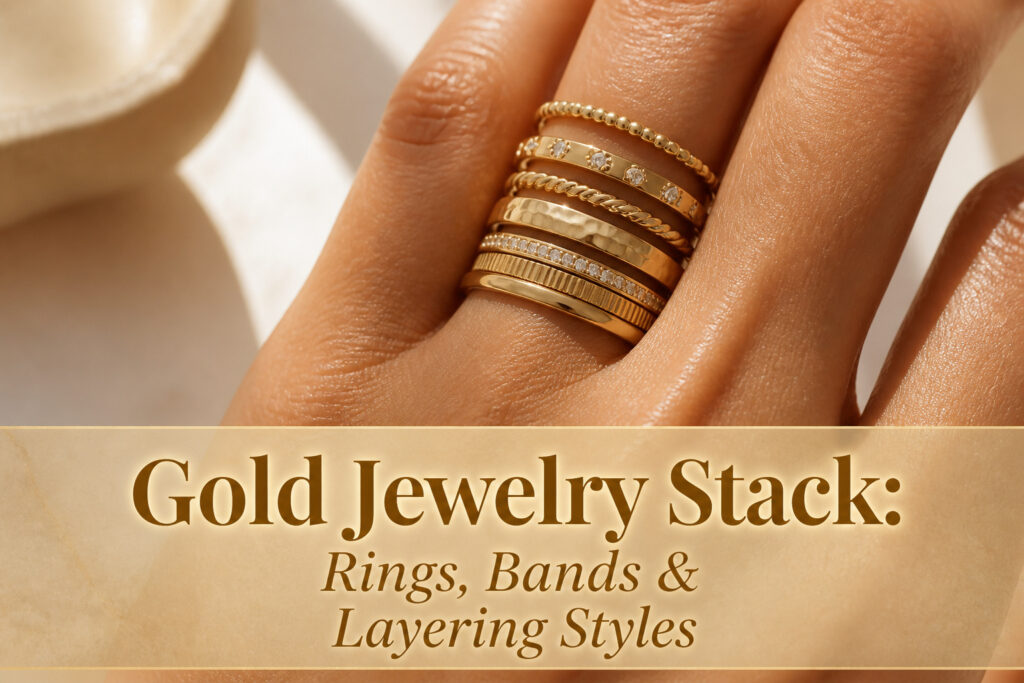
A gold jewelry stack is the practice of wearing multiple rings on one finger in deliberate layers, built from thin bands, textured pieces, and occasional gemstones. The trick is that any single ring can sink the whole arrangement if its texture fights rather than complements what sits above or below it. A 1.5mm plain band in 14k yellow gold, worn at the base, gives the eye a place to rest and makes everything else read as intentional.
Thin and Simple Bands
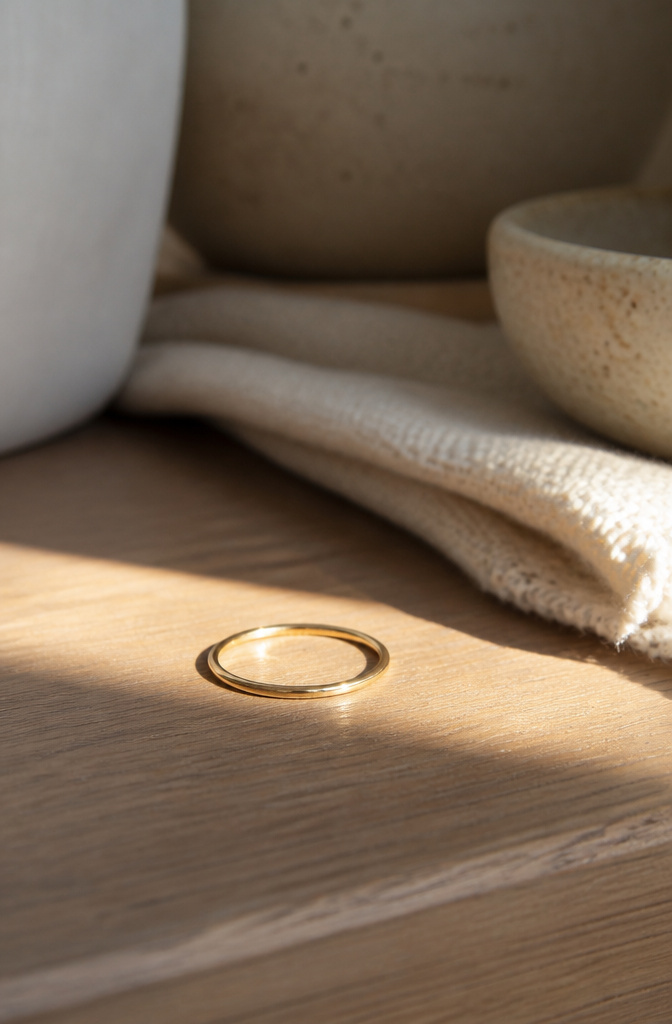
A thin, plain band is the quiet workhorse of every gold jewelry stack I’ve put together. It sits closest to the hand, stays out of the drama, and lets everything above it read as intentional rather than cluttered. The sources call this the foundation piece, and that framing stuck with me: start smooth and solid, then build outward.
The mistake I made early was grabbing something with just enough detail to compete. A whisper of etching, a barely-there milgrain edge. Those half-measures fight the stack instead of grounding it. A truly simple band gives the eye a place to rest, and that rest is what makes the textured or gem-set rings above it feel chosen rather than piled on.
Catbird has been at this since 2004, and their rule of thumb is to finish with another thin, delicate band at the top. Bookend the statement pieces. The geometry of it, a slim line below and a slim line above, turns a collection of rings into something that reads as one composed unit. I keep a 1.5mm round band in 14k yellow gold for exactly this purpose. Nothing riding on it, nothing to announce. Just the shape doing the work.
Hammered and Textured Bands
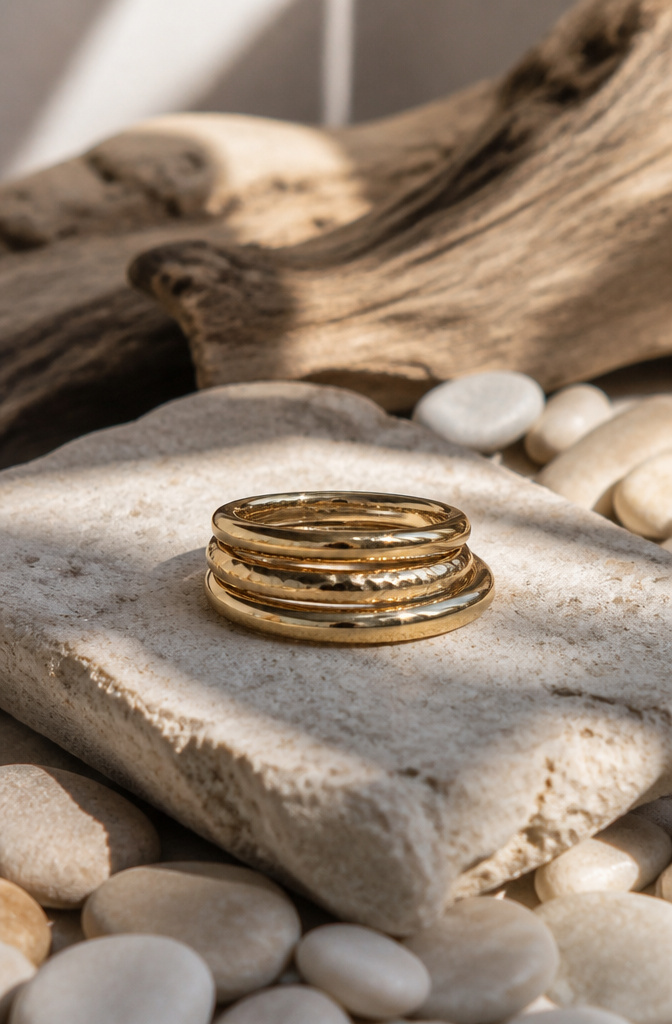
A hammered band catches light the way a smooth one never will. The tiny facets scatter it across your knuckles, so the ring seems to glow from inside rather than just reflecting what’s around it. I learned this by accident, stacking a matte hammered band between two polished ones and watching the whole arrangement come alive every time I moved my hand.
Different textures do different work. A lightly hammered surface gives subtle shimmer, almost like brushed metal with extra movement. Heavier pitting or cross-hatched tooling creates stronger shadow lines, which reads as more rustic or more architectural depending on the scale. The contrast against a plain band is the point: two smooth rings read as one wide shape, but slip a textured band between them and each ring keeps its own border.
Light behaves unevenly on these surfaces, and that is the advantage. A smooth band reflects a clean highlight; a hammered one breaks it into dozens of smaller glints that shift as you type, gesture, reach for coffee. The effect is quiet, not flashy, but it keeps the stack from looking like a single manufactured piece. Start with your smoothest band as the base, then add one hammered ring to test the difference before building further.
Signet Rings
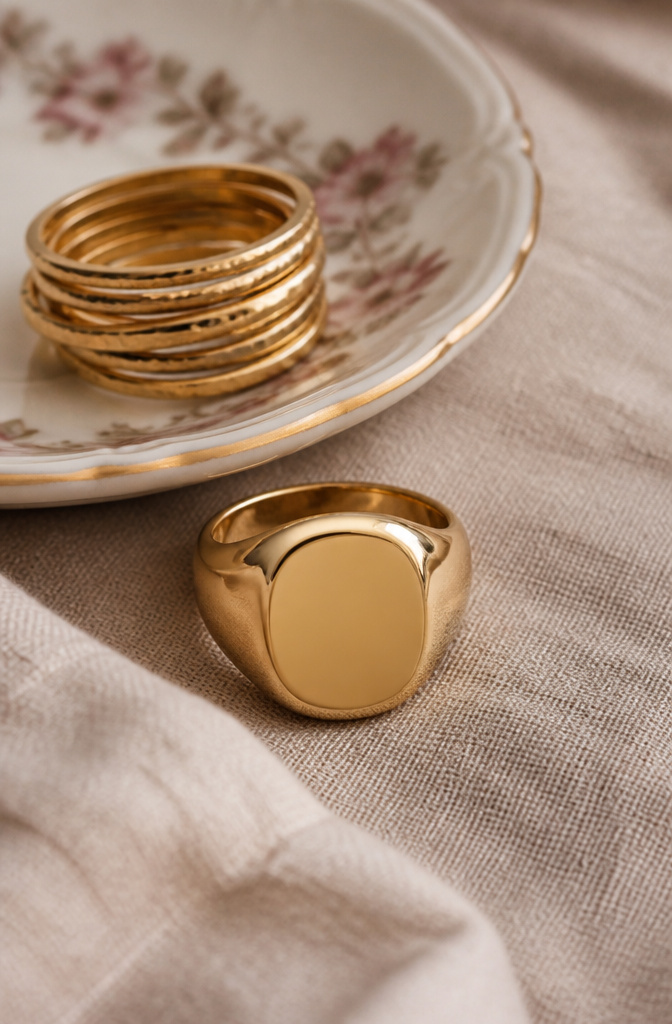
A flat, heavy face changes the whole rhythm of a gold jewelry stack. Signet rings carry that weight: centuries of use as seals and identifiers, now pressed into service as the visual anchor a layered set needs. The broad top gives you real estate for initials, a small engraving, or a clean mirror finish that catches light differently than any band around it.
Stacking one takes some planning. The face sits high, so slim bands thread underneath better than another bold piece fighting for the same knuckle space. I have seen a signet placed at the base of the finger, almost like a foundation, with two or three thinner rings riding above it toward the tip. The contrast in height keeps each piece readable without crowding.
The historical heft works in your favor here. A signet does not read as random accent; it reads as intention, even in a casual everyday stack. That is the role it plays: not filler, but punctuation.
Diamond Rings
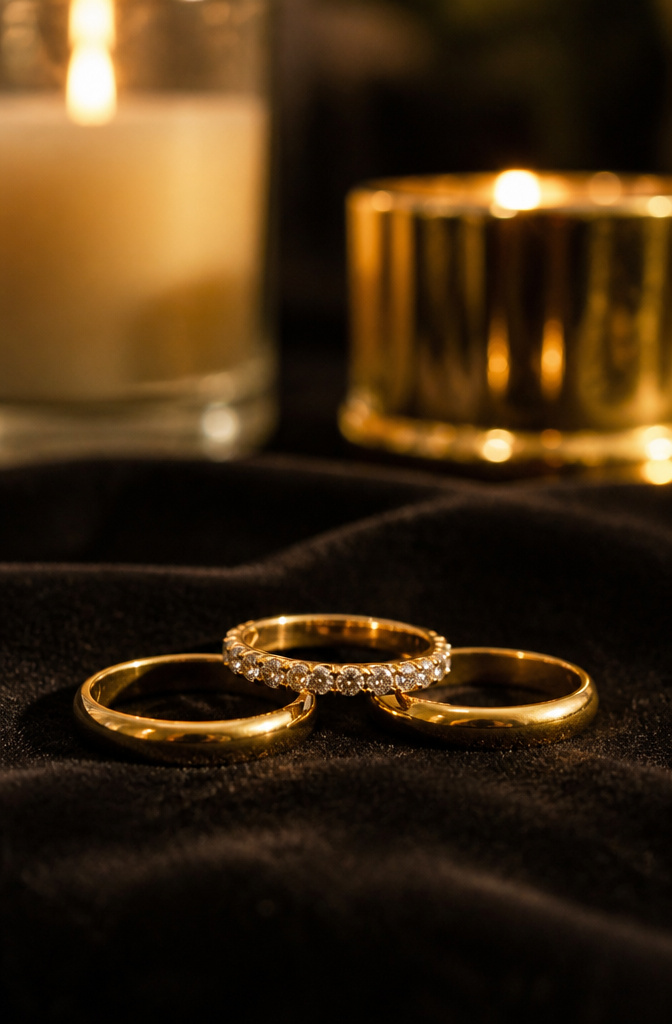
A diamond band changes the whole rhythm of a stack. Those tiny points of light catch every hand movement and pull the eye straight to whichever finger they sit on, which means placement is the entire game.
I learned this the hard way with my own set. Piling two diamond bands next to each other on one finger created a single blinding stripe that swallowed everything else. Splitting them, one above and one below a plain gold band, gave each stone its own stage and let the stack breathe. The contrast between sparkle and matte is what makes the combination work; without enough plain metal nearby, the diamonds start competing with each other instead of complementing the whole.
Catbird has been at this since 2004, and their diamond stacking rings are built thin on purpose so you can slip one in without throwing off the proportions. One diamond band per finger is usually the right limit, unless you are deliberately building a wedding set where the engagement stone and band are meant to read as a single unit. Even then, a curved or chevron band tucked underneath can add structure without starting a light war.
The real move is treating the diamond band as your stack’s punctuation, not its paragraph. Place it where you want someone to look, then build quiet space around it.
Open Rings

An open ring leaves a deliberate gap in its band, which means it can sit above or below your other rings without fighting for the same real estate on your finger. That gap creates negative space in the stack, a visual pause that keeps the whole arrangement from looking crowded. What sold me on them is the slight give in the fit. A 14k open ring can expand or compress a little as your stack grows, so one that felt snug in January still works in July when you’ve added a birthstone band or a textured piece. The gap is the forgiving detail that lets a stack evolve without resizing everything. I tend to place mine at the top of a finger stack, where the opening draws the eye upward, or at the very bottom as an anchor that leaves room above for smaller bands. The adjustability has limits; pull too far and the metal work-hardens, so small shifts beat big stretches.
Braided and Chain Rings

Braided bands and chain-link rings pull a gold jewelry stack out of flat uniformity without shouting for attention. The braid catches light along its interwoven grooves, so the band reads as intricate from arm’s length and only resolves into individual strands up close. Chain rings do something different: the tiny linked loops create actual movement, a slight shimmer that solid metal cannot replicate. Both occupy the textural middle ground between a plain band and something set with stones.
The catch with chain rings is structural. Linked construction is inherently more delicate than solid metal, and the points where loops connect are wear points. Catbird has stocked these since 2004, long enough to know they belong higher on the finger, away from the palm where gripping and knocking do the most damage. Upper-finger placement, either as a midi ring or just above a sturdier base band, lets the chain move visually without taking direct impact.
A stack built on these needs one grounded piece first. A smooth solid band or a braided band with reasonable heft should sit at the base; the chain ring layers above it. Reversing that order puts the fragile link where friction and pressure concentrate, and the repair on a chain ring is rarely invisible. The braid can go either position, though its raised profile means it sits more comfortably against the finger when it is not sandwiched between two other rings.
Curved Bands
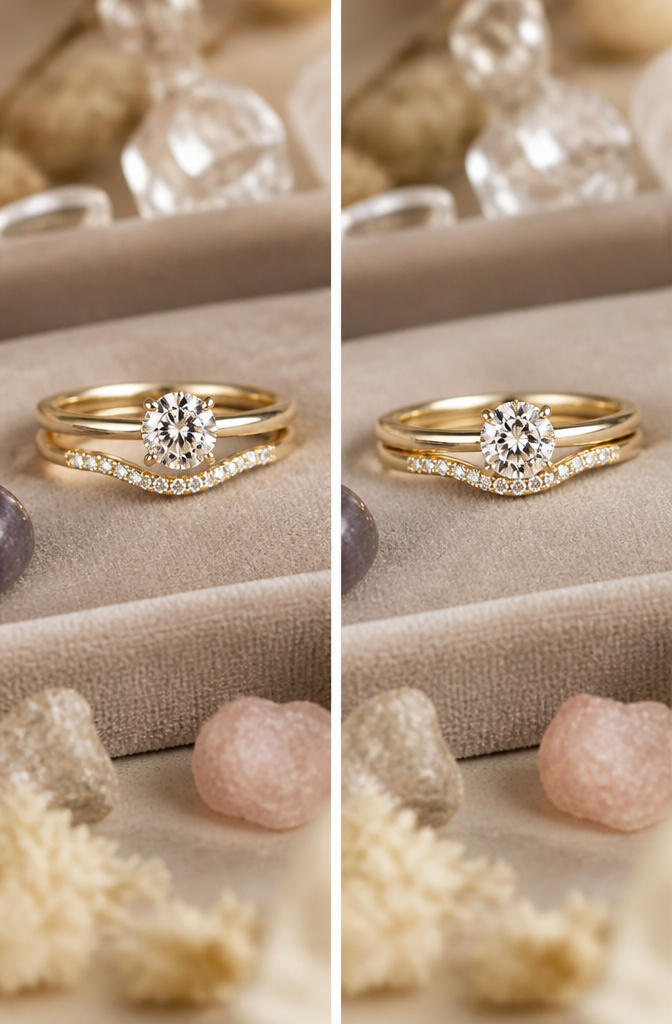
A curved band traces the contour of a larger ring, usually an engagement ring with a raised center stone, so the two pieces sit flush instead of leaving the awkward gap a straight band creates. The first time I understood why this mattered was watching a friend fidget with her stack at dinner, the straight wedding band knocked slightly askew by the diamond’s setting, a sliver of skin always visible between the two rings. The curved style solves this by nesting against the larger ring’s silhouette, turning two separate pieces into one continuous shape.
Catbird has carried curved and chevron styles since at least 2004 as part of their stacking collections, and they position these bands specifically to complement engagement rings and wedding bands in a "forever stack." The curve can face inward to cradle a solitaire, or outward if you prefer the arc to echo across multiple fingers. Either way, the function is the same: eliminating negative space that breaks the line of the hand. For milestones, adding a curved band above or below the engagement ring has become the modern way to build outward without starting over.
Chevron Styles

A chevron band draws the eye along its V-shaped point like an arrow on a map. That directionality is the whole reason it works in a gold jewelry stack: placed above a round stone, the point frames the curve from above; slipped below, it anchors the shape and keeps the eye moving downward.
The geometry is deliberate and sharp against softer forms. Where curved bands echo a round stone and tend to disappear into it, a chevron cuts across the visual field. The contrast is what makes the pairing readable from a distance.
Stacking two chevrons in opposing directions, points facing, creates a diamond-shaped negative space that reads as its own shape. It is a trick that fails with curved bands, which simply nest into each other and flatten.
The limit is finger real estate. A chevron needs room to read as a point; squeeze it between too many rounds and it becomes a zigzag noise. I keep chevrons at the top or bottom of a stack, never buried mid-finger, where the geometry gets lost.
Birthstone Stacking Rings
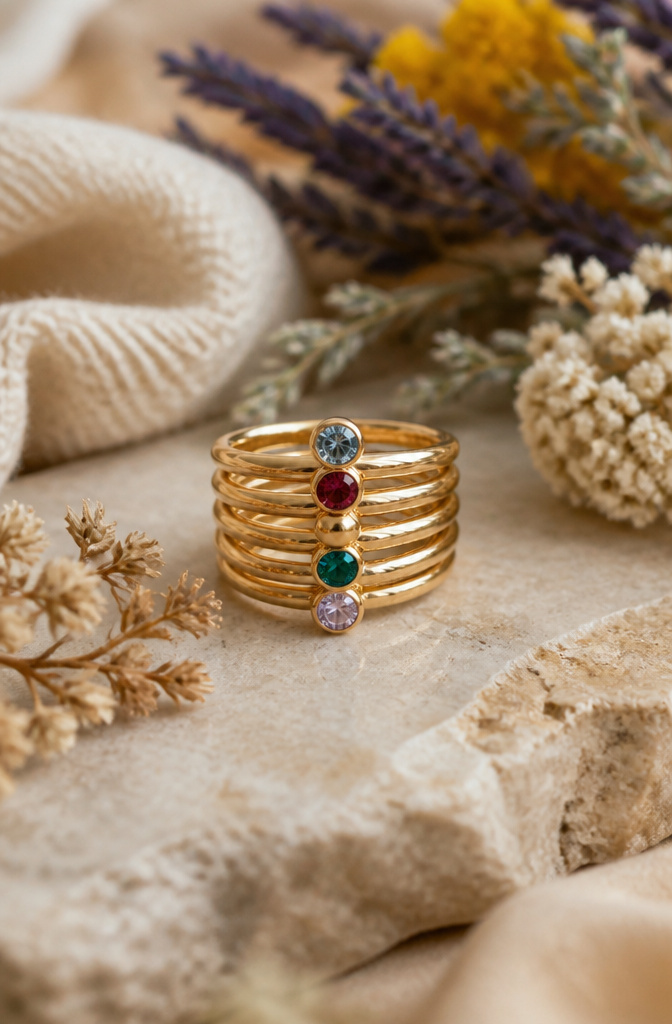
Birthstone rings bring the one element no other stack layer can: a specific person or date fixed in color. A garnet for January, a sapphire for September, each stone acts as a marker someone can read without asking. The color itself changes how the stack reads against skin and nearby metal; a cool amethyst steadies warm yellow gold, while an opal throws light around the plainer bands beside it.
What convinced me, reading how people actually wear these, is that the meaning scales with the number of stones. One ring marks a birthday. Three stacked narrow bands, each with a different birthstone, quietly map a family: mother, partner, child. The spacing matters more than the stones themselves. Set too wide apart on the finger, they look like separate decisions that happened to land together. Set close, with maybe a thin plain band between each to keep the colors from muddying, they read as one intentional story told in layers.
The risk is sentiment tipping into clutter. A full stack of five or six birthstones stops looking like jewelry and starts looking like a charm bracelet flattened onto a finger. Two stones, three at most, keeps the narrative legible. After that, the eye loses track of whose date is whose, and the whole point, the person behind each color, dissolves into noise.
Mixing and Matching Textures
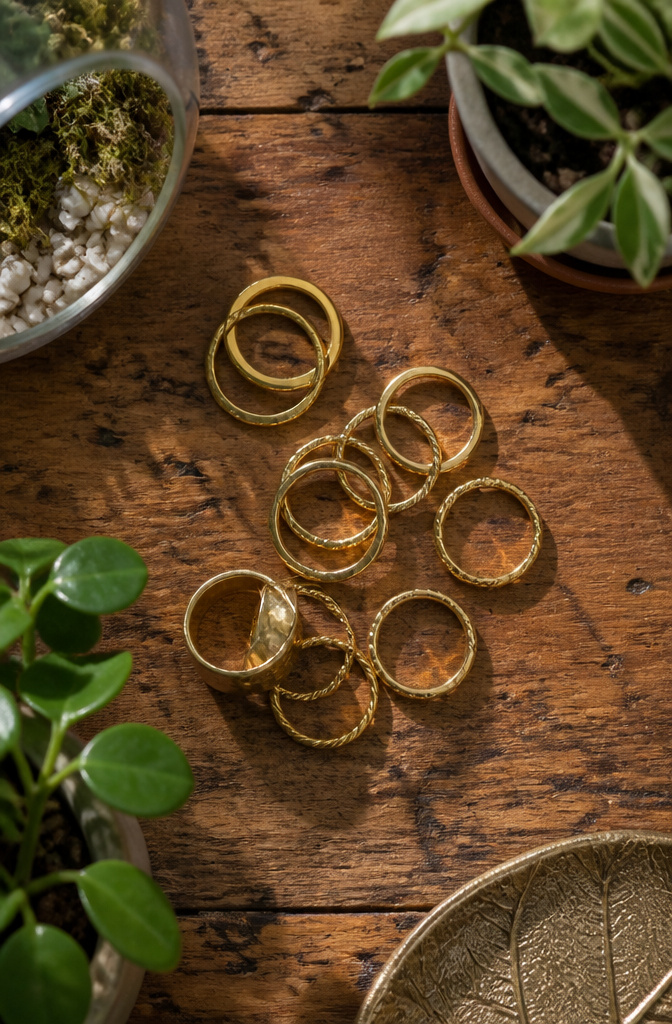
A gold jewelry stack lives or dies on contrast, and the fastest way to kill it is piling on rings that all share the same finish. Smooth bands read as one flat surface; the eye slides past them. Texture interrupts that glide and gives each ring its own territory.
Start with a simple band, something clean and unbroken. That smooth surface becomes the reference point, not the whole story. Against it, a hammered band catches light in scattered planes, and a chain ring introduces movement that a solid band cannot mimic. The contrast does the work; you are not decorating so much as calibrating.
Place the focal point with intention. A signet, a gemstone, a diamond ring: one of these belongs at the visual center, usually near the base of the stack or at a high point where the finger narrows. Everything else orbits that piece. Too many focal points and the stack shouts in every direction; too few and it never quite declares itself.
Finish with a thin, delicate band. After the weight of texture and the draw of a centerpiece, that final whisper of metal brings the whole arrangement back into balance. Alternating weight and finish is what keeps a stack from collapsing into noise; heavy next to light, polished against matte, each ring defined by what sits beside it.
What Stacking Rings Symbolize
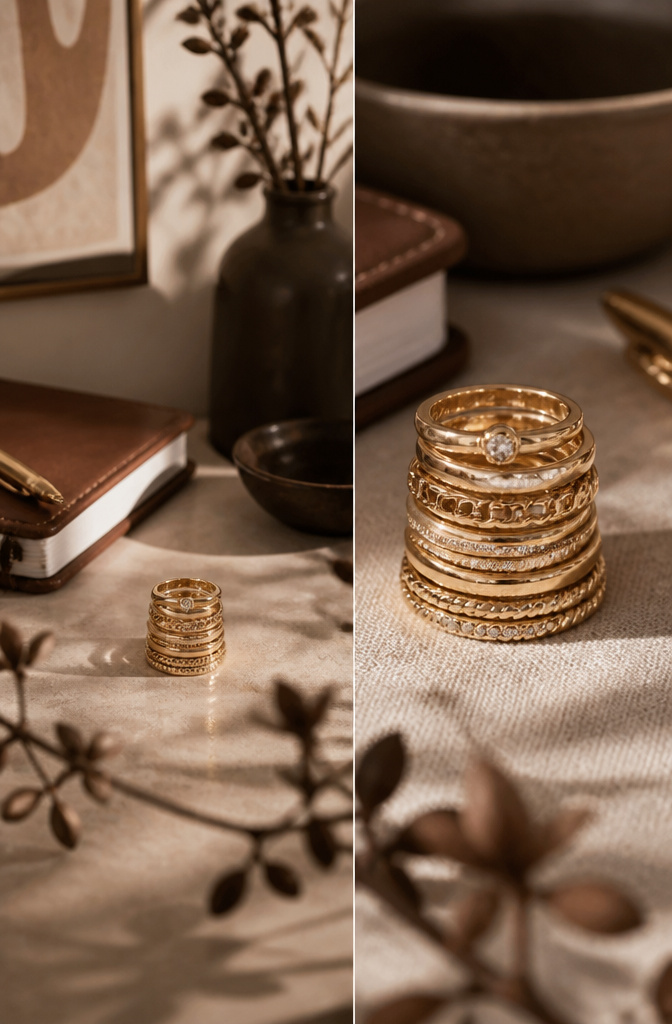
A gold jewelry stack turns the hand into a timeline you carry through the day. Each ring marks a point worth remembering: an engagement, a wedding anniversary, the birth of a child, a promotion you fought for, a year you survived. The first band sits alone for months, then another slides on beside it, then a third. Before long the stack tells a story in order, bottom to top, oldest to newest.
The meaning lives in when you added each piece and why. A slim band bought on a solo trip to mark a decision. A wider one gifted after a decade of marriage. A tiny stone ring for the month your daughter was born. None of this requires explanation to anyone else. The wearer knows which ring means what, and that private knowledge is most of the point.
What convinced me, reading how people describe their own stacks, is that the timeline keeps working even when the order gets jumbled. Some wearers stack chronologically. Others sort by metal weight, or what fits comfortably that morning, or pure mood. The story stays intact because they remember. The hand becomes a quiet journal, one you do not have to open to read.
Recycled Gold and Sterling Silver

Recycled solid gold and sterling silver are what most stacking rings are actually made from now, and that choice matters more than the finish when you are wearing four or five rings against skin every single day. The recycled content means the metal has already been refined once, so the grain structure is tighter and less porous than freshly mined material. That translates to bands that do not dent as easily when they knock against each other in a stack.
Sterling silver in a stack works as the contrast metal without the price jump of platinum, though it will darken faster than gold and needs the occasional polish. Solid gold, even 14k, holds up to the friction of layered wear better than vermeil or plating, which is why heirloom-quality pieces lean on it. The sustainability angle is straightforward: recycled gold cuts out the new mining footprint, and since a stack is a collection you build over years, the material should outlast the trend cycle. I would skip anything hollow or plated for a daily stack. The weight difference is immediate in your hand, and the durability gap shows up inside six months.
Frequently Asked Questions
What types of rings can I stack?
You can stack thin and simple bands, hammered and textured bands, signet rings, diamond rings, open rings, braided and chain rings, curved bands, chevron styles, and birthstone rings. Each type brings a different visual element, from the quiet foundation of a plain band to the directional punch of a chevron or the scattered light of a hammered surface. The variety is what lets a stack read as intentional rather than accidental.
How do I create a balanced ring stack?
Start with a simple band as the foundation, then add rings with different textures for contrast. Place one focal point, such as a signet or gemstone ring, where the eye should land. Finish with another thin, delicate band at the top to bookend the heavier pieces. Alternating weight and finish, polished against matte or smooth against hammered, keeps the arrangement from collapsing into noise.
What do stacking rings symbolize?
A gold jewelry stack turns the hand into a personal timeline, with each ring marking a milestone worth remembering. An engagement, a wedding anniversary, a child’s birth month, a solo trip, a decade of marriage. The order can be chronological or purely practical, but the meaning stays intact because the wearer remembers why each piece joined the collection. The hand becomes a quiet journal that requires no explanation to anyone else.