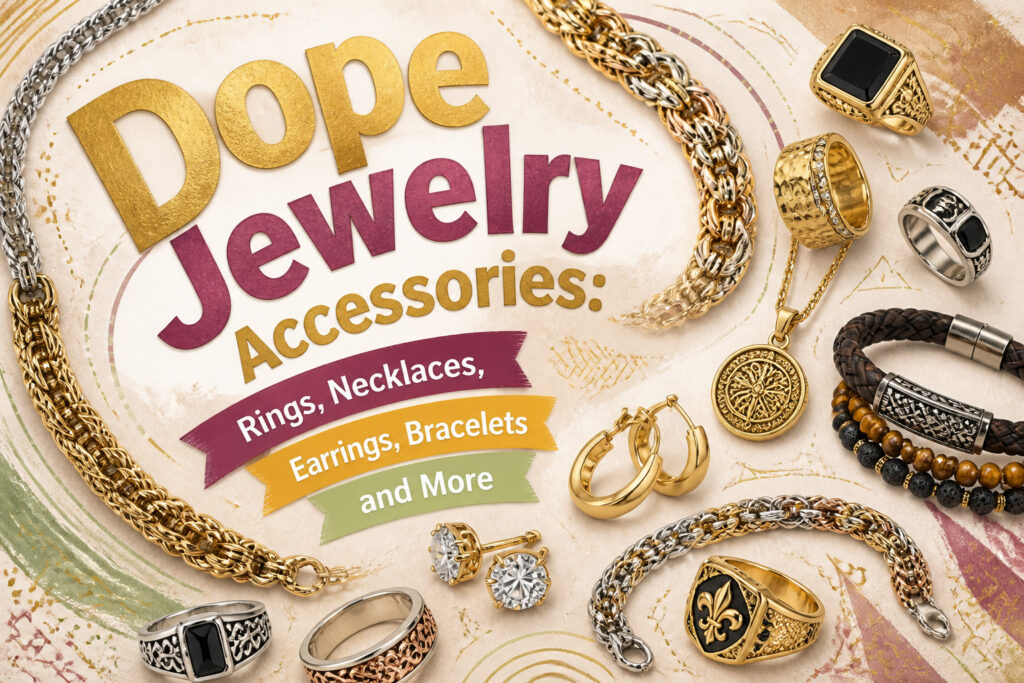
Dope jewelry accessories are pieces that get noticed because someone made a choice, not because they spent the most or shouted the hardest. The catch is that same intention has to carry through stacking, layering, and mixing metals, or the look collapses into costume. A $30 Byzantine chain with white, rose, and gold begets can do more work than a $25,000 pendant if the fit and confidence are there.
What Dope Jewelry Accessories Actually Are

The first time someone used "dope" seriously about jewelry, I was in a shop near Fairfax in Los Angeles. The seller pointed past the glass cases of standard gold chains toward a smaller display in the corner and said, "That’s the dope stuff." The pieces there weren’t the loudest in the room, and they weren’t the most expensive either. What set them apart was intention: a pendant carved from something that looked like bone but turned out to be stabilized wood, a ring with a stone cut so the setting sat flush enough to wear daily. Dope jewelry accessories are pieces that get noticed because someone made a choice, not because they spent the most or shouted the hardest.
The word has traveled a long way from street slang. Fifteen years ago, a retailer using "dope" would have sounded like they were trying too hard. Now I see it in product descriptions from stores that sell to lawyers and dental hygienists alike, no irony intended. The shift happened because the meaning shifted first: it stopped being about exclusivity and started describing anything with enough craft or story behind it that wearing it feels like a personal statement rather than a uniform.
Necklaces That Carry the Look

Chain style sets the tone before any pendant enters the room. A Byzantine chain with begets running down the middle carries weight differently than a standard Cuban, and the chalk color mix of white, rose, and gold gives you three metals in one rotation. Cuzzo’s Poolboy Necklace hit that sweet spot around thirty dollars, moved fast, and was copied everywhere within weeks. That is the market working: one clean design at the right price, then saturation.
Length is where most collections stall. Sixteen inches sits high, twenty to twenty-four drops to the sternum, and anything past thirty becomes a single statement whether you planned it or not. The real separation between owning necklaces and wearing them is layering: two chains at different lengths, different weights, different metals if you are confident. One chain is an accessory. Two or three, spaced so they do not tangle into a knot, is a look.
The ceiling most people are measuring against sits high. Doe Boy went out and got a new $25,000 piece just for the occasion of appearing on On the Rocks.
From the $100,000 eagle pendant given to him by Future to his $60,000 Rolex, Doe Boy shows off his insane jewelry collection.
— GQ
That quarter-million total is not the target. It is the reminder that the same rules apply at every level: chain, pendant, fit, and the confidence to wear it like it was made for you.
Earrings From Subtle to Statement

Hoops, studs, and drops each pull a different weight. The Classic Gold Large Hoops do the heavy lifting on their own; they throw light against the jawline and turn a plain white tee into something intentional. The Elegant Round Cut Flower Shape Diamond Stud Earring works the opposite way, sitting close to the lobe so it reads as polish rather than performance.
One good pair usually beats a crowded ear. I learned that after stacking three mismatched huggies with a dangling charm and catching my reflection in a coffee shop window. The look tipped from layered to lost. Stop at two per ear unless the pieces share a metal and scale, or the eye reads it as costume jewelry, not style. A single dramatic drop with a bare lobe on the other side works; four competing shapes do not.
Bracelets and Bangles Worth Stacking

Stacking bracelets only works when the pieces actually want to live together. Cuzzo’s Poolboy Bracelet, with its beaded texture and relaxed weight, sits flat against the wrist and stays there. The Gold Ribbed Bangles come as a set of three at €30.95, and the trick is the graduated widths: two slim, one slightly heavier, so the eye reads them as intentional rather than accumulated. I tried wearing all three on one wrist plus a chain bracelet I’d forgotten about. The clanking drove me to take the whole stack off by noon. Two pieces per wrist is the ceiling for anything that moves.
The Amazonite ‘Breathe’ Bracelet belongs to a different conversation entirely. Where the DC pieces read as polished and architectural, the amazonite beads carry that matte, healing-property angle: calming, grounding, the kind of thing you reach for on a Monday or after a rough week. The price sits higher, which makes sense given the stone sourcing and the stretch construction that has to hold up. I wouldn’t stack it with metal at all. The mix of materials fights itself, and the soft color disappears against gold. Wear it alone on the opposite wrist, or swap it in when the rest of the stack feels too loud for the day.
Rings and How to Wear More Than One

Stacking rings without looking like you grabbed a handful from a discount bin takes more intention than most people expect. The Ocean Aura Ring sits at the lower end of the investment range, around $280, and its ocean-toned stones work as an anchor piece on the middle or ring finger. The Unique Designer Two Tone Round Cut Diamond Ring pushes closer to $475, and that two-tone metal detail solves half the mixing problem for you: white and yellow gold already live in the same band, so stacking it with either metal reads as deliberate.
Finger placement matters more than count. A thick band on the index finger, a slimmer piece on the ring finger, and nothing on the pinky gives you three rings that each have room to breathe. The mistake is piling five thin bands on adjacent fingers so they blur into one metallic stripe. One bold ring, especially something like that two-tone diamond piece, usually draws more attention than a cluster of whisper-thin wires, and it saves you from the accidental look of someone who forgot to take yesterday’s rings off.
Starter pieces run around €10 if you’re testing whether you even like the weight of metal on multiple fingers. The jump to $500-plus territory makes sense once you know which fingers you actually wear things on, and which rings rotate annoyingly against each other.
Nose Jewelry and the Commitment Level

Studs sit almost flush against the nostril, so they read as a small accent unless the stone catches light. Hoops and chains need more projection, which is where the jump from clip-on to pierced starts to matter. A magnetic or spring-loaded fake ring spins, gaps, or sits at a weird angle under scrutiny. Once the hole is there, the jewelry stays put, and the gauge of the post opens up options you will not find in the clip-on aisle.
Septum chains, especially the ones that drape from the piercing down toward the lip, pull the whole face into the look. They can seem off if the rest of the outfit is timid. A plain tee and jeans with a septum chain looks like the jewelry is wearing you. Leather, stacked rings, or an open collar shirt gives the chain something to talk to.
The try-hard line is thin here. One nostril stud in a tiny diamond or black opal usually lands. Matching studs in both nostrils, plus a septum hoop, plus an ear stack, starts to look like a costume unless your clothing is equally deliberate. My own move, after swapping from fakes to a real nostril piercing, was to let the nose piece be the only facial metal for a month. That restraint taught me what scale actually read as cool on my face before I added anything else.
Watches and Grillz as Borderline Cases

Watches keep creeping into jewelry searches because the line blurred years ago. A steel tool watch on a leather strap reads as accessory first, timekeeper second, and that shift is what lands it in the same cart as chains and cuffs. The ones that pull double duty usually share traits with jewelry: precious metal cases, minimal numerals, bracelets that stack against a bangle. If the face is smaller than 38 mm and the band is gold or two-tone, it is functioning as jewelry, whatever the brand calls it.
Grillz sit at the far edge of this conversation, and I almost left them out. The single mention I found in research came from a trend forecast that grouped them under "dope accessories" without qualification, so they belong here on that technicality. Most readers will not buy them. The barrier is not price alone; it is the dental mold, the removal for eating, the social context that reads as performance rather than daily wear. Cultural weight outruns practical wearability by a wide margin. They matter to the category the way a runway piece matters to a ready-to-wear line: directional, not wearable.
What These Pieces Are Made Of

Recycled brass shows up in almost every piece I looked at, usually plated with 14K gold or coated in 925 silver. One collection calls it "empower and make a statement" material, another frames it as "fun, effortless, and made to be worn every single day." The brass itself is the same either way: a base metal that keeps costs down and lets the plating do the visual work.
The word "recycled" here is doing heavier lifting than the metal itself. It signals environmental concern without a chain of custody anyone can check. I treat it as a nice-to-have rather than a decision point, since the plating thickness matters more for how long the piece lasts.
I stopped trusting anything labeled "gold tone" after two rings turned green on my fingers inside a week. That experience rewired how I read product pages. Now I look for "14K gold plating" as a minimum, or solid recycled sterling silver when a piece is meant to be permanent. The sources that specify 14K gold and 925 silver over brass are the ones that have held up in practice.
The chakra-balancing gemstone claim sits in its own corner of the market. One shop pushes "restore balance and harmony to your body while looking great" hard, pairing high-quality gemstones with specific healing properties. Nobody else in this space mentions chakras at all. That gap tells its own story: either the gemstones are doing energetic work the other brands ignore, or it is a niche pitch that does not travel. The stones themselves, when they are genuine, do not change composition based on the marketing wrapped around them.
Styles That Are Actually Moving Now

Minimalist chains hit different when the metal is thick enough to catch light without shouting. I keep one 2 mm cable chain that reads as quiet luxury on its own, but layer it over a heavier pendant and the same piece suddenly anchors a full statement stack. No single style owns "dope" right now, and that is what makes the term useful rather than limiting.
Hip-hop influence still shows in width and weight, though the look has softened from the 90s era of massive medallions. What I notice in current stacks is the mix-and-build approach: a Cuban link bracelet paired with two thin bangles, or a single oversized ring flanked by bare fingers. The handcrafted luxury angle, with hand-finished clasps and slightly irregular links, gives even a simple piece enough presence to hold its own against bolder neighbors.
Mixed-metal was the rule I resisted longest. Then I watched a yellow gold signet ring against a silver chain turn the whole combination into something neither warm nor cool, just intentional. Layered looks work the same way: odd numbers, varied lengths, and one piece that breaks the pattern, whether through texture or an unexpected stone. The same birthstone pendant I wear solo on a 16 inch chain drops to 22 inches and becomes the quiet base of a four-piece stack. The distinction between minimalist and statement is not the piece. It is what surrounds it.
What You Will Actually Spend
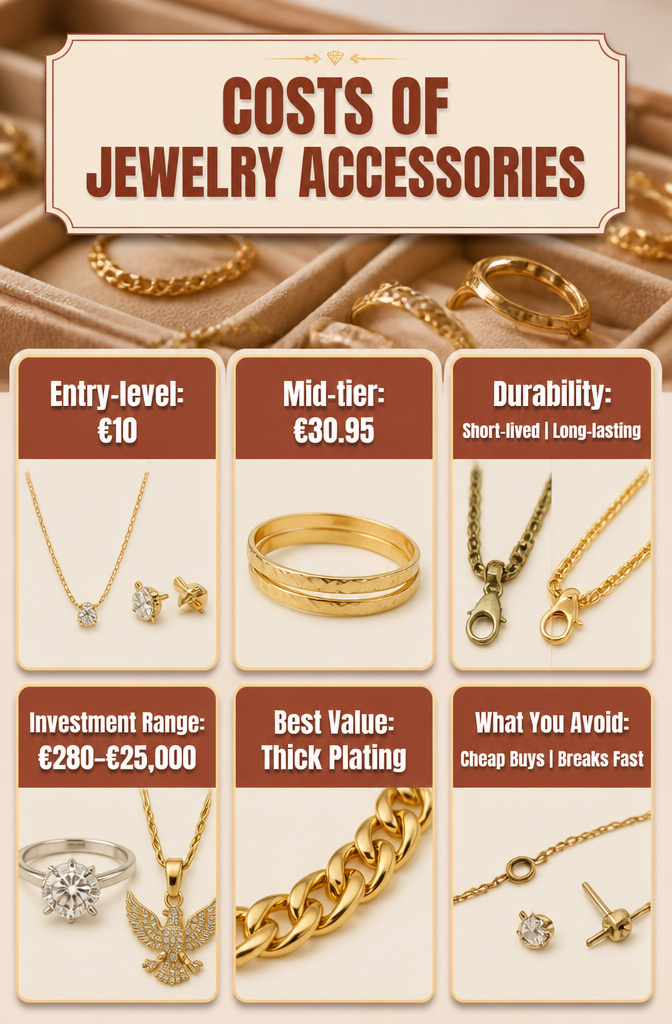
Entry-level pieces start around €10, which covers thin-plated chains and costume studs that look fine under bar light and turn your neck green by Tuesday. I know because I bought two of those €10 sets last spring instead of holding out for the €30.95 mid-tier bangles that actually use decent plating thickness. The second cheap buy snapped at the clasp three weeks in, and by then I had spent €20 on garbage instead of €30.95 on something that would still be in rotation.
Plating is fine for trend pieces you plan to cycle out within a season. Solid metal only matters once you cross into the $280–$475 range for diamond rings or anything you intend to sleep and shower in. Below that threshold, the extra cost buys you weight and finish, not eternal life. Above it, the jump to collector territory runs all the way to $25,000, the territory where Future gifts Doe Boy eagle pendants and you are buying narrative as much as stone. For everyday wear, the value sits in that middle band: thick plating or vermeil, clean settings, and a weight you notice on your wrist. My mistake was treating the low end like a bargain instead of a rental fee.
Frequently Asked Questions
What materials are used in dope jewelry accessories?
Most pieces use recycled brass plated with 14K gold or coated in 925 silver. Solid recycled sterling silver and genuine gemstones show up in the higher-end range, especially for anything meant to be permanent. Skip anything labeled "gold tone"; those pieces tend to turn green within a week.
What styles are trending in dope jewelry accessories?
Minimalist chains with enough heft to catch light, mixed-metal combinations, and intentional layering are all moving right now. The current look borrows from hip-hop width and weight but softens it: a Cuban link paired with thin bangles, or one oversized ring flanked by bare fingers. Handcrafted luxury details like irregular links and hand-finished clasps give even simple pieces enough presence to hold their own.
How can I customize my jewelry?
Customization options depend on the maker. Dope Jewells specializes in custom diamond jewelry designs, and Dope Alchemy Handcrafted builds each chakra healing piece individually using specific gemstones selected for particular properties. Dope Jewelry takes a different angle: all earrings sell as singles or pairs, so you build your own ear stack by mixing styles and metal tones yourself.