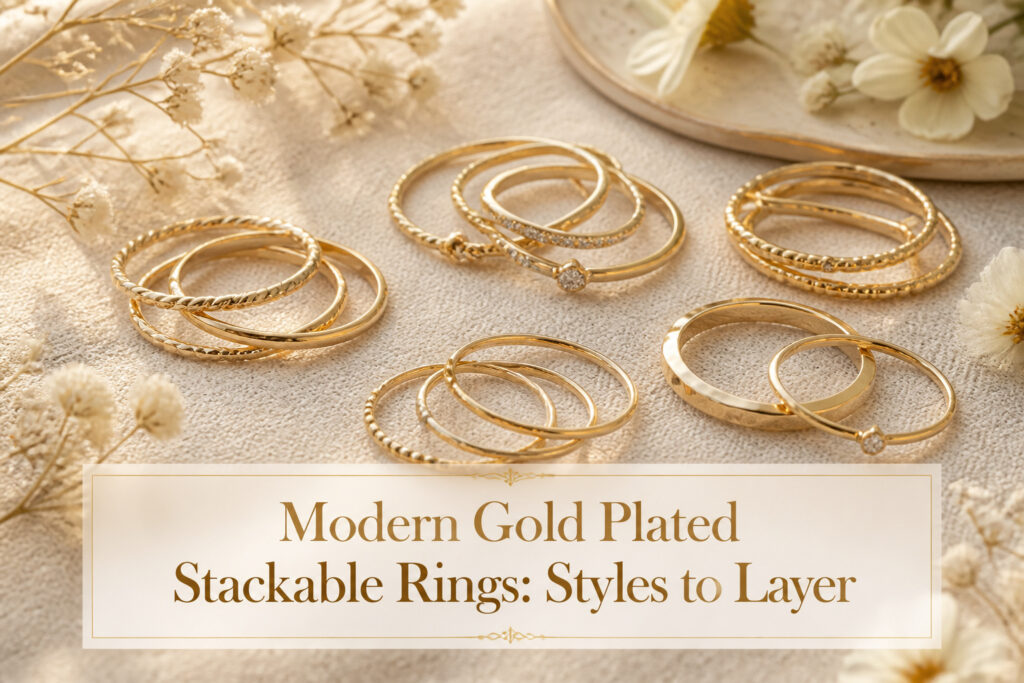
Modern gold plated stackable rings are thin bands designed to be worn together, layered across one or several fingers. The catch is the plating itself: measured in microns, it wears through fastest at the inner band where friction from neighboring rings grinds away the gold. My first set lasted eight months of daily wear before the brass base showed through, a lesson that re-plating costs eventually erase the upfront savings over sturdier options.
1. Gold Plated Rings
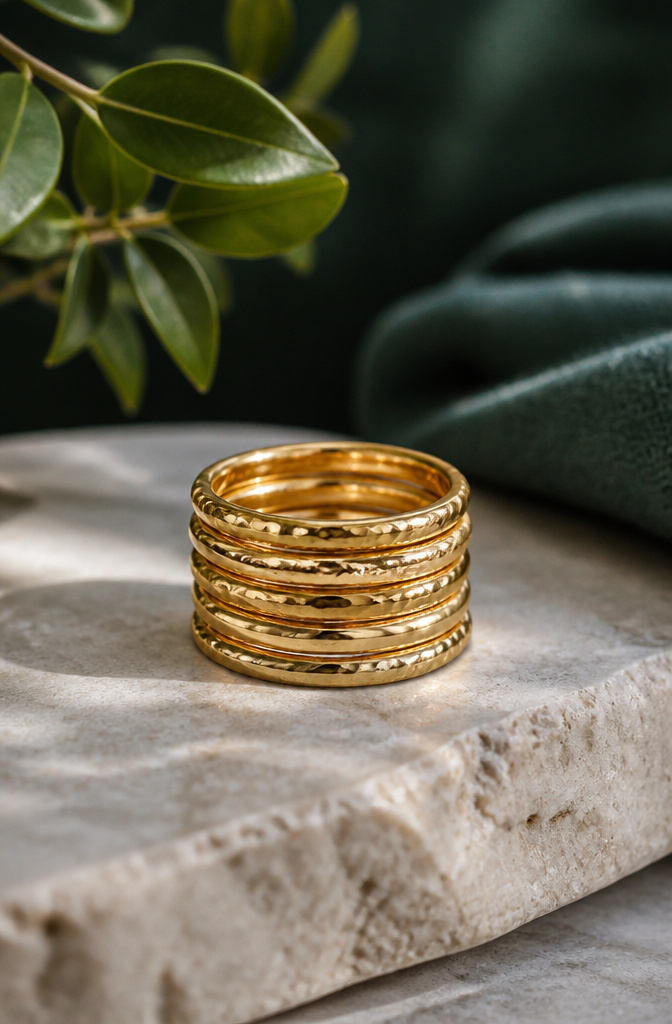
Gold plating starts with a brass or copper base that carries a thin layer of gold measured in microns. The thicker that layer, the longer the finish survives daily stacking and sliding against neighboring bands. Two industry guides treat this as the standard entry point for anyone building a ring collection without solid-gold prices.
The plating on my first set wore through at the inner band in about eight months of daily wear. That spot takes friction you do not notice until the warmer tone underneath starts showing. I bought that set in 2019 for roughly the cost of a single gold-fill band, and the math made sense until it did not. For occasional wear or a test run of a new silhouette, the lower price still holds value. For a stack you never remove, the re-plating cost closes the gap with sturdier options faster than the upfront savings suggest.
2. Diamond Stackable Rings
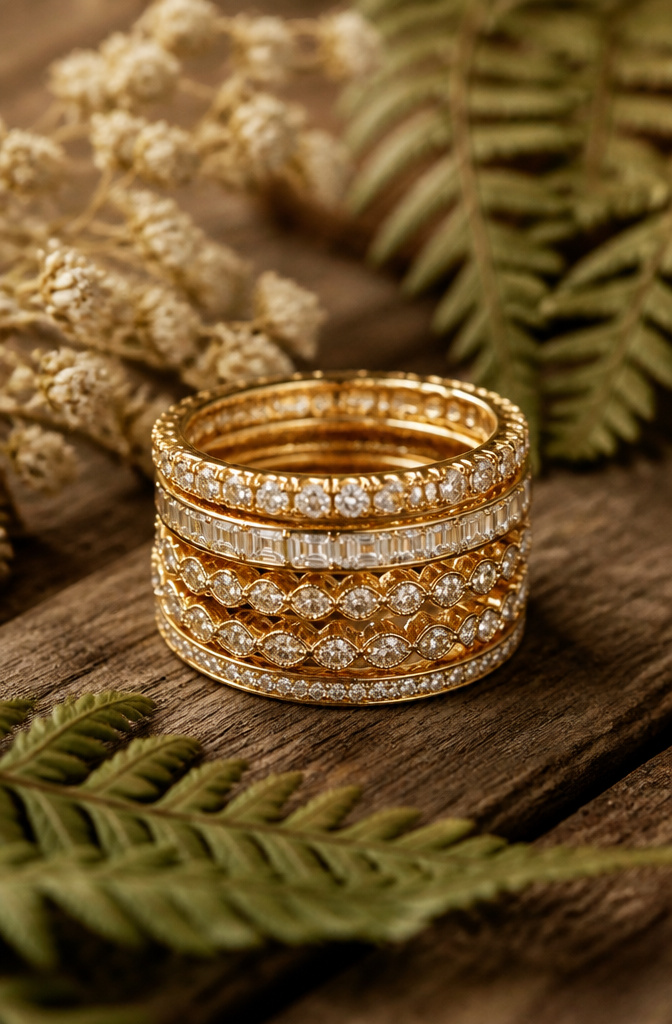
Small stones set into slim bands add points of light without overwhelming a stack. The way they’re held in place matters more than most people notice at first. Pave settings scatter tiny diamonds across the surface with minimal metal showing, so the band itself seems to sparkle. Channel settings sink the stones between two walls of metal, which protects the edges and gives a cleaner line but reads slightly heavier. Either one shifts a stack from casual to occasion-ready in a way plain metal bands never quite manage.
The distinction is worth keeping in mind when you’re building. Plain bands stack for everyday wear; diamond bands step in for dinners, meetings, or anywhere you want the arrangement to feel considered rather than accidental.
I learned the hard way which activities suit them. A tiny diamond in one of my stackables chipped when I wore the set rock climbing, the stone catching against a hold at exactly the wrong angle. Modern gold plated stackable rings with stones now stay home for anything that involves gripping rough surfaces or impact. The plating holds up fine, but the settings themselves have limits you can’t patch.
3. Textured Bands
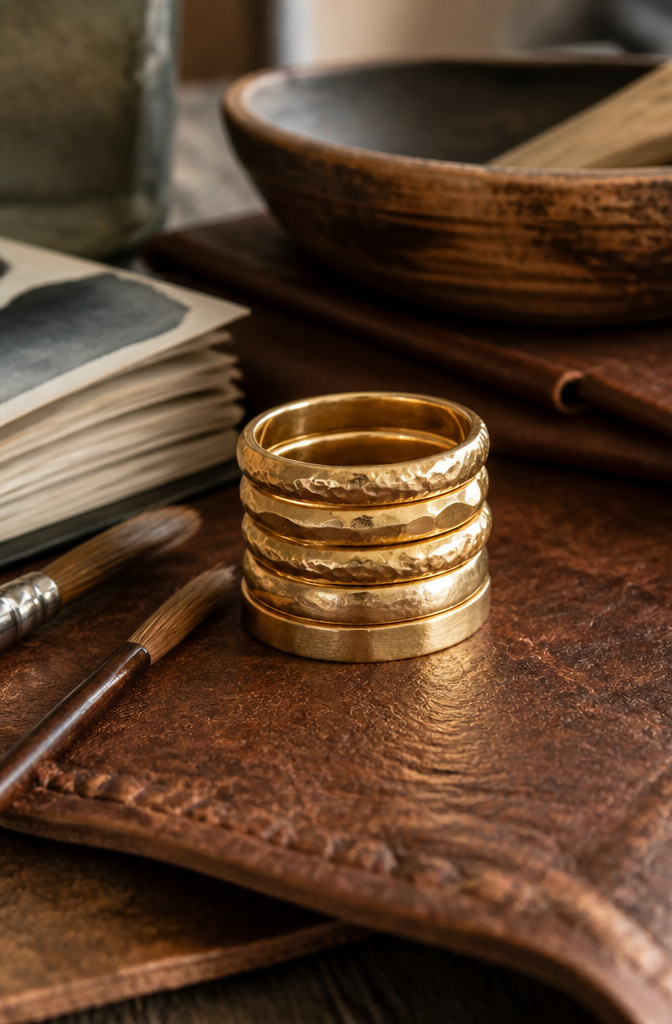
Hammered, brushed, and milgrain edges each catch light on their own terms, which is exactly what makes them worth layering into a stack of modern gold plated stackable rings. A hammered band throws off tiny, random highlights that read as sparkle without stones. Brush finishing diffuses light into a soft glow. Milgrain edges, those beaded borders, create a thin ridge of shadow that separates one ring from the next.
The real lesson came from pairing them wrong. Two hammered bands together, both catching light everywhere, flattened into a single noisy texture. No dimension, no point in wearing two. Swap one for a polished smooth band and the contrast does the work. Your eye travels between the surfaces instead of skipping over them.
Matte finishes have their own compromise. Daily scratches disappear into the dull surface, which keeps the stack looking newer longer. Skin oils are another story. They show up as darker patches where the ring sits, especially on brushed gold plating, and need a quick wipe more often than you’d expect. I keep a soft cloth in the same drawer as my rings now.
4. Simple Bands
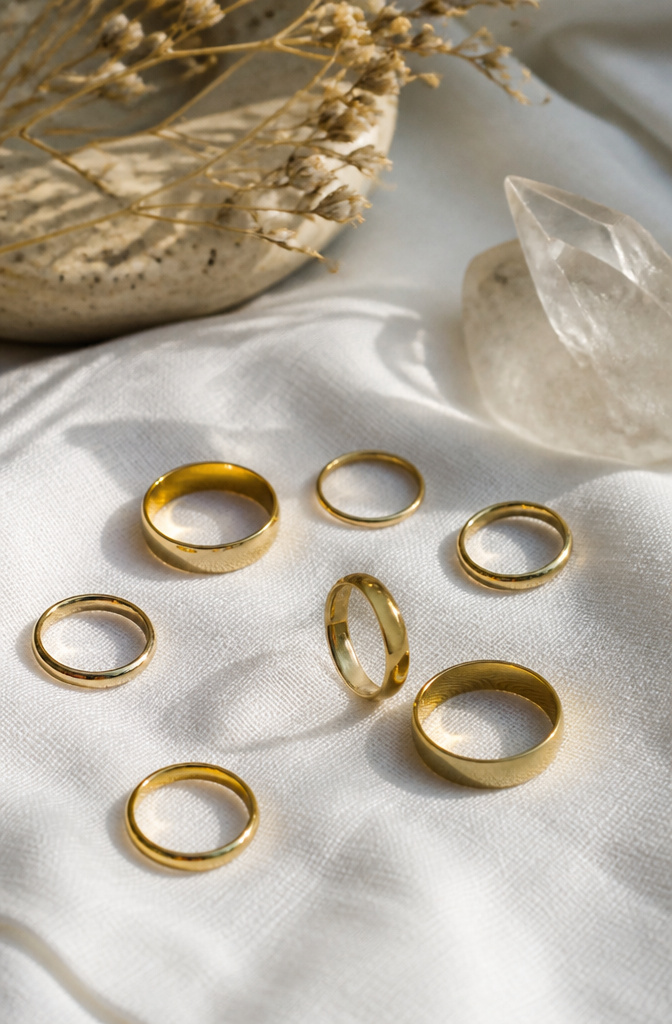
A plain round or flat band is where most stacks begin, and for solid reason. The minimal surface catches light evenly and leaves room for whatever sits above it. When I first started layering modern gold plated stackable rings, I picked up 2mm bands thinking they would hold their own. Alone, they disappeared on my hand. Between chunkier pieces, though, that delicacy became the point. They create breathing room without stealing attention.
Gauge and width matter more than the product photos suggest. A 2mm band reads as a whisper; push to 4mm and the same shape turns into a statement. Gold plate lets you own both extremes for the cost of one solid gold piece, which means building real volume without the weight that would make a five-ring stack feel like exercise equipment. The plate wears, of course, but on a band with no stones or texture to catch, the fade happens evenly. You replace it, or you do not. Either way, the stack stays intact.
5. Birthstone Rings
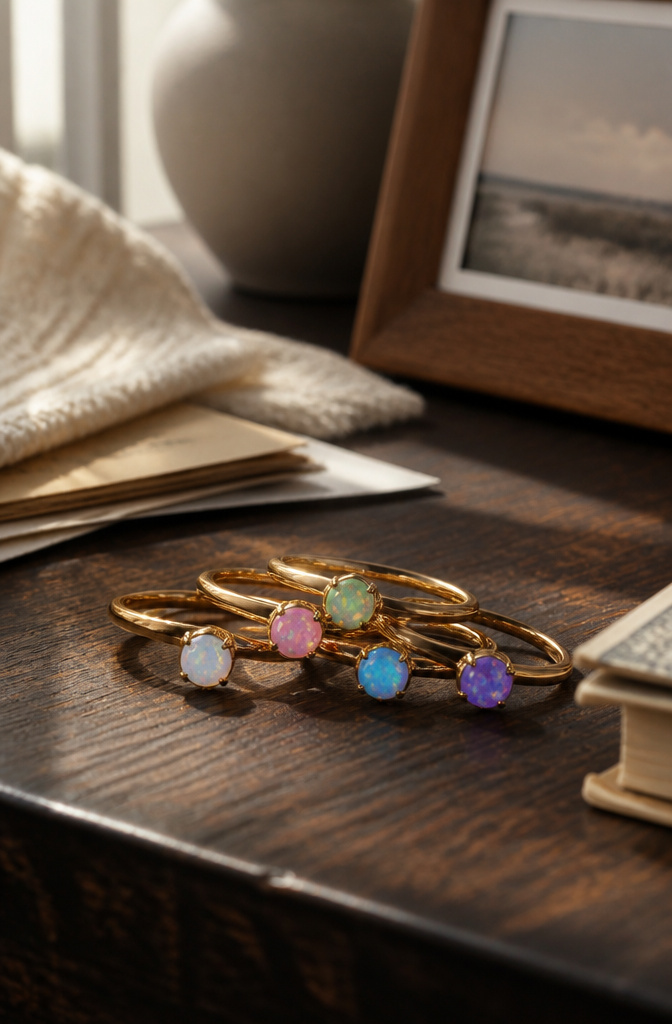
Single-stone rings carrying personal meaning behave differently in a stack than generic colored gems. The meaning becomes the organizing principle, not the color theory. When I added my daughter’s October opal to my set of modern gold plated stackable rings, it became the anchor everything else rotated around. Not because it was the largest or brightest, but because removing it made the whole stack feel arbitrary.
Opal sits at about 5.5–6.5 on the Mohs hardness scale, which makes it softer than sapphire or diamond and more vulnerable to scratching against harder neighbors in a daily stack. I learned to position it between two gold bands rather than against another stone ring, and I take the stack off before lifting anything abrasive. The extra care is worth the trade. A birthstone ring turns a stack from an accessory into something you keep looking at for reasons that have nothing to do with how the light hits it.
6. Curved and Chevron Bands
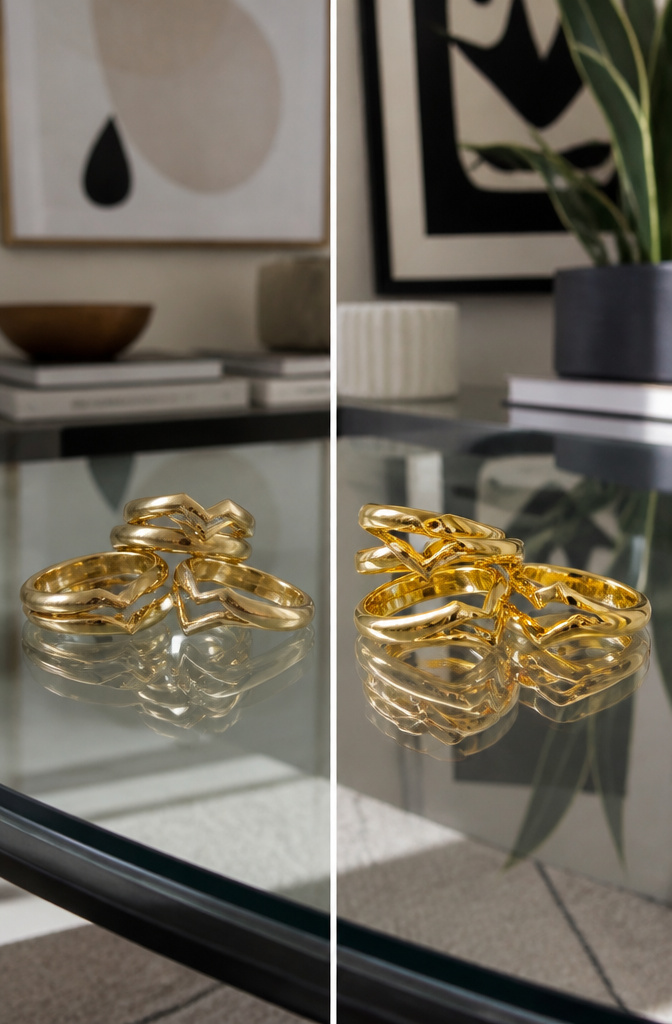
Curved and chevron bands solve the one problem that stops most stacking attempts dead: the gap around a solitaire or large center stone. A straight band leaves an awkward space, while a shaped ring nests right against the setting, following its contour like it was meant to be there. The chevron does something different, angling up or down to create architectural lines that read as intentional even when worn alone.
What convinced me, reading through how these are styled, is that the shape only works when the whole stack commits to the geometry. I tried pairing a single chevron with straight bands, and the result was a mess. In photos the gap looked almost deliberate, a negative-space choice. In person it read as accidental, like I’d lost a ring on the way out the door. Adding a second chevron above or below fixed it immediately: the repetition turned the angle into a design language instead of a mistake. Two chevrons frame a center stone; one just fights everything around it.
7. Signet Rings
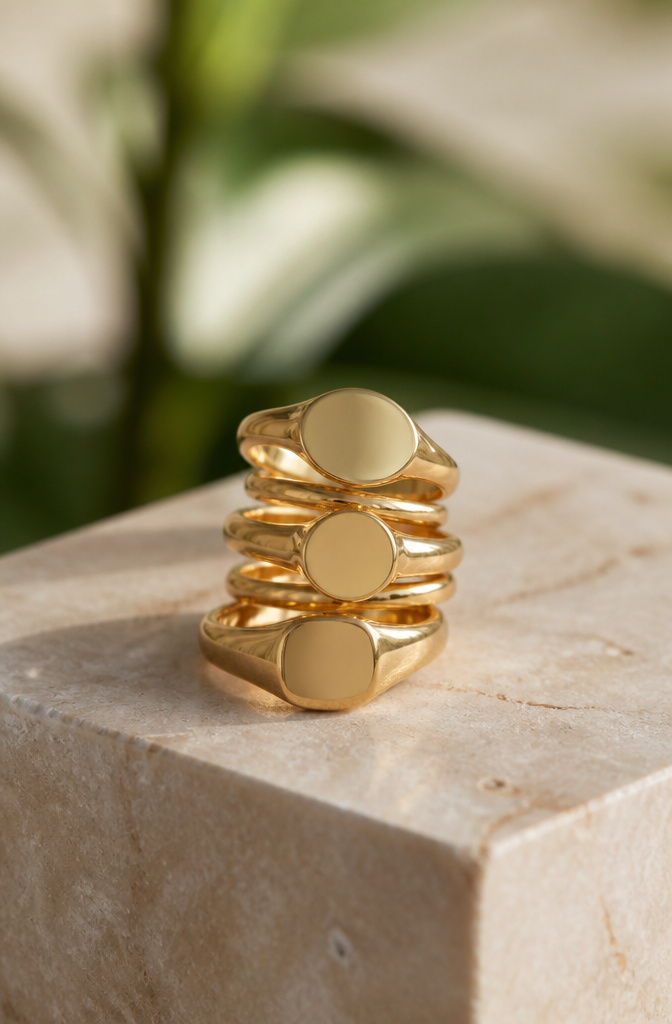
A mini signet changes how a stack reads. The flat table sits perpendicular to the band, so it breaks the line of ordinary rings and gives the eye a place to rest. That same mass adds weight, which keeps lighter pieces from sliding or twisting. The historical shape reads differently than band-style stackables; where a thin gold band disappears, the signet announces itself.
I bought a tiny oval signet with no engraving and left it blank. In a stack, blank signets look unfinished next to engraved ones. The surface catches light the same way, but without initials or a symbol it stays empty in a way a plain band does not. If you are choosing between the two, the engraved version wins for layering. The blank one now lives in a drawer.
8. Braided and Chain Rings
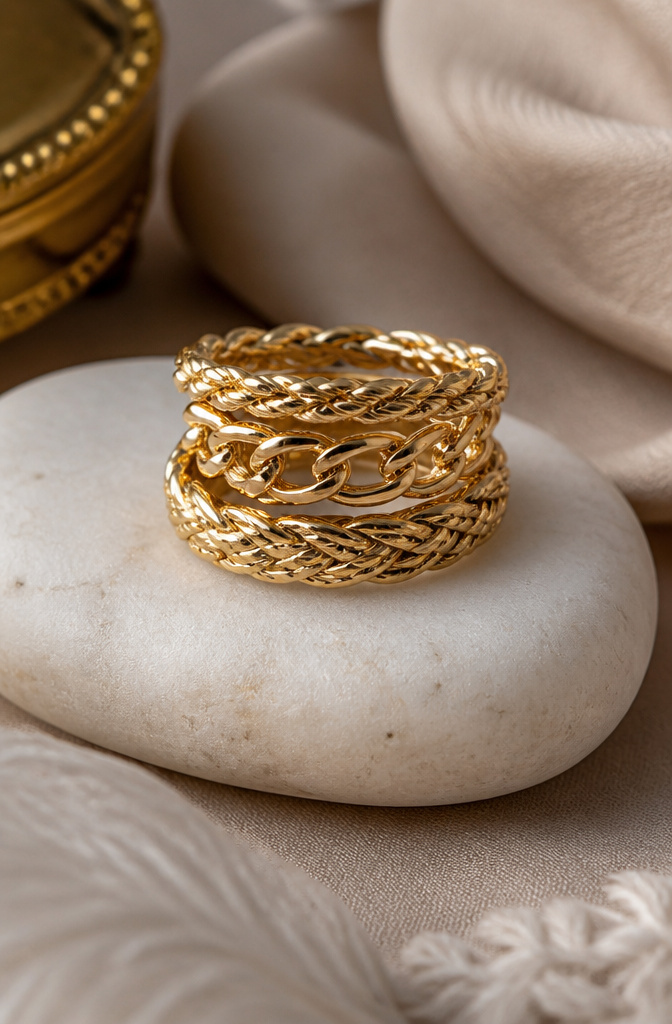
Braided and chain rings add linear complexity to a stack without the visual weight of solid metal. The gaps between links or strands create negative space that lets neighboring bands breathe, which is why they read as modern even when the pattern itself is centuries old. Slim widths help; a thick braided band looks costume, while the same weave at two millimeters stays current.
Chain-link stackables flex more than you’d expect. I learned this after one stretched slightly and sat crooked on my finger for a week before I noticed. The give is built into the design, so size down half a step if you’re between sizes, or expect to adjust more often than with a solid band. Braided patterns reference older jewelry traditions, ropework and sailor knots, but the narrow profile keeps them from reading as vintage costume. Pair either style with a plain band underneath; the contrast between open links and a solid surface is what makes the stack feel intentional rather than accidental.
Materials That Hold Up
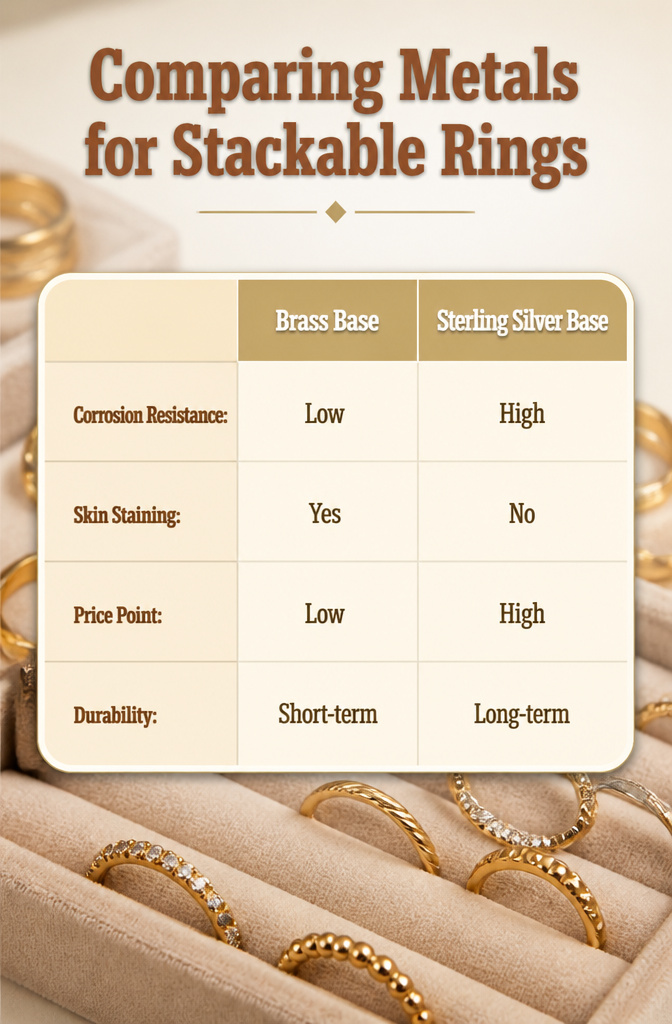
Most modern gold plated stackable rings under $50 sit on a brass base, which keeps the price low but carries a real downside. Brass corrodes when it meets sweat or humidity, and that corrosion bleeds straight through thin plating to turn skin green. I learned this the hard way one July afternoon when a brass-based ring left a pale stain that took two washes to fade. Now I flip every piece over and check the base metal before buying.
Sterling silver underneath the gold layer costs more, sometimes double, but the plating lasts because silver does not corrode the way brass does. A few makers now use recycled solid gold and recycled sterling silver for the base, which trims the environmental cost without cutting the wear time. Solid gold avoids the plating problem entirely, though at stackable-ring prices it moves the set from impulse buy to considered purchase.
The honest split runs like this: brass base for experimenting with a trend, silver base for pieces you plan to wear weekly, solid gold for the one or two rings that never leave your hand.
How I Build a Stack
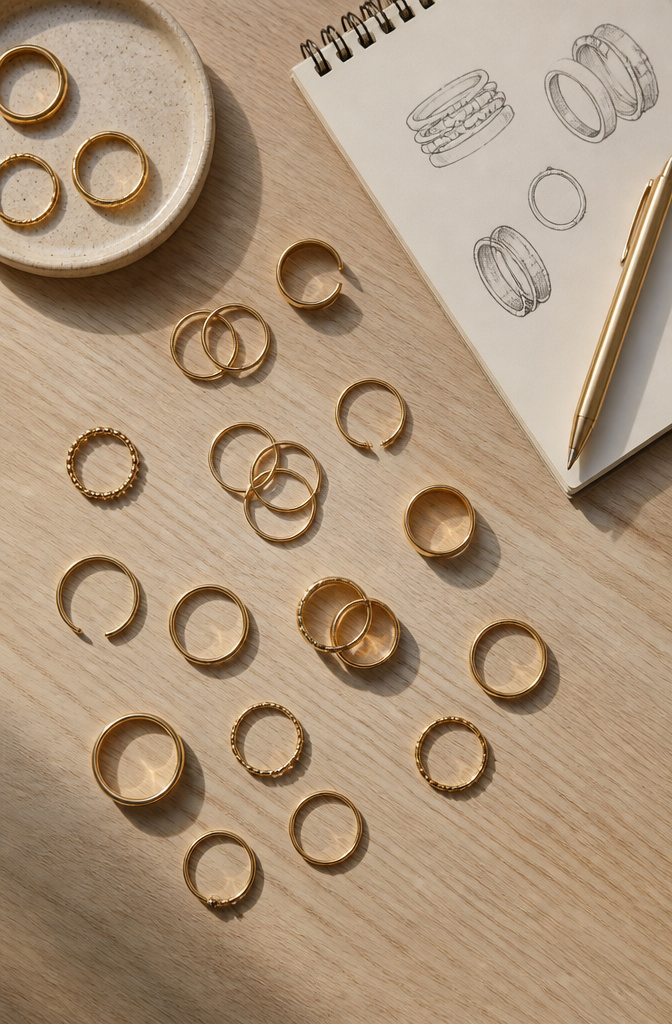
Every guide on stacking agrees on the same starting point: a simple band builds the foundation, then texture or a focal point adds contrast. There really is no wrong way to stack. The part nobody told me was how different a stack looks in a photograph versus on your hand.
I lay rings out on a white surface and take a picture before I commit. What felt balanced between my fingers often looks crowded or lopsided in the image, and the reverse happens too. A combination that seemed plain in my hands can read as clean and intentional on screen.
My first attempts always begin with about seven rings. Two or three fight for attention once they are together, so I pull those off. The final stack usually lands at three to five rings, which leaves enough room for each one to matter without the whole thing collapsing into noise.
Mixing Your Own Set
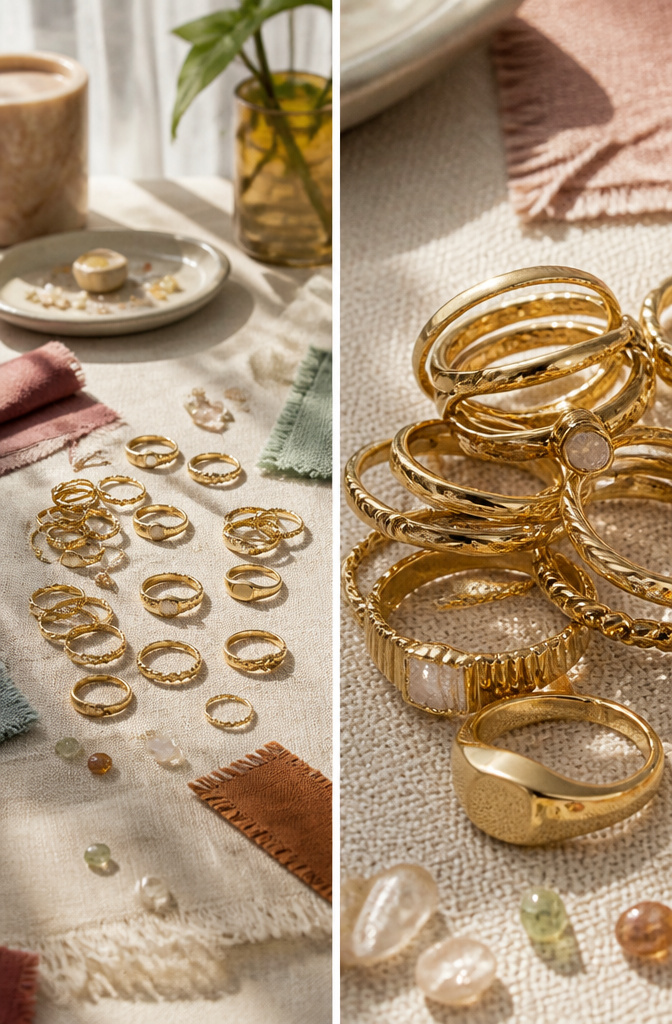
Every source on stacking talks about the mix-and-match approach, but that freedom only works if the pieces actually mix. I learned this the expensive way: three pre-made sets from different brands, none of which matched what I wore day to day. The metals clashed with my existing jewelry, or the widths sat awkwardly against rings I already owned. Buying rings singly costs more per piece, but the pre-selected combinations never solved the problem they claimed to. My current stack took two years to build from five different makers, a thin hammered band from one, a tiny signet from another, a whisper-thin plain band that took four months to restock. Catbird has encouraged this kind of creative stacking since 2004, and the advice holds: start simple, add texture, let the stack grow around what you already reach for. The result looks like you, not like a merchandised set.
When to Wear What
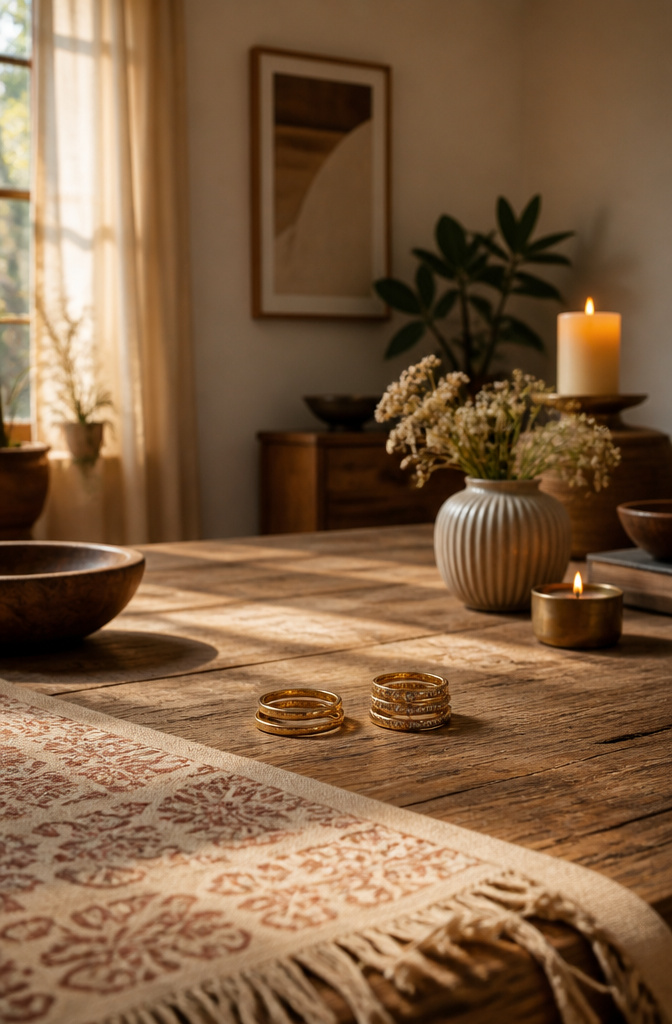
The distinction between everyday stacks and occasion stacks matters more than most people admit. A thin, plain gold plated band or two works for daily wear: smooth, quiet, unobtrusive through typing and hand-washing. For milestones, a slightly heavier stack with a small stone adds weight without shouting. Sources describe adding a new ring to celebrate each milestone, building a collection that maps onto memory.
I keep two stacks for this reason. The daily one is three slim bands, nothing that catches. The event stack includes a ring with a tiny diamond, just enough to read as intentional under restaurant light. The mistake I made was packing in a hurry for a funeral and grabbing the wrong pouch. The diamond stack clinked against itself during the service, a soft but persistent sound in a silent room. Metal on metal draws attention in places where you want none. Now the daily set lives in a separate compartment, and I check it by touch before any somber occasion.
Frequently Asked Questions
What are stackable rings?
Stackable rings are bands designed to be mixed and matched with other rings, worn together on the same finger or across multiple fingers. They let you build a personalized look by combining different textures, widths, and materials. Modern gold plated stackable rings make this approach affordable enough to experiment with several styles before committing to a set.
How do I stack rings?
Start with a simple band as your foundation, then add textural contrast with hammered, brushed, or stone-set pieces. The final stack usually works best at three to five rings; beyond that, individual pieces start fighting for attention. Lay your combination out and photograph it before committing, since what feels balanced on your hand can look crowded or plain in an image.
What materials are stackable rings made from?
Stackable rings come in gold plated, solid gold, and sterling silver options. Gold plated rings typically use brass or sterling silver bases; brass costs less but can corrode and turn skin green, while sterling silver underneath lasts longer because it does not corrode. Solid gold avoids plating wear entirely but moves the purchase from impulse buy to considered investment.