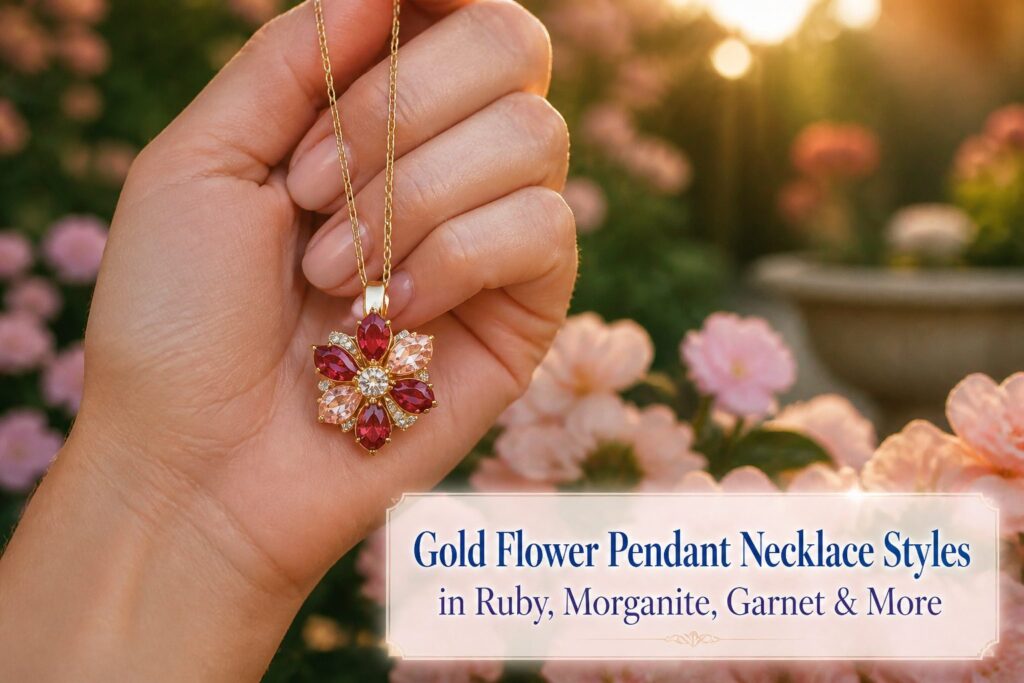
The right gold flower pendant necklace for you depends on which stone actually flatters your skin tone rather than fighting it.
White gold sharpens a ruby’s red into office-appropriate crispness, while rose gold extends morganite’s peach warmth so the piece reads as skin-tone jewelry rather than announcement.
The 1.27 carat lab-grown pink diamond carries IGI certification, the only third-party verified stone in the set, and costs 40–60% below mined equivalents.
That same carat weight appears across ruby, tanzanite, and multiple diamond colors, but the metal choice changes each stone’s temperature completely: yellow gold can turn garnet vintage-romantic or leave champagne diamonds muddy, and rose gold pushes aquamarine toward unexpected teal.
Handmade certification matters most where individual prong work around petal-shaped halo diamonds prevents the brittleness machine casting leaves behind.
1. 1.27 Carat Ruby Rose Flower Halo Pendant Necklace
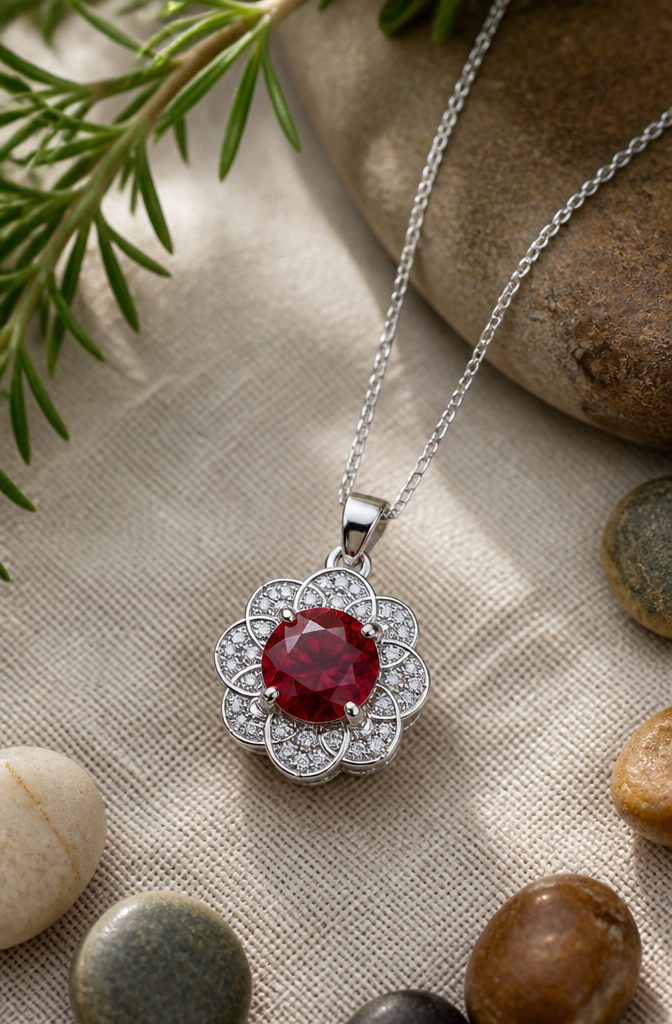
A 1.27 carat ruby carries enough visual weight to anchor a flower pendant without pulling the neckline down. The stone sits at that practical threshold where you notice it across a room but still wear it to the office.
The rose flower halo wraps the ruby in diamonds shaped like petals and leaves, a detail that reads as botanical rather than geometric.
You choose between 14K white gold or yellow gold, and the decision changes the whole temperature of the piece. White gold lets the ruby’s red pop forward; yellow gold warms it into something closer to antique.
I lean white for cooler skin tones and yellow for olive or deeper complexions, though either works if the metal matches what you already stack.
Handmade certification matters here because the halo setting demands individual prong work around each diamond.
Machine casting can leave those petal tips brittle; a certified handmade piece carries the maker’s guarantee that the prongs were finished by eye and tested for snag resistance.
That certification is not decorative paperwork. It is your proof that the 1.27 carat center stone was seated by someone who could adjust for the ruby’s exact depth and table, not forced into a preset mounting built for average dimensions.
The carat weight splits across the whole design: the ruby itself plus the diamond halo. Ask whether the 1.27 refers to the ruby alone or the total, since that changes the price bracket and the insurance valuation both.
2. 1.11 Carat Morganite Rose Flower Halo Pendant Necklace
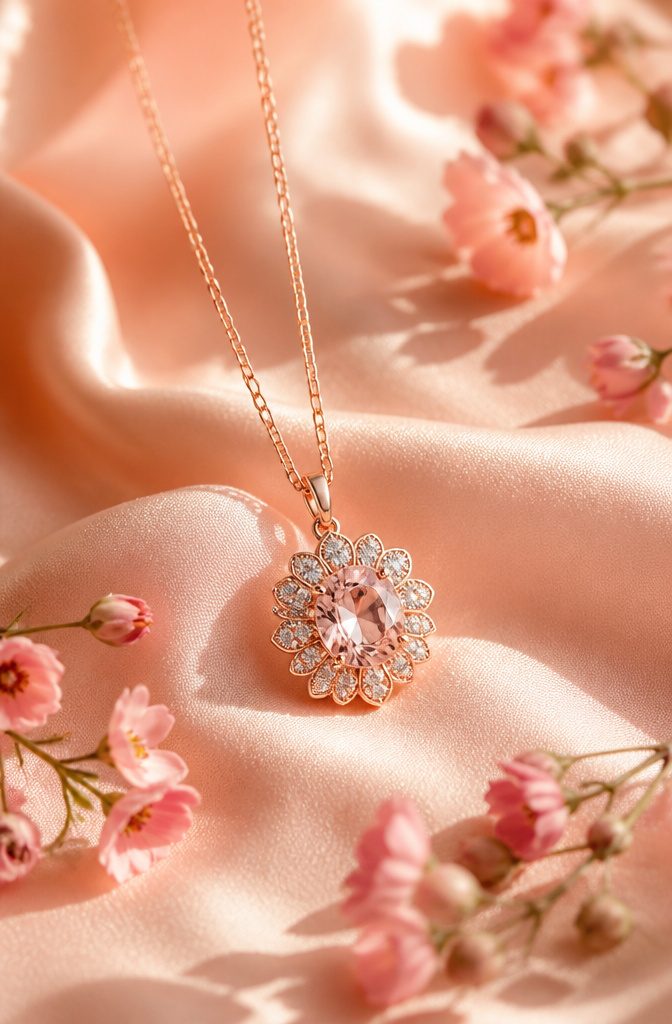
The 1.11 carat morganite piece is the lightest stone in this collection, and that delicacy is exactly what draws me to it.
Morganite sits in the beryl family alongside aquamarine, but its peach-pink warmth behaves differently than ruby’s saturated punch. Where ruby commands attention across a room, morganite reads as skin-tone jewelry: it flatters without announcing itself.
Rose gold is the pairing that makes sense here, not just the white gold alternative both settings offer. The alloy’s own pink undertone extends the stone’s color rather than framing it in contrast.
White gold sharpens morganite into something cooler and more formal; rose gold lets the halo of natural diamonds do the separating while the metal and gem share a conversation.
I would pick rose gold for daily wear and white gold only if the recipient’s existing jewelry runs silver.
Handmade construction with certification matters more at this carat weight than heavier pieces, because a lighter center stone lives or dies by its cut precision.
The floral detailing in the halo compensates for the smaller spread, giving the pendant visual presence that raw carat weight alone would not earn.
For someone building a jewelry wardrobe rather than buying a single statement piece, this is the practical entry point: the metal quality and diamond accenting match the larger stones in the series, but the total cost stays in gifting territory.
3. 1.41 Carat Garnet Rose Flower Halo Pendant Necklace
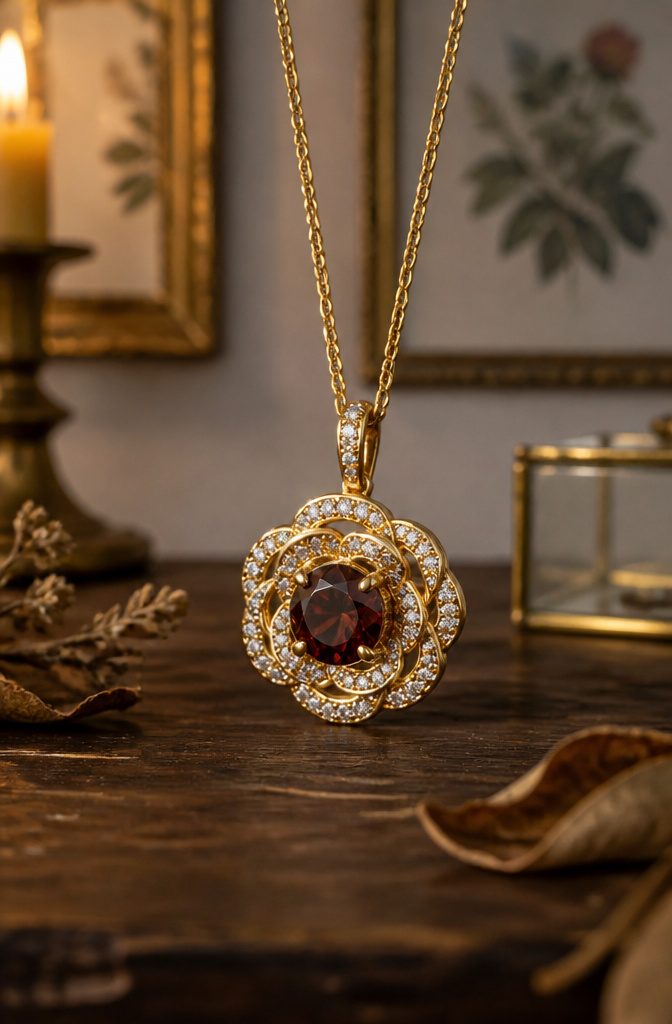
The 1.41 carat garnet in this rose flower halo pendant is the heaviest center stone in the set, and that weight changes how the piece reads against your skin.
Garnet carries a deep, brownish red that absorbs light rather than throwing it back, so the metal you choose becomes the deciding factor.
Yellow gold warms the stone further, turning the floral silhouette into something vintage and romantic.
The garnet sinks into the setting and the gold becomes the accent you notice first, which suits autumn palettes and lower necklines where you want the metal to glow.
White gold does the opposite.
It pushes the red forward, making the garnet look darker and more saturated by contrast. The stone becomes the focal point and the halo diamonds do more visual work, which reads crisper against workwear or cooler complexions.
Both settings are certified handmade in 14K gold with the same diamond halo framing the petals. The construction is identical; only the color story shifts.
For an everyday piece that moves between office and evening, I lean toward white gold. The garnet stays legible in dim light and the whole necklace avoids reading as seasonal.
4. 1.26 Carat Aquamarine Rose Flower Halo Pendant Necklace
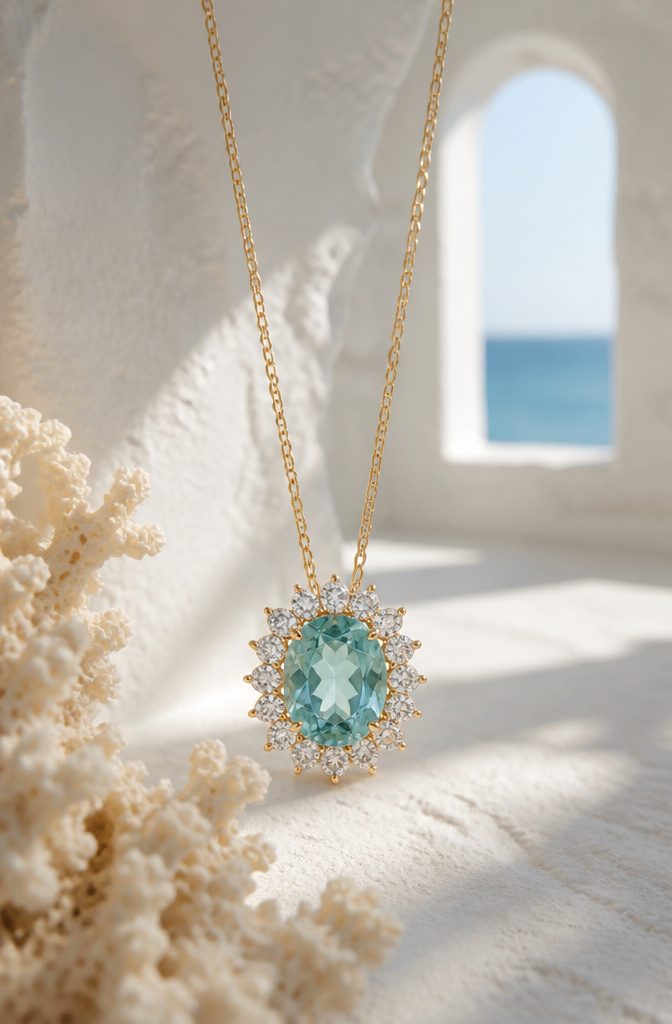
The 1.26 carat aquamarine rose flower halo pendant is the only piece in this collection that comes in all three 14K metals: white, yellow, and rose gold. That flexibility matters because the stone itself reads differently against each one.
On white gold, the aquamarine stays cool and crisp, the blue-green tint reading almost icy against the bright background.
Yellow gold warms the same stone toward a sea-glass effect, the gold picking up the green undertones and softening the whole piece for everyday wear.
Rose gold does something more dramatic, pushing the aquamarine toward a muted teal that feels slightly vintage, slightly unexpected. Same 1.26 carat weight, same certified handmade floral construction, but three distinct personalities depending on which metal you choose.
I lean toward the rose gold pairing myself, though I would not call it the safe choice. The white gold version is what I would buy for someone whose metal preference I did not know.
The yellow gold sits in the middle, versatile without being ordinary. The halo setting keeps the flower shape defined in all three, and the handmade certification means the build quality is consistent regardless of metal.
If you are deciding between them, start with the metal you already wear daily; the stone adapts, but the frame has to live with your other jewelry.
5. 1.27 Carat Lab Grown Pink Diamond Rose Flower Halo Pendant Necklace
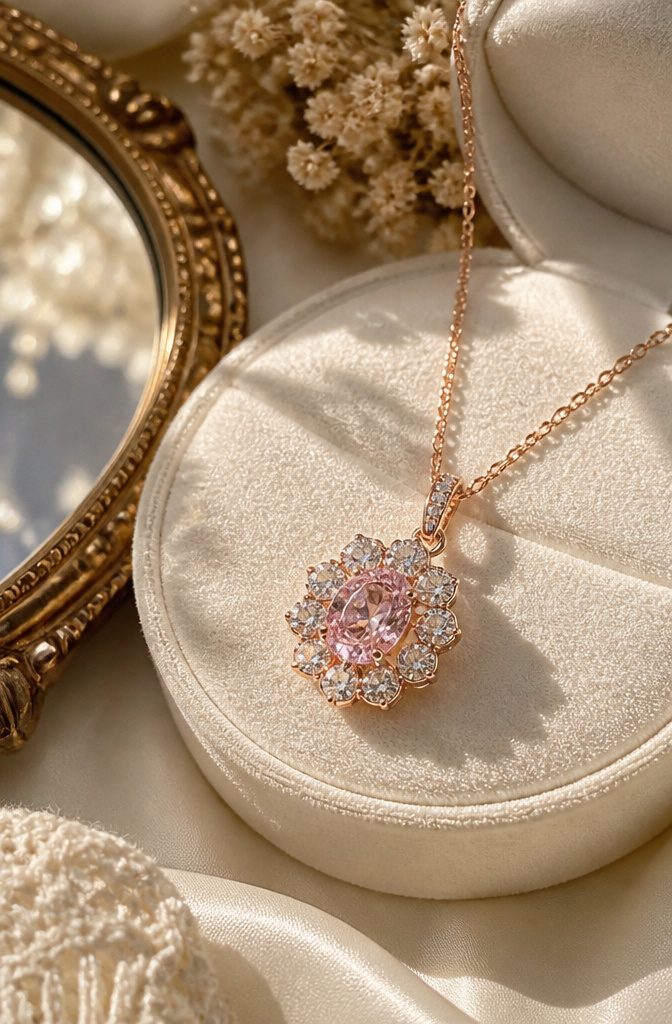
A 1.27 carat lab-grown pink diamond sits at the center of this rose flower halo design, framed by smaller stones in a handmade 14K setting that comes in white, yellow, or rose gold.
The IGI certification matters here: it verifies the carat weight, color grade, clarity, and cut quality of the lab-grown stone, giving you the same documentation a mined diamond would carry.
That paperwork is what separates a certified piece from a vague "lab-grown" claim.
The pricing is where this option pulls ahead. Lab-grown pink diamonds typically run 40–60% below equivalent mined stones, and in a 1.27 carat fancy color, that gap widens because natural pink diamonds of this size are exceptionally rare.
You are paying for the chemistry and the cut, not the geological accident.
This is the only IGI-certified piece and the only lab-grown stone in the dozen styles. The handmade floral construction means slight variations between pieces, which I prefer to factory-perfect casting for a flower motif that should look organic.
Rose gold warms the pink diamond most coherently; white gold sharpens the contrast if you want the stone to read more distinctly against the metal.
Yellow gold works but fights the pink slightly. Lab-grown diamonds match mined ones for hardness, but the 14K gold setting will show wear faster than platinum would, and the halo adds surface area that catches on loose knits.
6. 1.27 Carat Tanzanite Rose Flower Halo Pendant Necklace
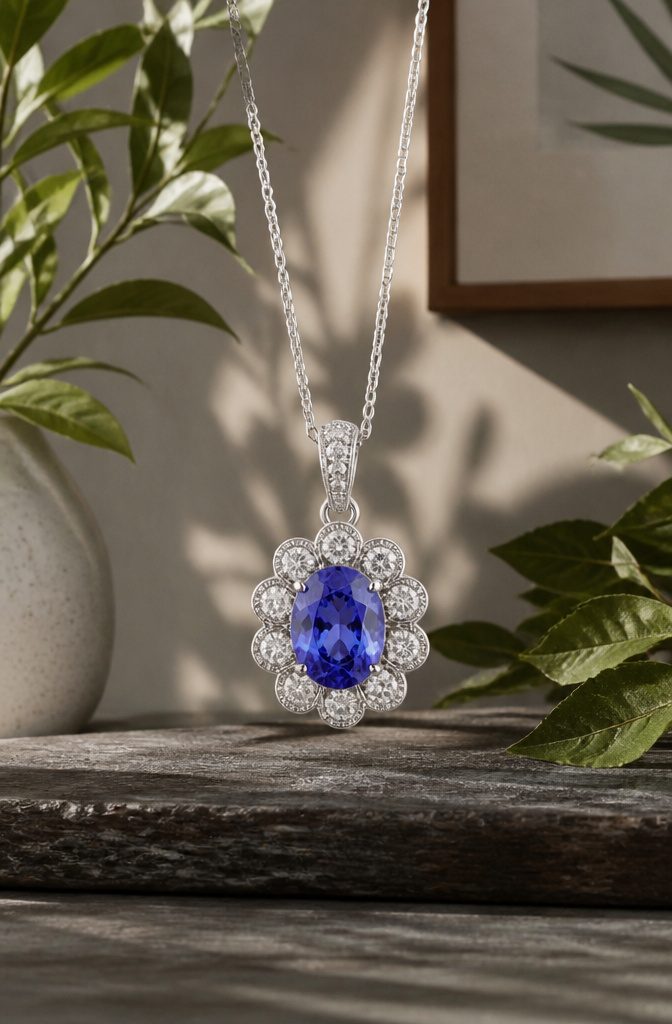
The 1.27 carat tanzanite rose flower halo pendant necklace comes handmade in 14K white gold or 14K yellow gold, with certification on the stone.
Tanzanite carries that violet-blue shift under different light, cooler than sapphire and more dramatic than amethyst, which is why it reads as a statement stone even at this size.
The halo of smaller stones around the carved rose setting pushes the color outward rather than letting it sink into dark metal.
I would not hunt for this piece in rose gold. The warm copper tones in standard 14K rose gold fight the violet rather than framing it; white gold sharpens the blue phase, and yellow gold plays up the violet.
Both choices make sense. Black gold appears in a vintage-style variant from the same maker, though that reads as evening-specific where the white or yellow versions could handle office lighting without looking costume.
Handmade certification matters here because tanzanite is routinely heat-treated to reach that saturated color, and the paperwork tells you the treatment was stable, not surface-level dye.
For daily wear, I would set the chain at 18 inches minimum so the pendant sits below the collarbone curve and catches light when you move.
7. 1.27 Carat Champagne Diamond Rose Flower Halo Pendant Necklace
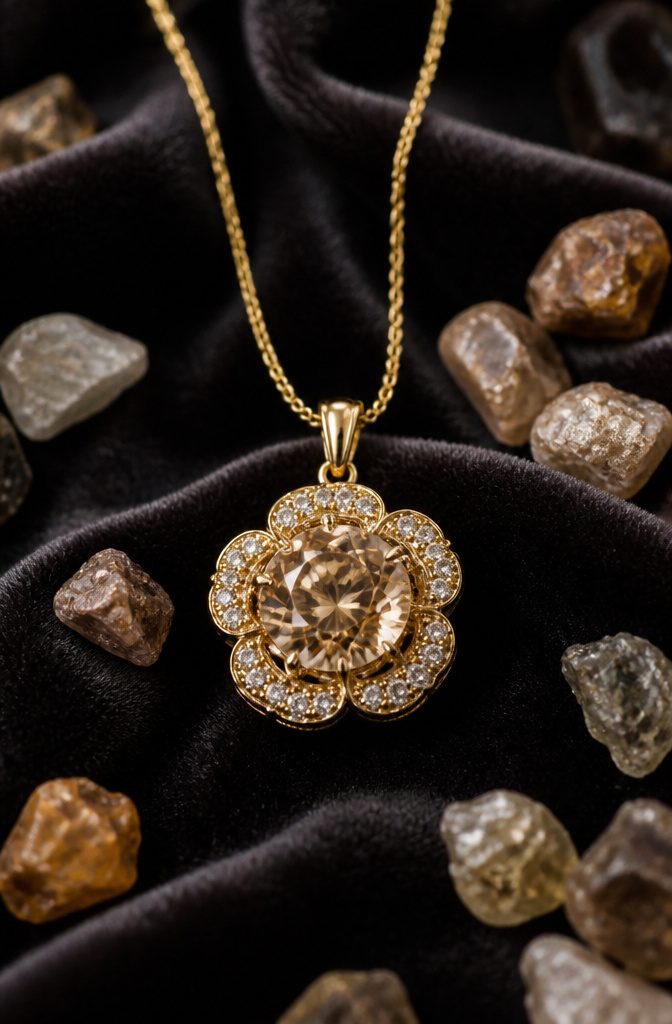
The 1.27 carat champagne diamond rose flower halo pendant necklace comes in 14K white gold, yellow gold, or rose gold, each handmade and certified.
Champagne diamonds carry a light brown tint that reads noticeably warmer than a white diamond of the same cut grade, and the metal you choose either amplifies that warmth or holds it in check.
Against 14K white gold, the champagne tone flattens slightly; the cool base metal creates contrast, but the overall effect can look muddy if the diamond leans darker.
Yellow gold pushes the warmth further, sometimes into territory where the stone loses definition against its own setting.
Rose gold strikes the balance: its copper content echoes the diamond’s brown undertone without overwhelming it, so the petal details in the floral halo stay crisp and the center stone still registers as diamond rather than tinted glass.
If you want the champagne character front and center, rose gold is the metal that delivers.
8. 1.27 Carat Yellow Diamond Rose Flower Halo Pendant Necklace
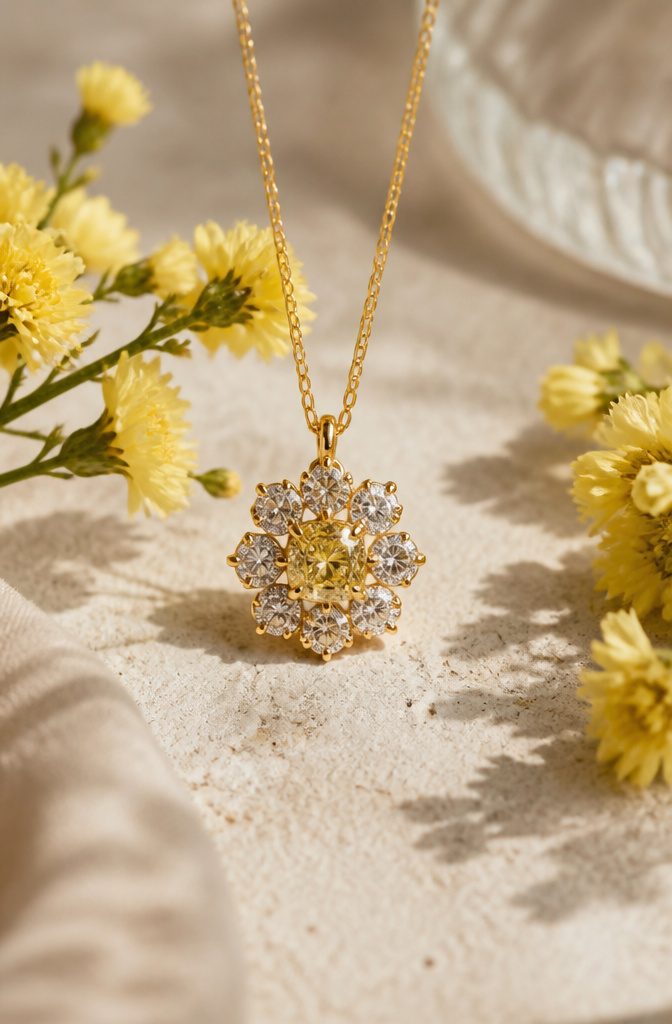
A 1.27 carat yellow diamond set in a rose flower halo gives you three metal choices, and the decision between them is sharper than it first looks.
The piece is certified handmade, which matters for a floral setting this intricate; machine production rarely gets the petal curves tight enough to hold a halo securely.
Yellow diamond against yellow gold reads as intentional warmth, not overload, if the stone carries enough contrast in saturation.
The halo diamonds break up the field, so the eye registers texture rather than a single yellow wash. I would still steer most buyers toward white gold or rose gold for this particular stone.
White gold throws the yellow forward and keeps it crisp; rose gold softens the whole piece into something that wears easily with autumn palettes and vintage styling.
Yellow gold wins only when the wearer already owns a stack of yellow gold chains and wants this pendant to slip in without fighting the collection.
Even then, the 14K alloy keeps enough alloy content that the metal reads slightly paler than 18K would, which helps the diamond hold its own.
Yellow on yellow photographs beautifully in warm light but can flatten under office fluorescents. Rose gold or white gold forgive more lighting conditions, and for a piece at this carat weight, versatility usually matters more than a perfectly matched set.
9. 1.27 Carat Red Diamond Rose Flower Halo Pendant Necklace
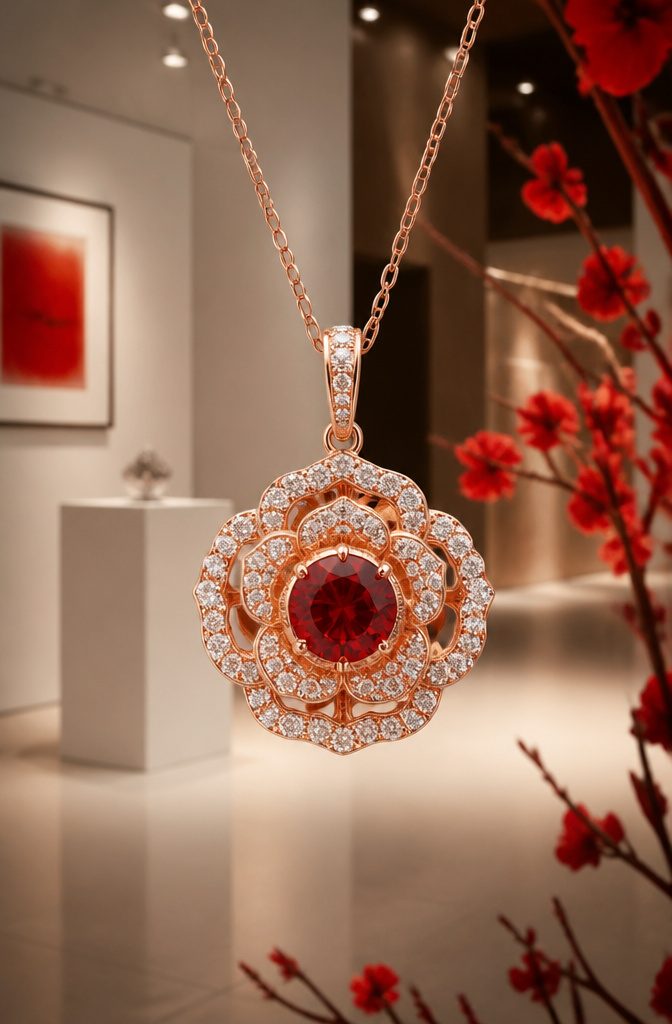
A 1.27 carat red diamond set in a rose flower halo already signals something most flower pendants never attempt.
Red diamonds rank among the rarest natural stones on earth, and even lab-grown versions carry that scarcity in their pricing and their visual weight.
The maker offers this piece in 14K white gold, rose gold, or yellow gold, which at first seems like standard variety, but the three metals actually solve different problems for the stone.
White gold sets the red diamond forward with cold contrast, the way a jeweler might frame a warning.
Rose gold warms the whole piece toward blush, which some wearers find softens the drama rather than amplifying it. Yellow gold splits the difference and, in my view, risks muddying the red unless your skin tone pulls distinctly warm.
The certified handmade construction matters here because a halo of smaller stones around a center this unusual needs exact alignment; any gap or tilt reads as error, not charm.
Lab-grown red diamonds keep the color saturation natural-mined stones command, at a fraction of the supply-chain anxiety.
That matters less for ethics than for availability: a natural red diamond at this carat weight would sit in a vault, not a catalog with metal options.
The choice of gold becomes the main decision the buyer controls, and white gold wins if you want the stone to do the talking.
10. 1.27 Carat Blue Diamond Rose Flower Halo Pendant Necklace
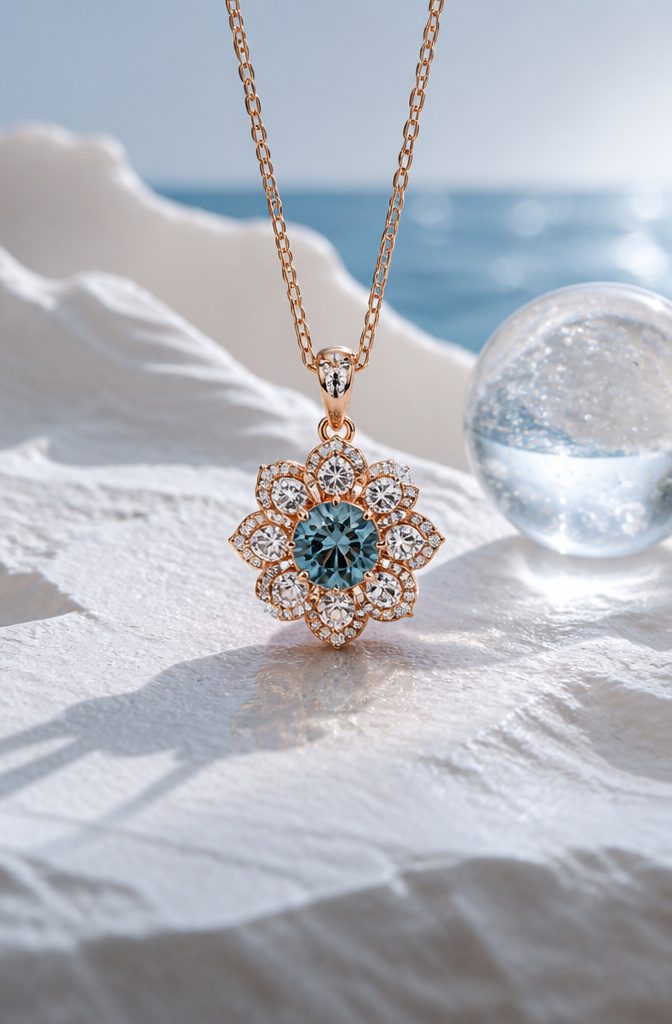
A 1.27 carat blue diamond set in a rose flower halo reads differently depending on which of the three 14K gold options you choose.
The stone itself sits in that unusual space between neutral and statement: in daylight it looks like a pale sapphire, but under evening light the blue intensifies and the piece becomes unmistakably bold.
Rose gold is the metal that keeps it from turning cold. The warmth in the alloy pulls the diamond toward violet rather than ice, which flatters most skin tones and softens the halo’s sparkle.
White gold sharpens the blue to something more dramatic, better suited if you already wear cool-toned metals and want the pendant to coordinate rather than stand apart.
Yellow gold creates the most contrast, almost vintage in effect, though the combination can feel costume if the outfit isn’t equally deliberate.
Handmade certification matters less for bragging rights than for the setting security: a halo this intricate, with petals wrapping the center stone, needs prongs placed by hand rather than cast in bulk if you plan to wear it daily.
11. 1.27 Carat Green Diamond Rose Flower Halo Pendant Necklace
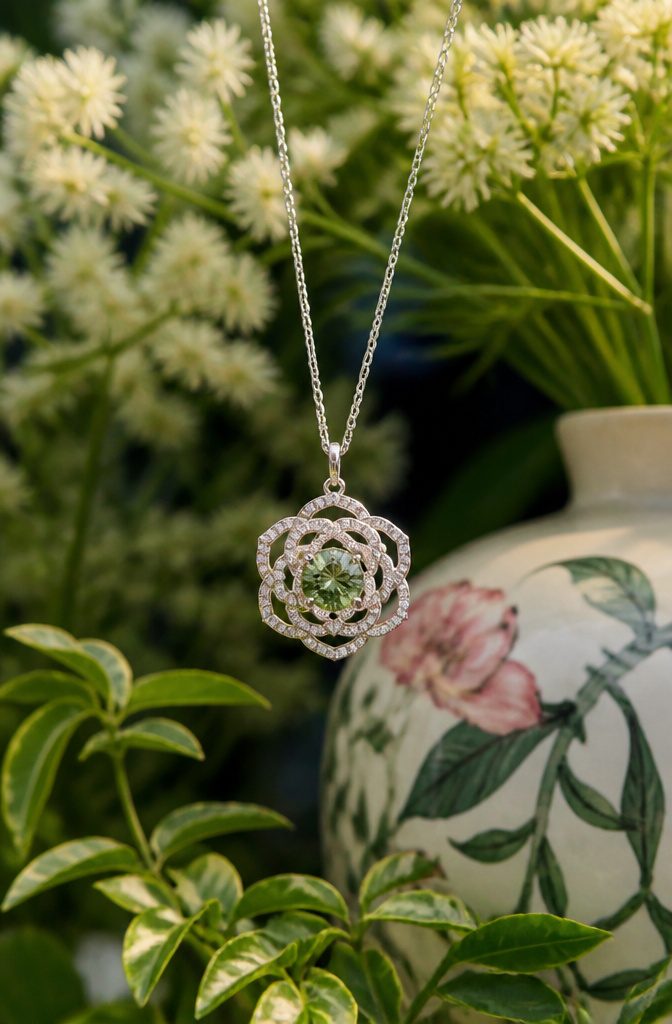
A green diamond in a flower setting is the kind of choice that either reads as a living leaf or misses the mark entirely.
The 1.27 carat stone here sits inside a handmade rose halo, and the color lands differently depending on the metal you pick. White gold keeps the green crisp and botanical, almost like a succulent caught in frost.
Rose gold warms it toward olive, which some find richer and others find muddy. Yellow gold pushes the stone toward a yellow-chartreuse that, to my eye, fights the floral concept rather than serving it.
The piece is certified handmade, not cast from a common mold, and that matters for a motif this specific.
A machine-stamped rose at this price point would feel like costume jewelry; the hand-finished petals here carry the slight irregularity that makes the flower look grown rather than manufactured.
Green diamonds are treated or irradiated to reach this hue in most cases, and that is not a flaw, just a fact worth knowing before you buy.
The 1.27 carat weight gives the center stone enough presence to justify the halo without turning the whole pendant into a brooch-scale piece.
For daily wear, the size sits at the upper edge of what stays comfortable under a blouse collar. I would choose the white gold setting and let the green read as botanical rather than novelty.
12. 1.36 Carat Black Diamond Rose Flower Halo Pendant Necklace
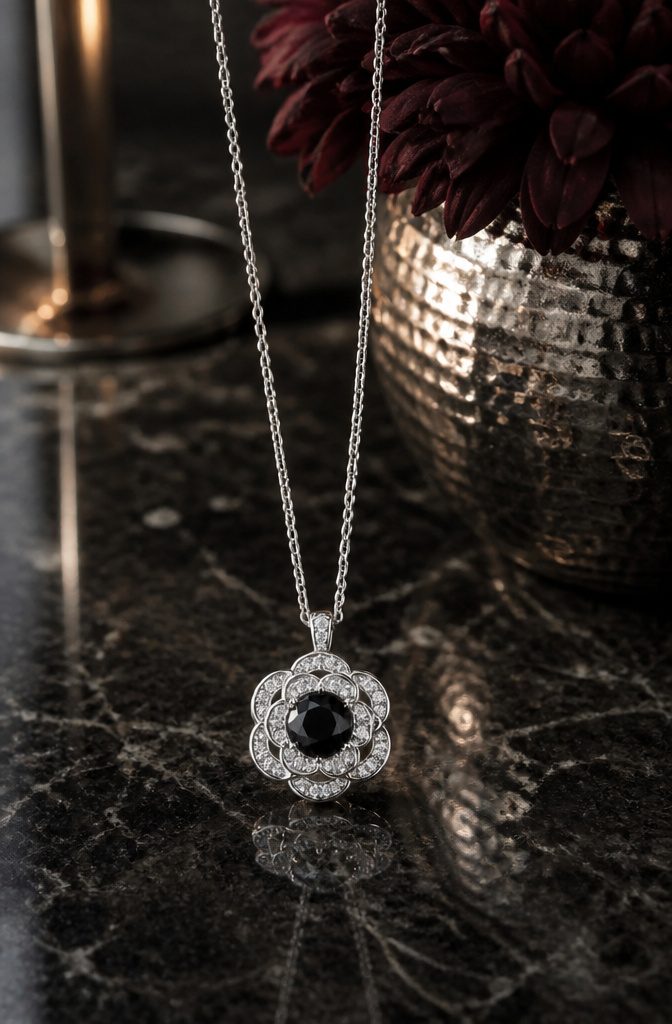
At 1.36 carats, this black diamond rose flower halo pendant is the heaviest stone in the collection and the only one that inverts the halo effect entirely.
Where lighter gems rely on surrounding diamonds to amplify their fire, the black diamond absorbs light and throws it back as a sharp, mirror-like flash.
The halo still frames the center, but it reads as a bright border against a dark field rather than a boost to a pale one.
The piece comes in 14K white gold, rose gold, or yellow gold, and the metal choice matters more here than with any other stone in the series.
White gold sharpens the contrast and keeps the silhouette crisp, which is what I would pick for someone who wants the floral shape to read clearly from a distance.
Rose gold warms the black diamond toward something softer, almost antique, though it does muddy the edges of the petals. Yellow gold sits in the middle, offering enough definition without the starkness.
Certified handmade construction means the setting is built around this specific stone weight rather than adjusted to fit a standard mount.
That shows in the balance: 1.36 carats is substantial for a daily pendant, and the halo spreads the visual weight so the chain point does not sag.
14K Gold and Platinum Options
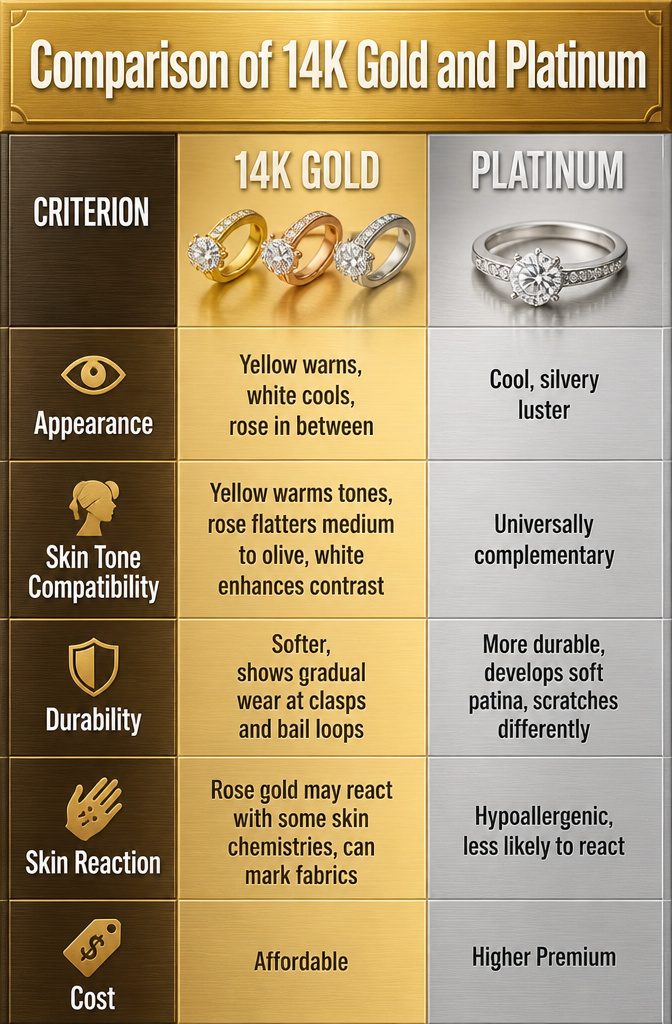
14K white gold sets a cool, silvery stage that makes rubies and garnets look deeper and more vivid against the skin. Yellow gold warms up morganite and champagne diamonds in a way that feels intentionally vintage rather than dated.
Rose gold lands somewhere between the two, and on medium to olive skin tones it often reads as the most flattering neutral of the three.
Platinum appears in a few of the higher-end pieces, and the difference matters if you plan to wear the pendant daily: platinum is denser and scratches differently, developing a soft patina rather than the gradual thinning that gold can show at chain clasps and bail loops over years of friction.
For a piece you will put on and forget about, I lean toward yellow or white 14K rather than rose, since the copper alloy that gives rose gold its color can react with some skin chemistries and leave a faint mark on lighter fabrics.
Platinum wins on pure durability but costs noticeably more, and for a flower pendant that sits still rather than taking the knocks of a bracelet or ring, 14K yellow or white gold is the practical ceiling where you get the wear without the premium.
Halo Settings and Floral Construction
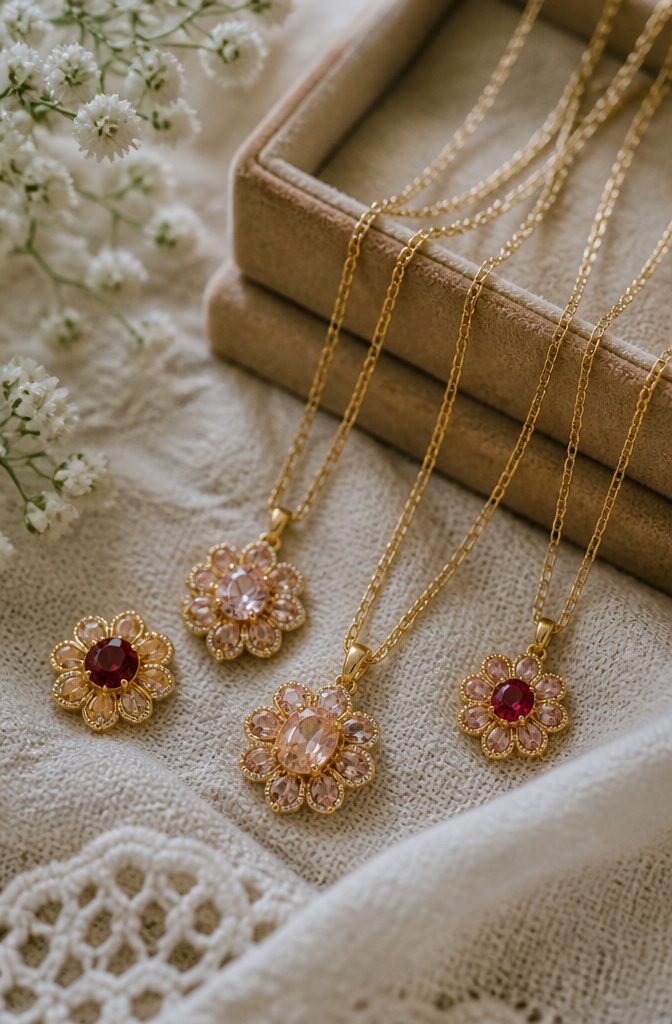
A halo setting builds outward from the center stone rather than piling everything into one expensive point.
The 1.11 carat morganite and 1.41 carat garnet pendants I looked at both follow this same architecture: a single colored center held in a rose flower frame, then a ring of smaller diamonds pressed around the edge.
That outer ring catches light the center alone would miss, so the face-up size reads larger than the carat weight suggests. You get presence without paying for it all in one stone.
The rose motif is structural, not just decorative. Petal-shaped bezels or prongs divide the halo into segments, which breaks up the metal and lets more of the smaller stones show to the eye.
Handmade construction in 14K white, rose, or yellow gold means those petal walls are thick enough to hold the setting together, but the gaps keep the piece from looking heavy.
For everyday wear, that balance matters: too much solid metal and the pendant turns into a disc; too little and the small stones loosen over time.
I prefer the halo here over a solitaire of equal total weight.
A single 2-carat stone in the same flower shape would cost more, sit higher, and snag on collars. The split weight spreads the risk: if a tiny accent diamond chips, you replace one small stone, not the whole show.
Those petal crevices collect lotion and need a soft brush every few weeks. For the gain in visual spread and the lower entry price, I accept the maintenance.
Certification Marks and What They Mean
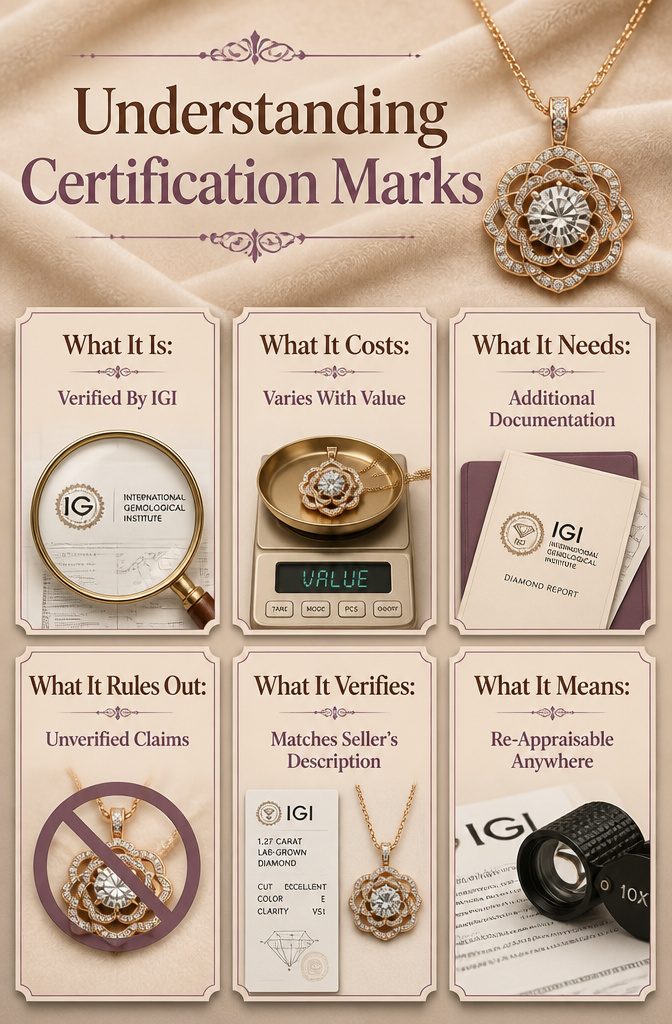
A certified gold flower pendant necklace carries more weight than the same design without paperwork, especially when the center stone is a lab-grown diamond or a premium colored gem.
The listings that mention IGI certification, specifically the 1.27 carat lab-grown diamond rose flower halo pendants in platinum and 14K white, yellow, or rose gold, have been through third-party grading for carat weight, cut, color, and clarity.
The International Gemological Institute does not guarantee value, but it does verify that the stone matches the seller’s description.
For handmade floral pieces, that verification matters because the setting obscures parts of the stone that a buyer cannot easily inspect.
A halo of smaller diamonds around a ruby or morganite center complicates visual assessment even further. Certification gives a baseline for insurance replacement and resale, though it will not prevent depreciation.
The practical difference: an uncertified 1.27 carat pendant relies entirely on the maker’s word, while an IGI-certified one can be re-appraised by any jeweler who recognizes the report number.
Not every gold flower pendant needs this layer. A small garnet or aquamarine piece without diamond accents probably costs less than the certification fee itself.
The 1.27 carat lab-grown diamond models are the ones where the paperwork pays for itself, particularly in platinum, since that metal’s density makes the finished piece heavier and more expensive to replace if the stone quality is disputed later.
Frequently Asked Questions
What is a flower pendant necklace?
A flower pendant necklace is jewelry built around a floral motif, usually with a center stone set inside petal-shaped metalwork or a halo of smaller gems arranged like petals.
The designs in this collection use rose-shaped halos in 14K gold, with stones ranging from 1.11 to 1.41 carats.
What does a flower pendant symbolize?
A flower pendant typically carries meanings of growth, natural beauty, and renewal. In this collection, the rose flower halo specifically frames the center stone as something cultivated and intentional, with handmade construction emphasizing that personal, grown-rather-than-manufactured quality.
What are those flower necklaces called?
They are called flower pendant necklaces, rose flower halo pendants, or floral pendant necklaces depending on the exact construction.
The pieces here are specifically rose flower halo designs, with a ring of smaller diamonds forming petals around a colored center stone.
What is a popular flower necklace?
The ruby and morganite rose flower halo pendants are the most versatile entries in this set.
Ruby at 1.27 carats works across office and evening settings; morganite at 1.11 carats sits in a lower price bracket while keeping the same handmade quality and diamond halo as the larger pieces.
How do I choose a gold pendant necklace?
Match the gold color to your existing jewelry stack and skin tone first.
White gold sharpens cool stones like aquamarine and pushes red gems forward; yellow gold warms garnet and morganite into vintage territory; rose gold flatters medium to olive complexions and pairs best with pink or champagne diamonds.
Then verify handmade certification, since the halo settings here require hand-finished prongs to avoid brittleness.
Where is the best place to buy gold pendants?
Buy from makers who provide handmade certification and third-party stone grading, such as the IGI certification on the lab-grown pink diamond piece in this collection.
That paperwork verifies carat weight, color, clarity, and cut quality, and it gives you a baseline for insurance and resale that an uncertified piece cannot match.