
Mixed-metal jewelry costs nothing extra and takes no skill beyond noticing what you already own. Most people fail at the 70/30 split, the point where one metal leads and the other accents, not at picking the pieces themselves.
Silver at 70 percent with gold filling in, or the reverse, keeps the combination from looking accidental. A two-tone ring or bracelet does that bridging for you, which is why I reach for them first when a stack feels uncertain.
1. Choose a Dominant Metal
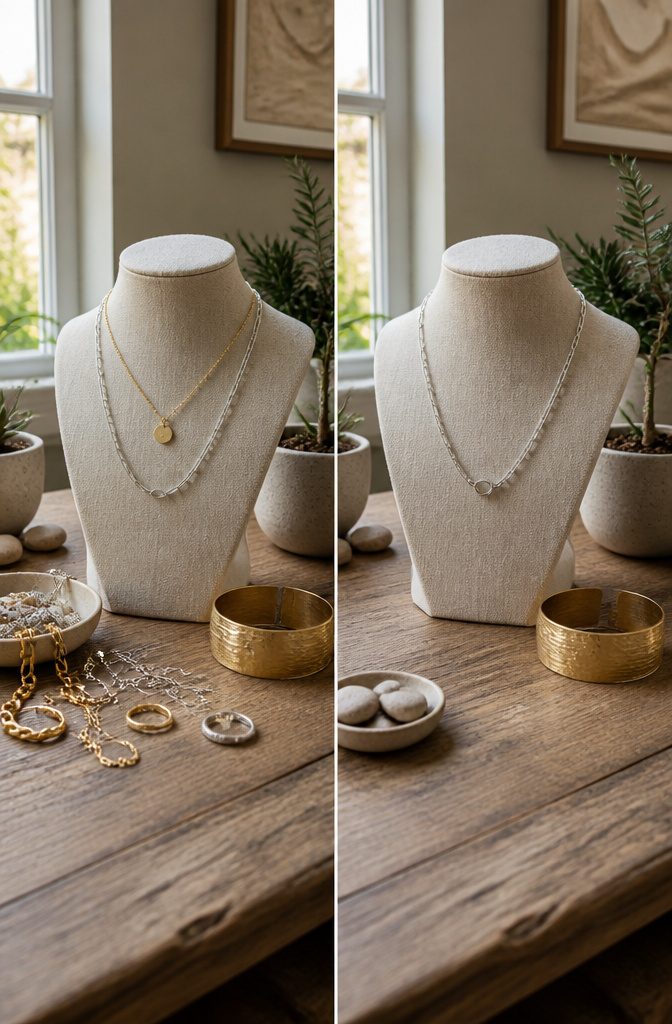
The 70/30 split is where I start every mixed-metal look. One metal leads at roughly 70 percent, the other fills in at 30, and that ratio keeps the combination from looking like you dressed in the dark.
Pick one metal to lead; silver or gold, the intention matters more than which you choose.
Your existing collection usually decides which metal dominates. Most of us already lean one way, so work with what you own rather than buying a whole second wardrobe of jewelry.
Skin tone matters too. Warm undertones tend to read better with gold in the lead, cool undertones with silver, though I have seen the reverse done deliberately for contrast and it can work if the proportion stays disciplined.
Outfit undertones follow the same pattern: a camel coat or cream sweater nudges the balance toward gold, while charcoal or crisp white pulls toward silver.
The 70/30 rule holds either way. What breaks the look is sliding closer to 50/50 without a bridge piece to carry it, which is a move for another section.
2. Layer Necklaces by Length
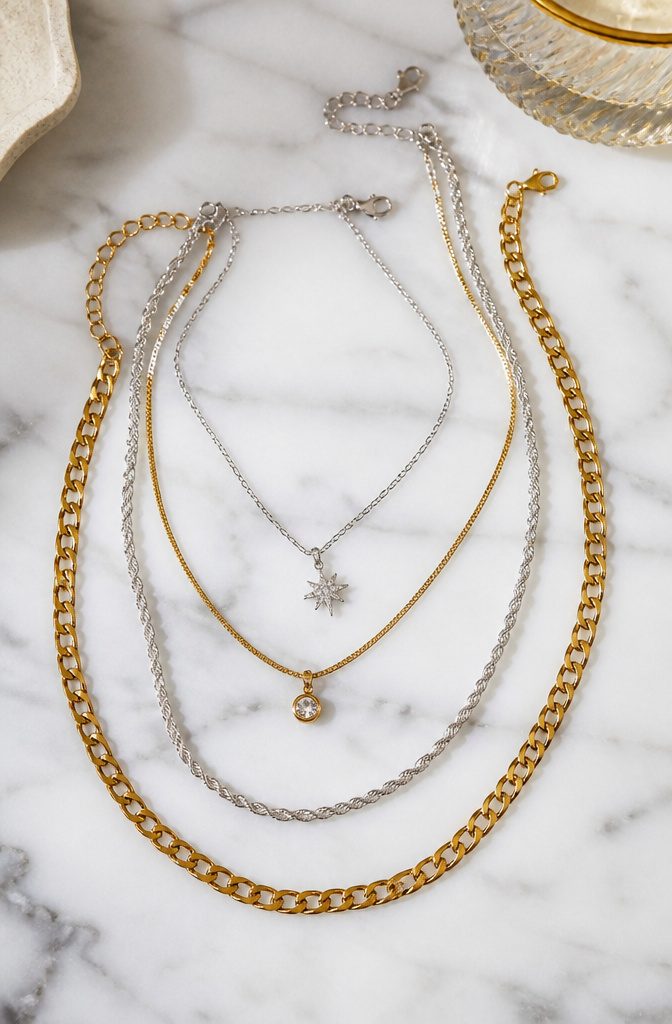
The spacing between chains matters more than the metals themselves.
A 16-inch silver chain sitting at the collarbone, an 18-inch gold piece at the hollow of the throat, and a 20-inch chain falling lower creates three clear visual stops. Each metal reads as deliberate because each occupies its own territory.
Two chains at the same length fight each other; staggered, they complement. The eye travels down instead of catching on a tangle of competing links.
Mixing chain styles helps this along. A fine silver cable chain against a slightly heavier gold rope chain, or a gold curb link with a silver snake chain, gives each layer a different texture to justify its place.
The contrast in metal becomes one of several deliberate choices rather than the whole story.
Start with a 16-inch base, add the 18-inch, and let the 20-inch finish the cascade.
If the shortest chain is gold, the middle can be silver, the longest gold again, or any rotation that suits what you already own. The rule is the spacing, not the sequence.
3. Incorporate Mixed-Metal Pieces
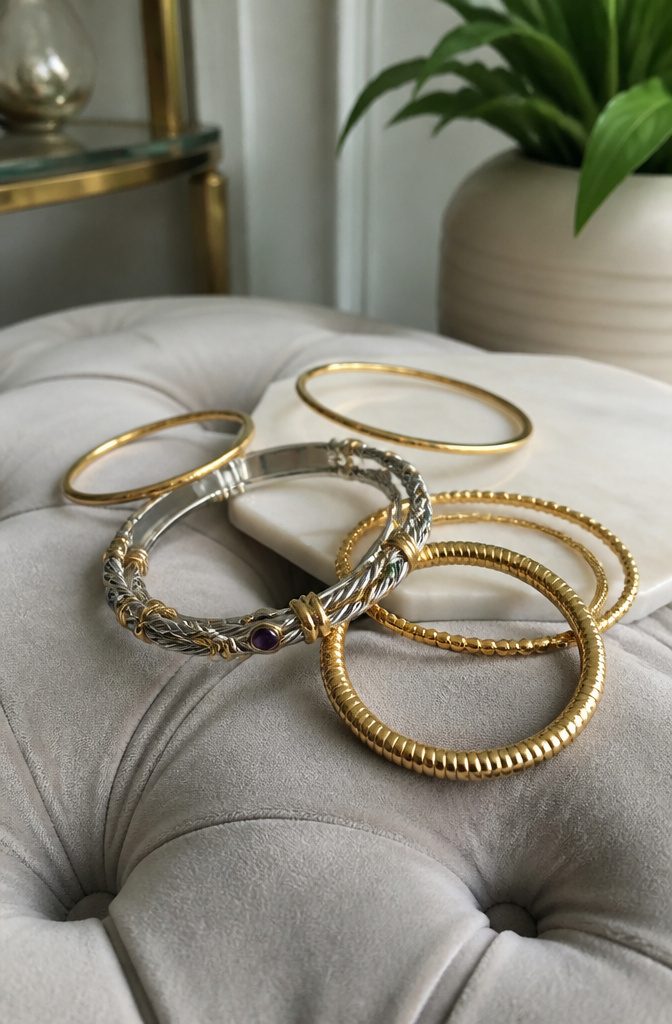
A two-tone bracelet or mixed-metal ring does the bridging for you, which is why I reach for them first when I’m unsure about a pairing.
The designer has already settled how the warm and cool tones interact, so the piece reads as intentional rather than accidental.
A pendant that sets silver against gold, or a ring with alternating bands, gives your eye a path to follow and makes the mix feel planned.
Placement matters if you want that connector role to hold.
I put the two-tone piece at the center of a stack: a bracelet with dual-metal links sits between a silver chain and a gold bangle, or a mixed ring anchors a finger that carries one plain metal on each side.
Keep the mixed piece central and let the single-tone pieces echo outward in a sequence that feels deliberate.
On the neck, a pendant combining both metals belongs at the shortest layer or at the center of a graduated trio, never drifting off to one edge where it looks like the odd piece out.
The same logic holds for earrings: mixed-metal hoops or drops should sit level with their surroundings, not hang below a stack of single-tone studs where they read as an afterthought.
You get cohesion without having to balance every element yourself. These pieces cost no more than their single-metal equivalents in most lines, and they save you the moment of second-guessing whether the stack works.
4. Balance Proportions Across Your Look
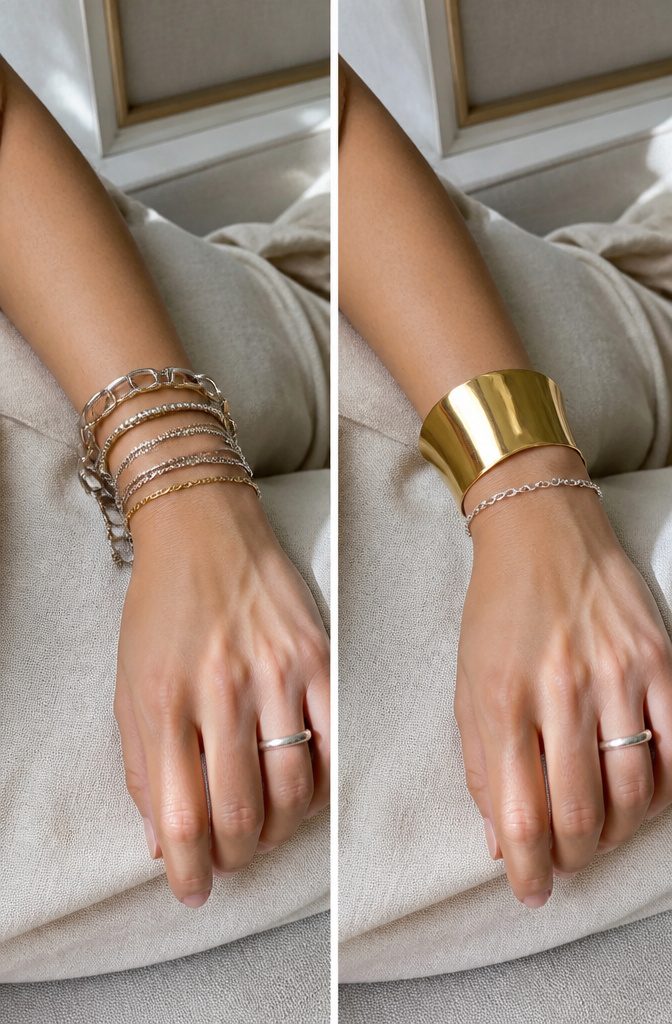
A heavy gold cuff against a slim silver chain gives the eye something to travel between.
The weight difference is what makes the pairing work, not in spite of it. I reach for this when I want the gold to own the moment and the silver to keep it from shouting.
Matching bulk for bulk is where most mixed-metal looks fall apart.
Two thick bands or two wide cuffs on the same wrist start competing for attention instead of talking to each other. The result looks deliberate in the wrong way, like you tried too hard to even the score.
The 70/30 split handles this better.
Let one metal lead and the other drop in as accent. That might mean a bold silver chain with a single gold pendant, or a gold ring stack with one thin silver band catching light at the edge.
This rule runs across your whole look, not per limb. A chunky gold necklace pairs naturally with minimal silver studs and a fine silver bracelet; the balance lives in the total picture.
I think of ears, neck, wrists, and hands as one shared canvas, not four separate contests. A delicate gold ring still reads against a broader silver band if the overall spread keeps one weight dominant.
5. Match Your Outfit to the Mix

A neutral outfit reads mixed metals as intentional rather than accidental.
Black, white, navy, beige, and gray step back and let the jewelry do the talking; busy prints or saturated colors compete for attention and win, which is rarely the plan.
That said, a warm-toned dress pulls gold forward, and a cool-toned suit lets silver take the lead. Adjusting your 70/30 split toward the metal that matches your clothing’s undertone keeps the whole look coherent.
Gold-heavy against camel or cream, silver-heavy against charcoal or slate. The mix still registers, but now it feels like part of the architecture of the outfit instead of a random grab from the tray.
6. Stacked Rings
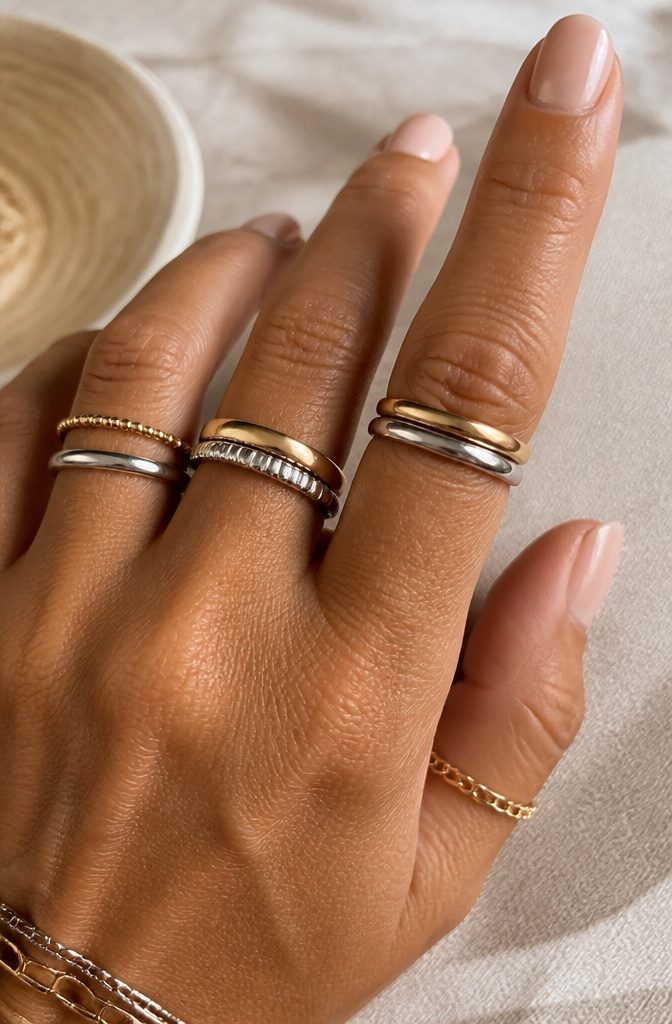
Stacking rings in both metals on one hand is the quickest way to make mixed metals look intentional. I start with a two-tone ring as the anchor, something that already holds silver and gold in a single band.
That piece does the work of tying the stack together so the eye reads the combination as planned rather than accidental.
From there, spacing matters more than the exact count of rings per metal. Alternating silver and gold across fingers usually looks more controlled than clustering one metal on two fingers and the other on the rest.
If I wear two thin bands on the same finger, one of each metal, I treat that finger as the center and echo both metals on neighboring fingers so nothing sits in isolation.
Random placement tends to read as leftover rings rather than a styled stack.
The even rhythm of alternating metals keeps one tone from swallowing the other, and the mixed-metal anchor gives the whole hand a single reference point to orbit around.
7. Layered Necklaces
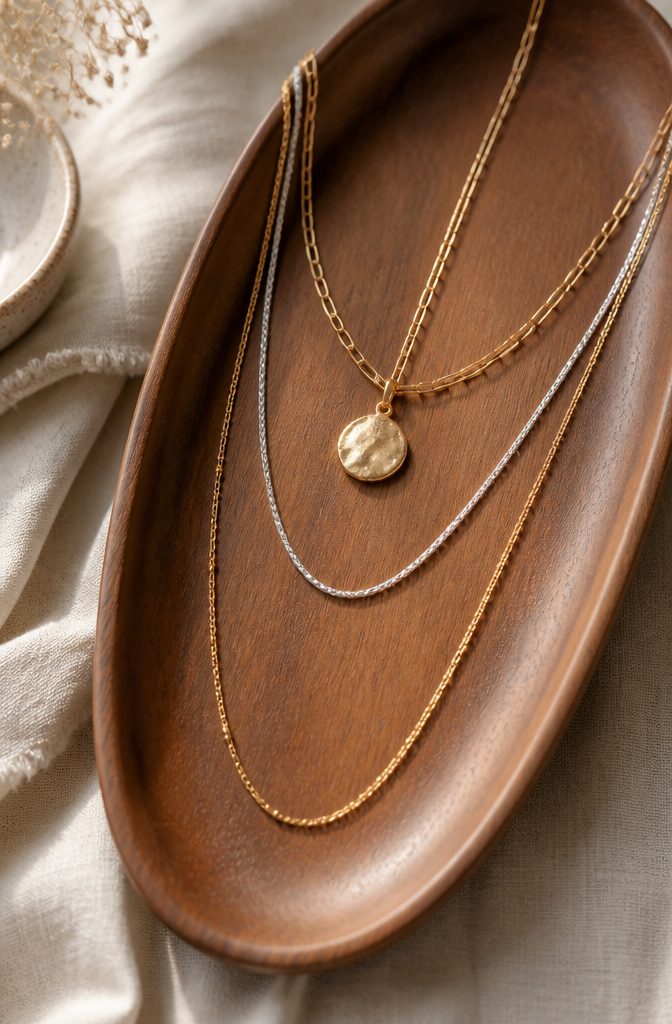
Layered necklaces are where mixed metals stop looking like an accident and start reading as intentional style. A short gold pendant paired with a longer silver locket gives you a clear hierarchy that keeps the eye moving without chaos.
Three distinct lengths work best when you alternate the metal at each drop: gold at the collarbone, silver at the sternum, gold again at the upper chest. Consider chain thickness, size, and design as you build.
A delicate silver chain with a chunky gold chain adds a contemporary twist. Repeating the same link style across both metals helps the eye process the combination as a single collection rather than random pieces thrown together.
Clasp placement matters more than most people bother with. Fasten each necklace so the clasp sits at the back center, then slide the attachments slightly apart from each other.
That offset alone cuts most of the tangling that ruins a stacked look. When chains still knot during wear, the fix is usually that the pieces share too similar a weight and dance together instead of hanging independently.
A lighter chain against a heavier one tends to stay separate as you move. Textured layered chains also help because their surfaces catch differently and do not slide past each other so easily.
8. Mixed-Metal Bracelets
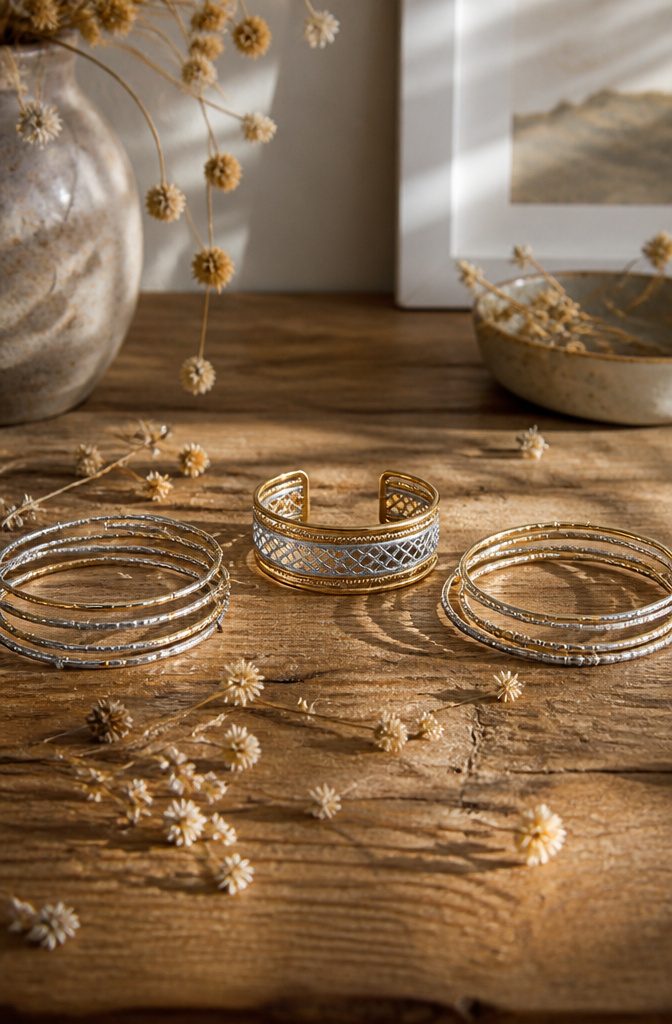
A two-tone bracelet does the bridging for you, so the rest of your wrist stack can stay single-metal without looking accidental.
I prefer a cuff for this: the rigid shape sits still while your arm moves, letting the silver and gold sections catch light at different angles as you gesture.
Chain styles work too, but they shift constantly, which can make the metal mix read busy before you’ve added anything else.
The wrist handles mixed metals better than neck or ear because it moves through space so actively.
A neckline stays relatively fixed; an earring swings but only on one axis. The wrist rotates, bends, passes through shadow and light dozens of times per hour, so the eye accepts metal variation there as natural shimmer rather than clash.
Stacking multiple two-tone pieces takes restraint. One mixed-metal cuff anchors the stack; add a slim silver chain or a gold bangle, alternating sides so neither metal clusters.
I stop at three pieces total, two of them single-metal. Any more and the wrist starts looking like a display case.
Keep the two-tone piece at center or slightly above the wrist bone, with single-metal accents above and below it, so the eye travels rather than sticking at one crowded point.
9. Statement Two-Tone Earrings
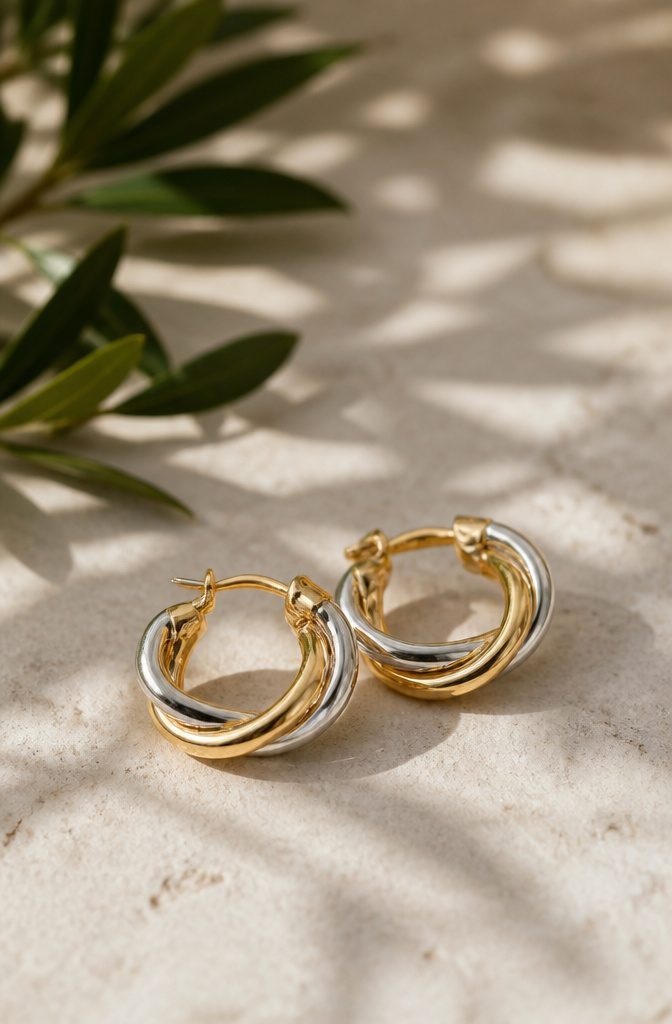
Earrings are the simplest place to start with mixed metals because they come in pairs and sit close enough to the face that the blend reads as intentional.
A single pair of two-tone studs, drops, or hoops does the balancing work for you, so you can skip coordinating necklaces or bracelets into the same equation.
Stud earrings that combine silver and gold in one design keep the look subtle.
Drop earrings let the metals move and catch light separately, which softens the transition between tones. Hoops split or wrapped in both metals give the curved shape visual weight without demanding matching pieces elsewhere.
The real advantage is restraint. Bold two-tone earrings frame the face and fill their own space, so the neck, wrists, and even the second ear piercing can stay quiet.
Sources suggest letting one metal dominate rather than splitting evenly, and a 70/30 mix inside a single earring pair follows that same principle automatically. The earring becomes the hero; everything else stays accent or absent.
My preference runs toward a substantial two-tone hoop in a medium diameter, roughly 25–30 mm, because it shows both metals clearly without dangling below the jawline.
Wear them with simple silver or gold studs in secondary piercings if you have them, or leave the ears alone and skip necklace layering entirely. The pair has already done the work.
10. Watches With Mixed-Metal Bands
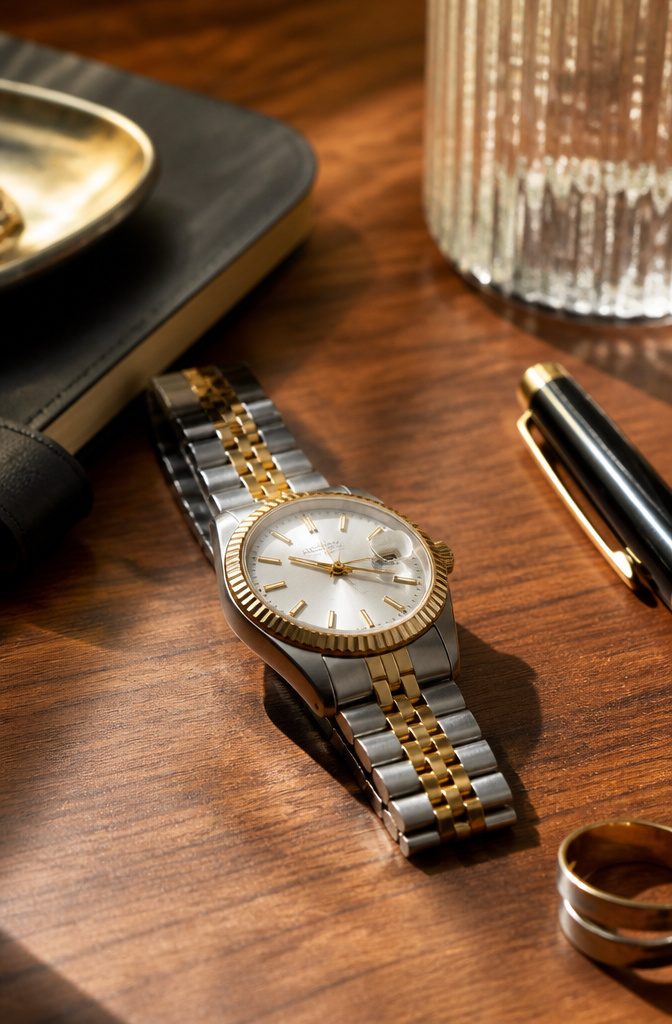
A two-tone watch band does the bridging for you, which matters because most people who wear a watch daily already have metal sitting on their wrist.
The band sets the ratio by showing exactly how much gold and silver the eye expects together, so the rest of your arm can follow its lead rather than fight it.
I like this approach because it removes the guesswork. You are not deciding whether to favor warm or cool; the craftsman fused that decision into the links.
The opposite wrist is where you echo rather than duplicate. Stack bracelets there in the same two metals, but shift the balance.
If your watch runs heavier on silver with gold accents, let the bracelets lean slightly more gold, or alternate the emphasis. This keeps the mix from looking copied and pasted.
A mixed-metal bracelet with gold links interspersed with silver ones works particularly well here, since it speaks the same visual language without mirroring the watch exactly. The result reads intentional, not accidental, and it holds together from a distance.
Warm Versus Cool Undertones
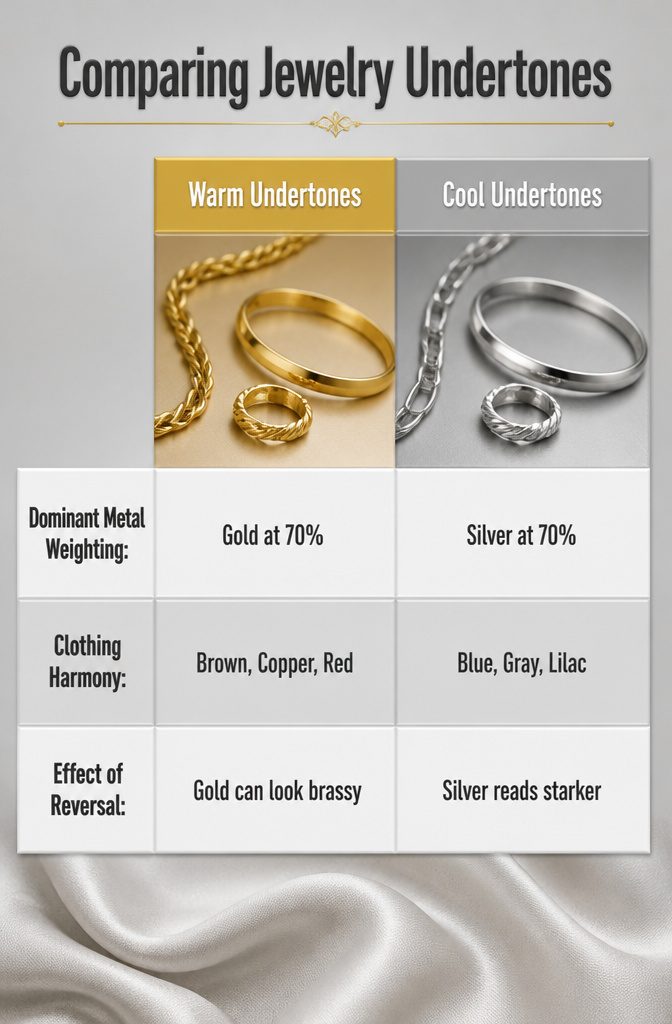
Gold reads warm against skin because its yellower alloys bounce light with an amber cast, while sterling silver and white gold throw back a bluer, sharper reflection.
That distinction matters more than most people realize when they are building a mixed-metal stack.
The standard check still works: look at the veins on your wrist in natural light.
Blue or purple usually signals a cool undertone, greenish points warm, and a mix of both means neutral. Most people lean one direction, not the other, though plenty of us guessed wrong for years because bathroom lighting lies.
Why bother finding out?
It lets you weight the 70/30 split intelligently rather than copy it from a tutorial. Cool undertones tend to read crisper when silver takes the dominant role; warm undertones settle into gold’s glow more naturally.
The point is not that mixed-metal styling only works for neutrals, it works on everybody. Calibration just makes the combination look like you chose it, not like you forgot to match.
| Factor | Warm Undertones | Cool Undertones | Neutral Undertones |
|---|---|---|---|
| Dominant metal weighting | Gold at 70%, silver accents | Silver at 70%, gold accents | Even 50/50 or seasonal shift |
| Clothing harmony | Brown, copper, bronze, red | Blue, gray, lilac | Either palette |
| Effect of reversal | Gold against cool skin can look brassy; still wearable but louder | Silver against warm skin reads starker; still wearable but more graphic | No penalty either direction |
I put silver heavier in my own rotation because it flatters my complexion, but I keep one gold chain at 30% to break the monochrome. The undertone test told me why that proportion feels settled rather than arbitrary.
Minimal Versus Statement Mixing
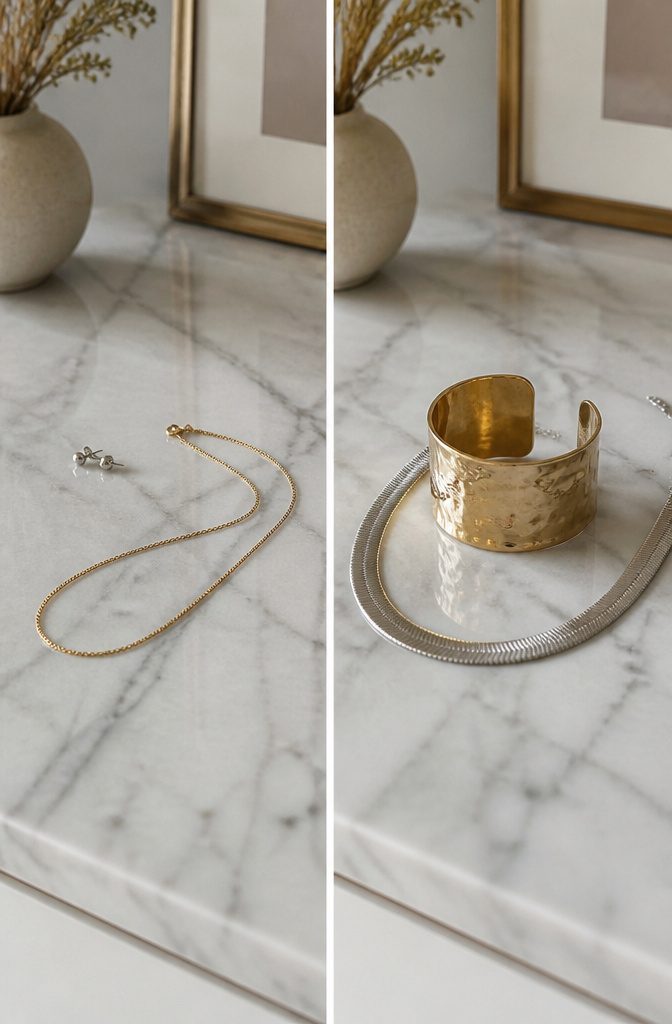
There are two ways to mix silver and gold, and they ask different things of you.
The minimal route keeps both metals small, thin, and scattered, a whispered accent rather than a declared choice. A silver stud and a gold chain so fine it disappears into a collar, that kind of pairing.
The balance is almost automatic because neither piece demands the eye, though the effect is modest too; easy to miss, easy to forget you are wearing two metals at all.
I treat this as my default for errands and quiet days when jewelry should sit there without becoming a conversation.
Statement mixing is the opposite gamble. A chunky gold cuff against a silver collar necklace, both visible from across a room.
The proportions here need to be deliberate, and this is where the dominant metal rule becomes nonnegotiable. One metal must lead, around a seventy-thirty split, or the eye bounces without rest and the look feels accidental rather than composed.
I find statement mixing suits evenings and occasions where jewelry is doing the work of a blouse, defining the silhouette.
The risk is higher because bold pieces already fight for attention; two bold metals without hierarchy read as costume, not style. Start dominant, then let the second metal appear once, precisely, like a single gold hoop against silver everything else.
Keeping Styles Coherent
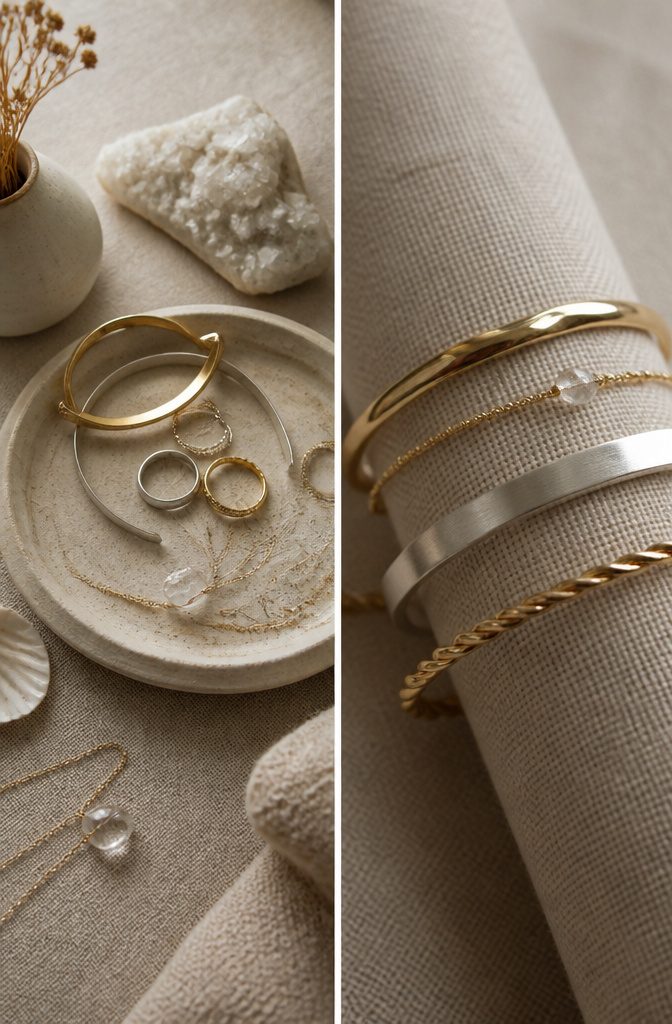
Mixing silver and gold only holds up when the pieces speak the same visual language.
A vintage hammered silver cuff and a polished modern gold bangle share nothing in finish, line, or era, so the eye reads them as two separate outfits fighting for attention.
The through-line might be shape, such as repeating circular motifs across both metals, or finish, like pairing brushed silver with a brushed gold band that carries the same matte quality.
Ring stacking works on this principle: a sterling silver band set beside a minimal gold ring reads intentional when both stay thin and clean-lined, while a textured statement ring in either metal would demand the other pieces match its weight.
Deliberate contrast is its own system, but it needs more skill. A smooth, polished surface against a hammered finish can work, yet only when the contrast itself becomes the unifying idea rather than an accident.
The person wearing it has to carry that intention. Most mornings, consistency in era or texture wins faster and lasts longer through a full day.
Frequently Asked Questions
Can you wear silver and gold jewelry together?
Yes.
Combining the two metals reads as intentional and fashion-forward when you use balance and proportion rather than random placement. A simple sterling silver chain with a delicate gold necklace lifts even a basic outfit.
How do you mix silver and gold jewelry?
Start with a 70/30 split so one metal leads and the other accents. Layer necklaces at staggered lengths, use mixed-metal pieces as bridges between single-tone items, and keep textures or eras consistent so the pieces look like they belong together.
What is the best way to layer silver and gold jewelry?
Space chains at different lengths, 16, 18, and 20 inches, so each metal occupies its own territory. Alternate metals at each drop and vary chain styles so the contrast in metal becomes one of several deliberate choices rather than the only story.
Is it okay to mix and match silver and gold jewelry?
Yes.
The old rule against mixing metals has faded, and intentional pairing now signals style rather than accident. Focus on proportion, a dominant metal, and cohesive design language so the combination looks planned.
What is the 80/50 rule for gold to silver?
The proportion it recommends is 70/30, one metal dominant, the other at roughly 30 percent, to keep the combination disciplined and avoid a scattered 50/50 split without a bridge piece.
What is the 2:1:1 rule in jewelry?
Its guiding proportion for mixed metals is 70/30, with one metal leading and the other supporting, applied across your whole look rather than per limb.
Can you wear gold rings with a silver watch?
Yes.
A two-tone watch band does the bridging work for you, setting the ratio the eye expects. Let the rest of your arm follow its lead, echoing both metals on the opposite wrist without duplicating the exact balance.