Mexican gold jewelry is gold worked in traditions that blend Spanish colonial metalwork with indigenous craft, and the distinction that matters most is karat law: Mexico stamps 8k as legal gold, below the 10k floor enforced in the United States.
That darker, copper-heavy alloy you see in sidewalk stalls from Mexico City to Oaxaca cannot be resold as fine jewelry once you cross the border.
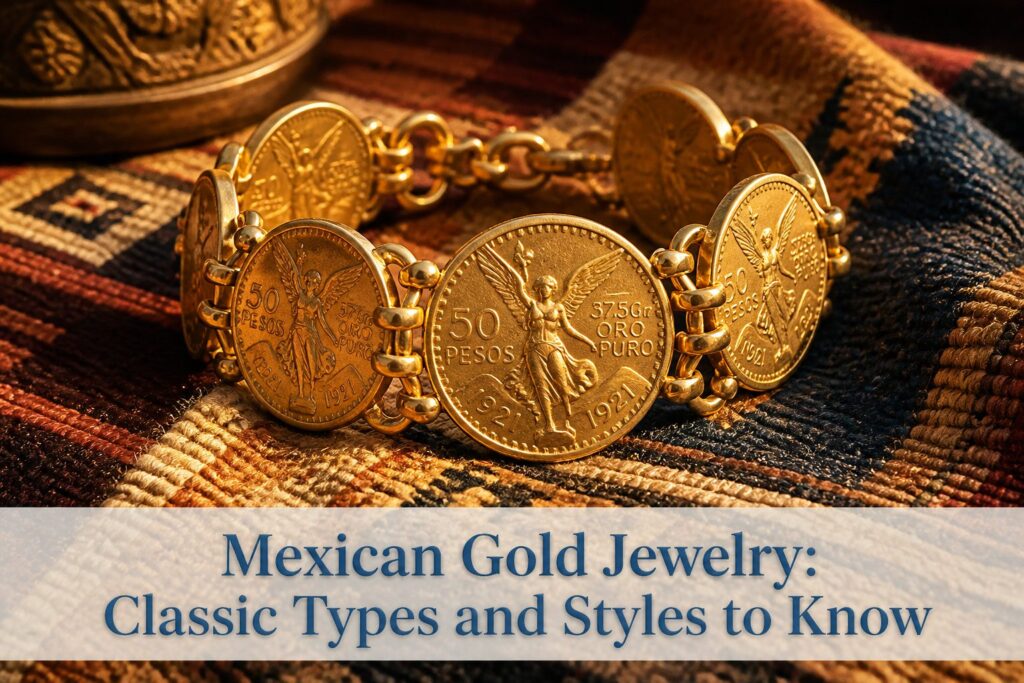
The 50 peso coin bracelet, struck in 90% pure gold at the Mexico City Mint in 1921, carries 1.2057 troy ounces and functions as ornament near bullion; the 20 peso version wears lighter for daily use.
1. Religious Pendants and Crosses
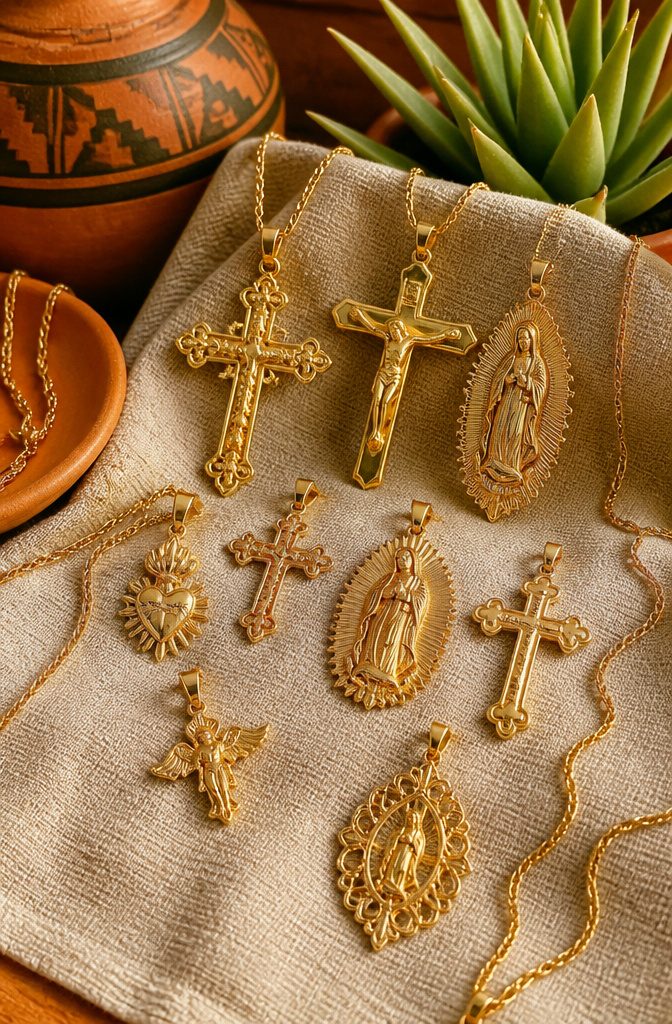
Gold pendants and crosses shaped by Mexican Catholic tradition range from plain crucifixes to milagro-inspired forms, and the Spanish colonial layer runs through all of them.
I look for pieces where the indigenous craft shows in the hand-finished surface or the slightly irregular proportions, not as a flaw but as the mark of the two traditions merging.
The colonial influence brought European devotional imagery; local makers kept their own sense of weight and silhouette. That combination is what still reads as distinctly Mexican rather than generic religious jewelry.
Daily wear pieces tend toward smaller crosses, maybe 1 to 1.5 inches, in 10k or 14k yellow gold that holds up to constant contact with skin and clothing.
Feast-day pendants go larger and often carry more elaborate milagro shapes, hearts or limbs rendered in gold as votive offerings.
The same workshops that produce these often sell them in Mexican shops and through online channels, so the distinction between buying in Mexico and buying elsewhere matters less than whether the piece carries the hand-worked detail or was cast smooth and anonymous.
2. Rope Chains
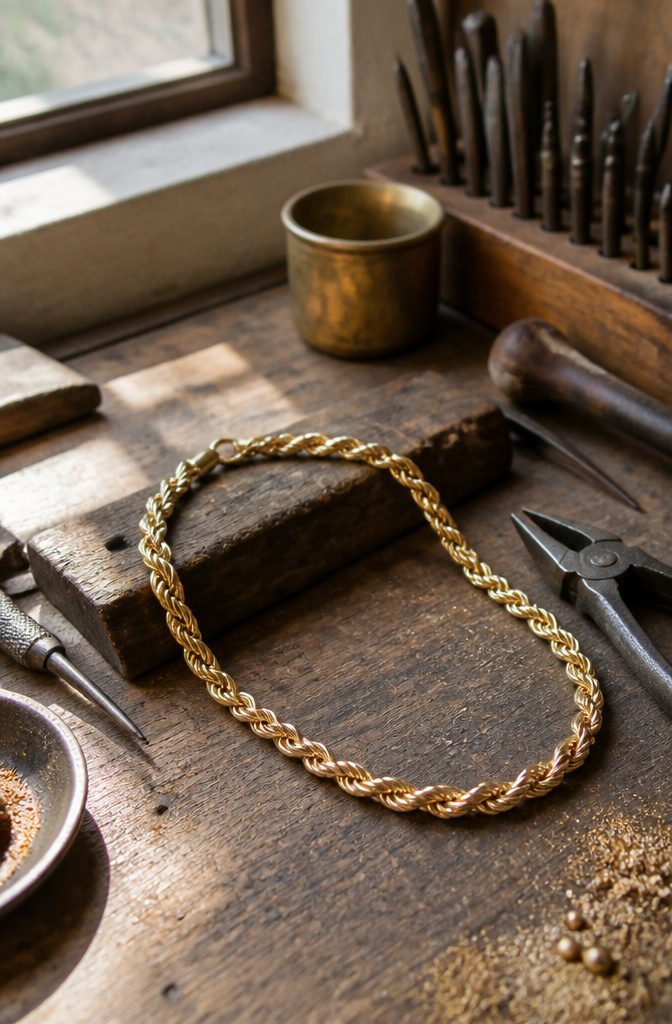
The twisted-link construction of a rope chain is what gives the style its name and its heft.
Each link is a short, curved wire segment twisted into a spiral, then interlocked with the next so the finished chain resembles a length of actual rope.
That geometry catches light from every angle, which is why the style reads as heavier and more substantial than a simple cable chain of the same width.
In Mexican markets, 10k and 14k dominate this style, and for practical reasons. The lower gold content, 41.7% in 10k and 58.3% in 14k, hardens the alloy enough that the fine twisted links hold their shape under daily wear.
An 18k rope chain exists but bends and kinks more easily; an 8k piece, which Mexican standards do allow, can carry a stamp yet contains only 33.3% gold and tends to look pale beside its higher-karat cousins.
Widths run from about 2 mm, fine enough to layer, up to 6 mm or more for a single statement piece.
The weight scales fast with width, so a 4 mm rope chain in 14k sits noticeably on the collarbone where a 2 mm version barely registers.
For everyday wear, I would take 14k at 3–4 mm: the color reads as gold without the fragility of 18k or the diluted tone of 8k.
3. Link Bracelets
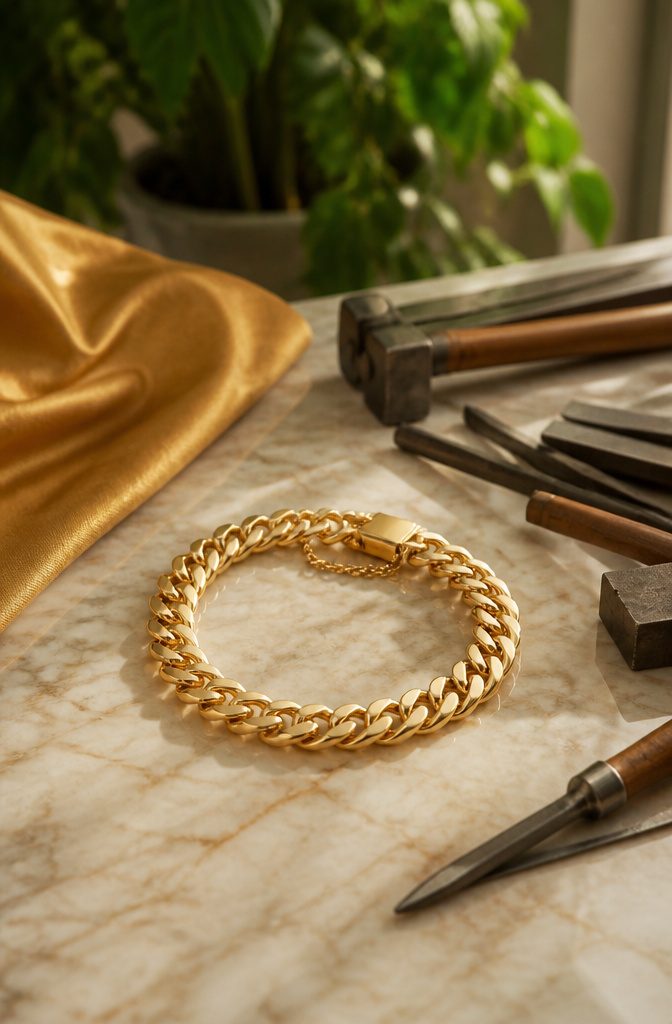
Curb links sit flat and interlock in a uniform grid, catching light along every edge so the bracelet reads as a solid band of gold until you look closer.
Figaro breaks that rhythm with one elongated link after every three shorts, a pattern Italian immigrants brought to Mexico in the late 1800s that Mexican goldsmiths now claim as their own.
I prefer the hand-finished link to anything cast in a mold; you can tell by the slight irregularity along the inner curve where a file or burnisher touched every surface, and by the way the piece drapes rather than kinks when you roll it in your palm.
The clasp is where most link bracelets fail. A lobster claw in thin stamped sheet metal will loosen its spring inside a year.
What I check for is a cast clasp with a rounded trigger that snaps shut with audible resistance, soldered directly to the end link rather than looped through a jump ring that can torque open.
On heavier pieces, a box clasp with a figure-eight safety catch costs more but stays secure through daily wear.
If the bracelet slides around your wrist and the clasp keeps drifting to the top, the links are probably hollow; solid links carry enough weight to sit where you put them.
4. ID Bracelets
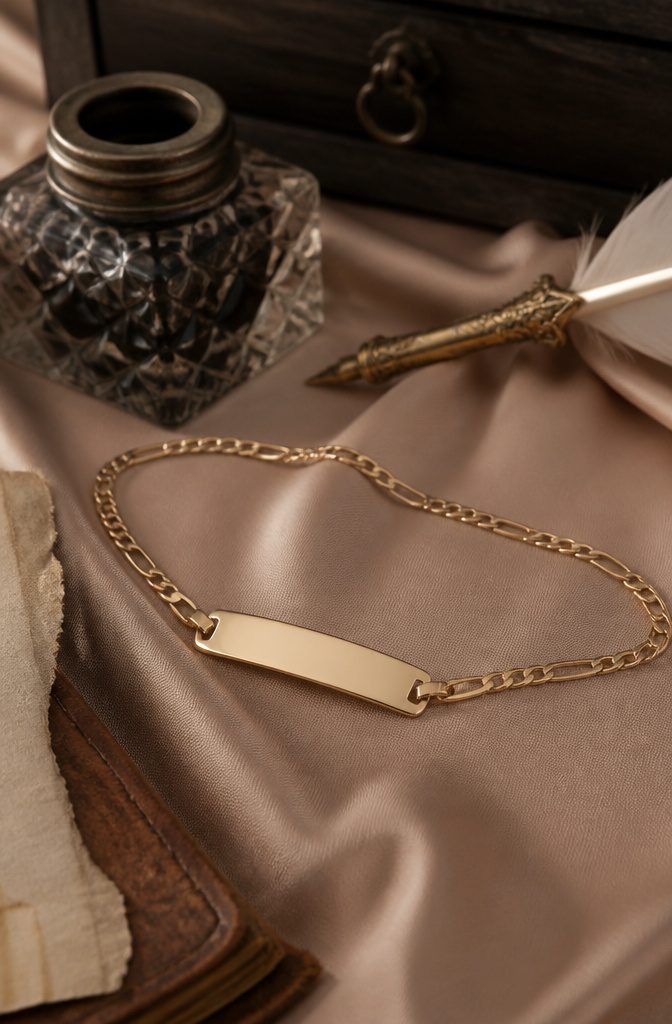
The engraved plate sits at the center of these bracelets, usually rectangular and slim enough to tuck under a cuff but long enough for a name or short phrase.
14k yellow gold strikes the right balance here: it holds up to the friction of desk work and keyboard use without the price jump you see at 18k.
Most wearers I picture for this piece want it on daily, so that durability matters more than the deeper color higher karats offer.
Chain styles tend toward curb or Figaro links, both lying flat and keeping the plate from flipping.
A lighter chain saves cost but risks kinking; I would rather see a medium weight that matches the plate heft so the whole piece reads as one unit rather than hardware store parts.
The plate itself works as a display piece when the engraving carries weight: family names, coordinates, a date in numerals. Left blank, it looks unfinished, so factor the engraving cost into the total.
For sizing, these bracelets run with a bit of slack, maybe half an inch past a snug wrist measurement, since the plate needs room to settle on top rather than dig at the sides.
5. Gold Coin Bracelets
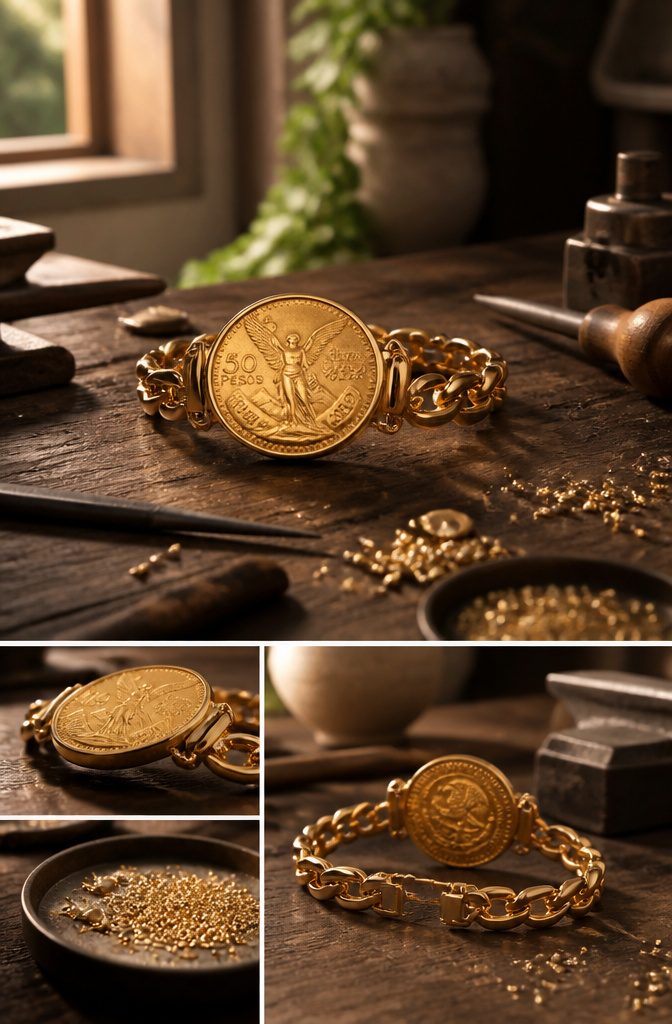
A 50 peso Mexican gold coin bracelet carries 1.2057 troy ounces of 90% pure gold, which works out to 21.6 karats and 37.5 grams.
The smaller 20 peso piece holds the same purity at 0.4823 troy ounces. Both were first struck at the Mexico City Mint in 1921 to mark Mexico’s independence, and that origin matters to collectors.
Coin jewelry differs from struck pendants in what it preserves. A bezel-set coin keeps the original relief, date, and mint mark intact; the piece functions as both ornament and something close to bullion.
Struck pendants, by contrast, melt the metal down and lose that history entirely. For everyday wear, the 20 peso makes more sense; the 50 peso wears heavy on most wrists and the bracelet construction needs to be substantial enough to support it.
Either way, check that the bezel does not obscure the coin’s edge; a clean rim helps verify authenticity if you ever want to sell or trade.
6. Aztec-Inspired Gem Pieces
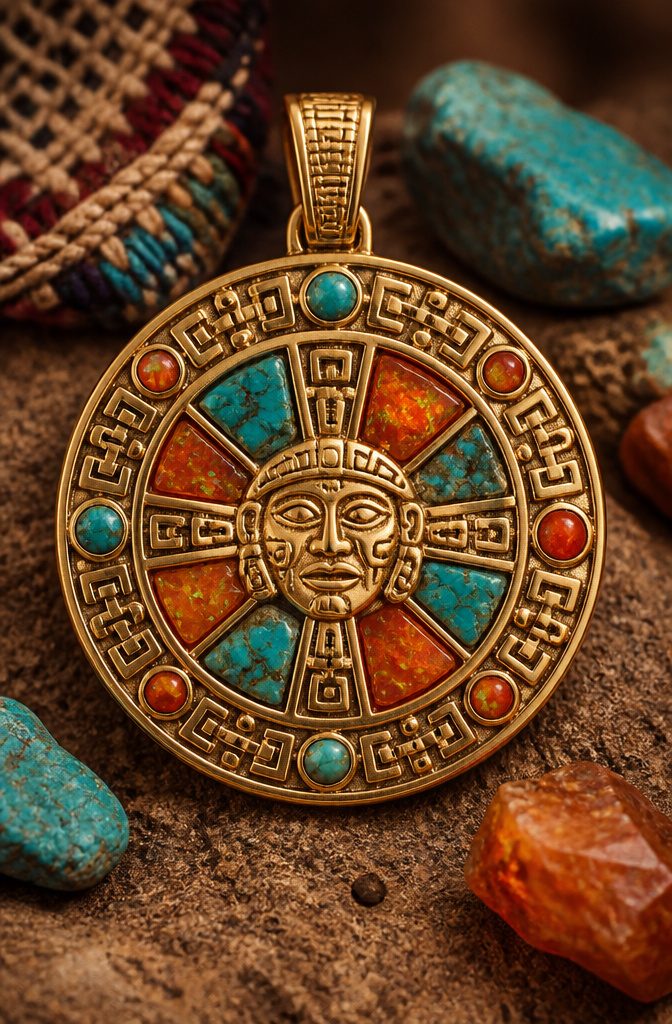
Pre-Columbian iconography gives Mexican gold jewelry some of its most recognizable weight.
Sun stones, feathered serpents, and jaguar profiles turn up constantly, but the pieces that hold my attention set those motifs with turquoise, malachite, or fire opal rather than engraving them plain. The stone does the storytelling; the gold frames it.
Modern artisans walk a narrow line here. A museum replica feels costume-y, and most skilled makers know it.
What I look for instead is abstraction: a sun stone rendered as radiating gold rays with a single fire opal at the center, or a feathered serpent suggested by graduated turquoise tablets rather than scaled out literally.
The jaguar especially benefits from this restraint. A full cat prowling across a pendant reads as tourist-grade; a jaguar’s eye in malachite, flanked by two gold fangs, reads as design.
The turquoise itself varies enough to matter. Sleeping Beauty mine material, pale and even, sets differently than darker Mexican or Chinese rough.
Fire opal carries more risk: too much red and the piece shouts, too little and the motif goes flat. I tend toward stones with orange body color and scattered green flash; they catch light without stealing focus from the goldwork.
For everyday wear, these pieces run heavier than religious pendants or rope chains.
A 2-inch sun disk on a 16-inch chain sits at the collarbone and catches on nothing; the same motif at 3 inches with dangling opal drops turns into occasion jewelry.
Size the chain up 2 inches if the pendant has any projection at all.
7. Mayan-Inspired Designs
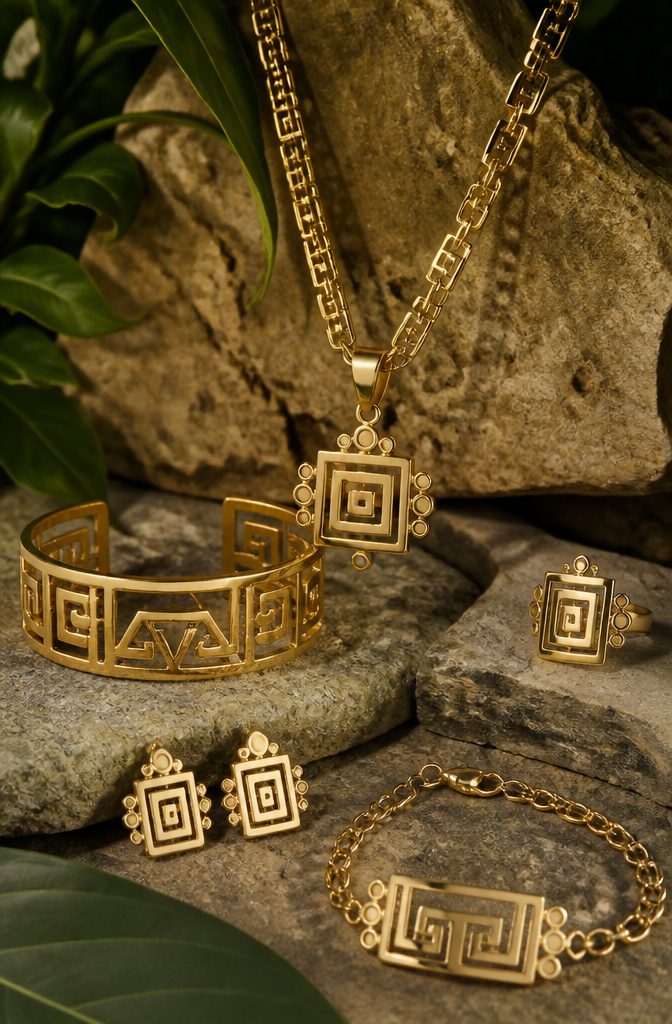
Geometric precision separates Mayan-inspired gold work from the heavier, more militaristic Aztec revival pieces you will see elsewhere in the market.
Stepped fret patterns, the xicalcoliuhqui motif, repeat in tight sequences across pendants and cuff bracelets, each angle cut to suggest the terraced limestone of Yucatan architecture.
The long count glyphs, the bar-and-dot numerals recording calendar cycles, mark the pieces that come from workshops with actual lineage in the tradition, not the tourist-grade casts that borrow vaguely "tribal" geometry.
Regional difference matters here. Yucatan smiths, particularly around Merida, tend to keep the fretwork shallower and more linear, suited to the flat planes of modernist jewelry that sells to collectors in Mexico City.
Chiapas workshops, especially those tied to San Cristobal, work the same symbols with deeper relief and heavier gold weight, closer to pre-Columbian forms.
I prefer the Yucatan pieces for everyday wear; the lower profile does not snag on knits, and the craftsmanship is no less rigorous. The Chiapas work reads more ceremonial, better for a single statement piece than for layering.
Either way, ask whether the glyphs are copied from documented stelae or just invented pattern. A workshop that names its source monument usually cares more about the metal too.
8. Spanish-Influenced Religious Jewelry
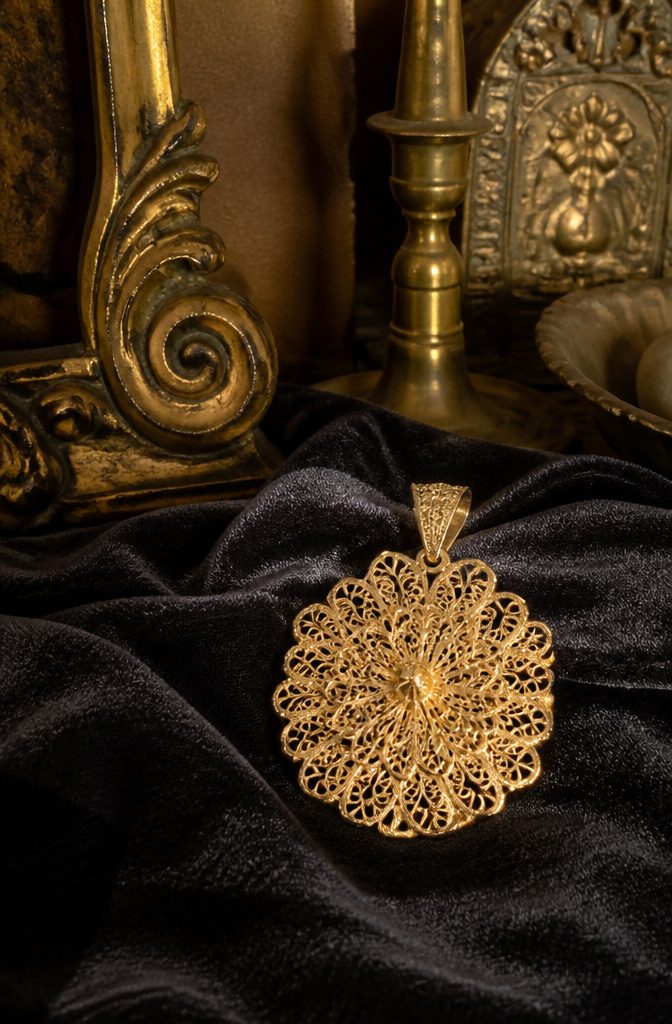
Colonial Spanish metalwork still runs through much of the Mexican gold jewelry you’ll find in markets from Taxco to San Miguel de Allende. The techniques themselves tell the story.
Filigree work, built from twisted threads of gold soldered into lace-like patterns, arrived with Spanish craftsmen in the 16th century and never left. Repoussé, where the metal is hammered from the reverse to raise a design, carries the same lineage.
What distinguishes these pieces from indigenous-religious fusion work is the subject matter and the hand behind it: Spanish-influenced work centers on Catholic iconography rendered through European methods, not the blended symbols you see when native traditions absorb Christian figures.
The saints and virgins depicted follow specific regional devotions. Our Lady of Guadalupe appears in both traditions, but in colonial Spanish-style filigree she is rendered with the aureole of European Baroque convention, not the indigenous codex style.
St. Jude, St. Francis, and the Virgin of San Juan de los Lagos turn up repeatedly in vintage pieces, their identities readable by their attributes: the flame above St. Jude’s head, the stigmata on St. Francis’s hands.
When I handle these pieces, the weight of the gold tells me something about period.
Earlier colonial work tends toward heavier gauge filigree, while 20th-century reproductions often lighten the construction to cut cost. For everyday wear, this matters.
A solid filigree pendant from the 1940s wears differently than a contemporary piece with the same face dimensions but half the gold weight. The older work holds up to daily use; the newer piece wants occasional wear and careful storage.
What 8k to 18k Actually Means Here
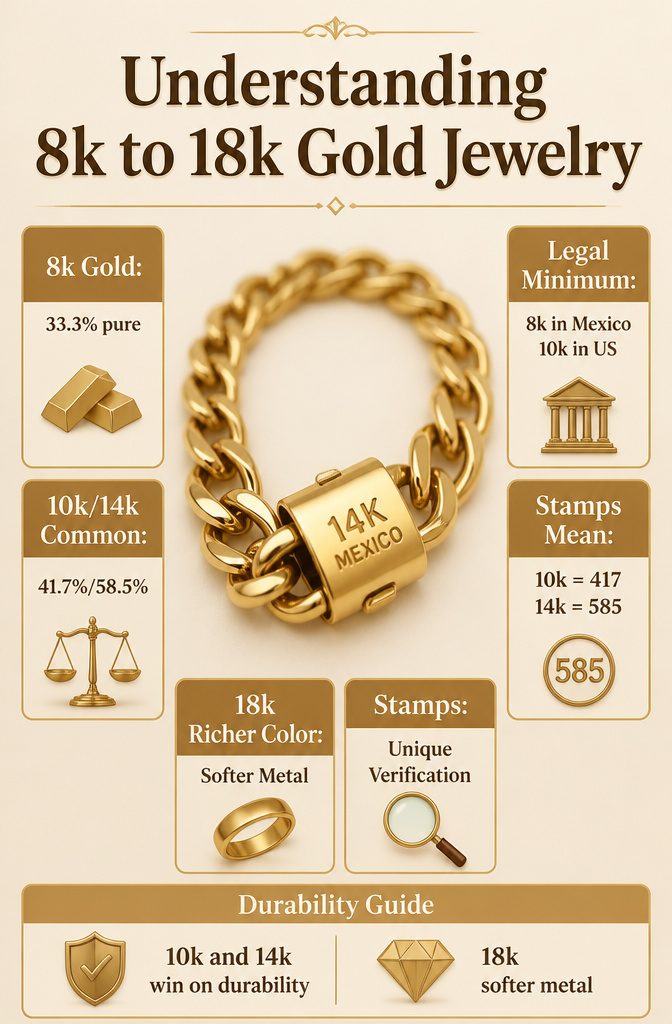
In Mexico, 8k gold is the legal floor for jewelry stamped as gold, which sits below the United States minimum of 10k.
That 8k stamp means roughly 33.3% pure gold against 66.7% alloy metals like copper, silver, or zinc. The math is straightforward: divide the karat by 24 to get the percentage.
Most Mexican gold jewelry you will actually encounter runs 10k or 14k, with 18k marking the top of what is typically available.
A 10k piece usually carries a "417" stamp, while 14k gets "585" — those numbers correspond to the 41.7% and 58.5% gold content respectively.
For buyers, the stamp is your first line of verification, but it is not the last. I would check that the marking is crisp and properly placed, then weigh the piece against the karat claim.
The lower Mexican minimum means a 10k bracelet from a border shop and a 10k bracelet from a US chain contain identical gold percentages; the difference is only in what each country allows sellers to call gold in the first place.
If you are shopping for everyday wear, 10k and 14k win on durability. If you want richer color and do not mind softer metal, 18k is the better choice, though you will pay more and scratch it faster.
Where Mexican Gold Is Mined
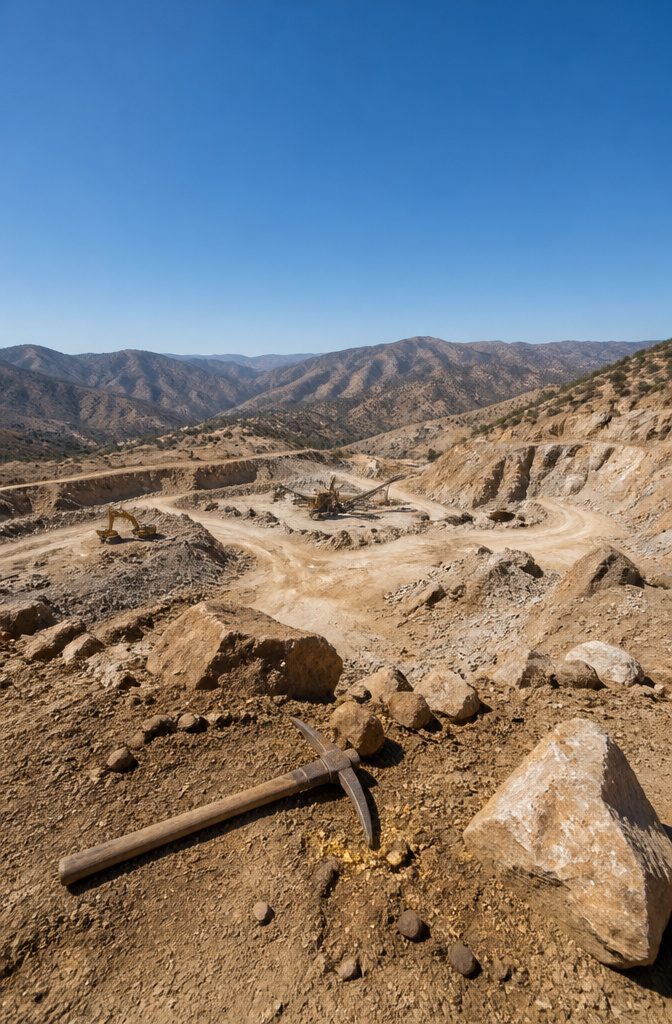
Six Mexican states mine every ounce of the country’s gold: Sonora leads with more than 30% of national output, followed by Zacatecas, Chihuahua, Guerrero, Durango, and San Luis Potosí.
The world’s 11th-largest producer does not lack for raw material, and its most productive mine, Peñasquito, pulls low-grade hard ore from the ground alongside operations like Fresnillo, La Herradura, and Los Filos.
For the jewelry buyer, this geography matters far less than you would think. Raw gold enters global supply chains before it ever becomes a chain or pendant.
What reaches a workshop in Taxco or Guadalajara may have circulated through refiners in several countries first. A piece stamped "Hecho en México" carries the story of its maker and design tradition, not the bedrock of a particular mine.
Sonora ore and Canadian-registered corporate control mean little to the physical ring on your finger; the 14k stamp and the smith’s handwork tell you what you are actually wearing.
Buying in Mexico Versus Buying Online
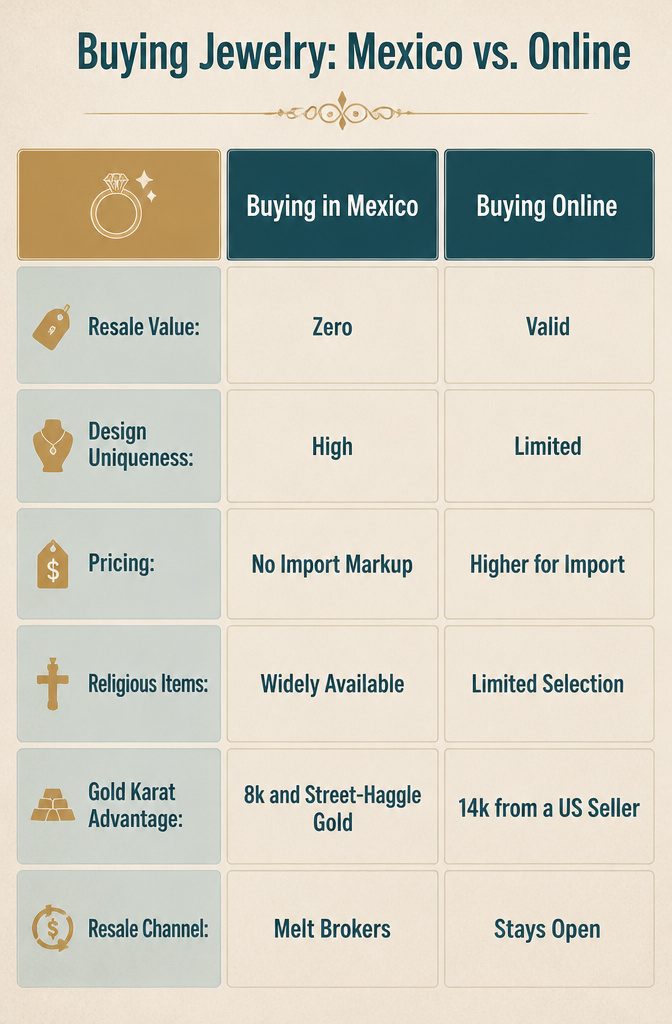
Taxco silver gets the guidebook love, but 8k gold bought in a Mexico City sidewalk stall cannot be resold as fine jewelry once you cross the border.
US law stamps 10k as the floor for that label, so those pieces land with melt brokers if you try to liquidate them later.
The same 8k bracelet, bought from a US online seller, already carries that disclosure upfront; the metal does not change, only what you can call it.
Local boutiques in Guadalajara and Oaxaca carry indie designers whose work never reaches American e-commerce. Religious pendants, crucifixes, and street-haggle gold sit in those shops at prices that reflect no import markup.
I would buy there for the design, not the investment. 14k from a US seller wins if you want value that holds; the alloy costs more per gram, but the resale channel stays open.
Handcraft Versus Cast Production
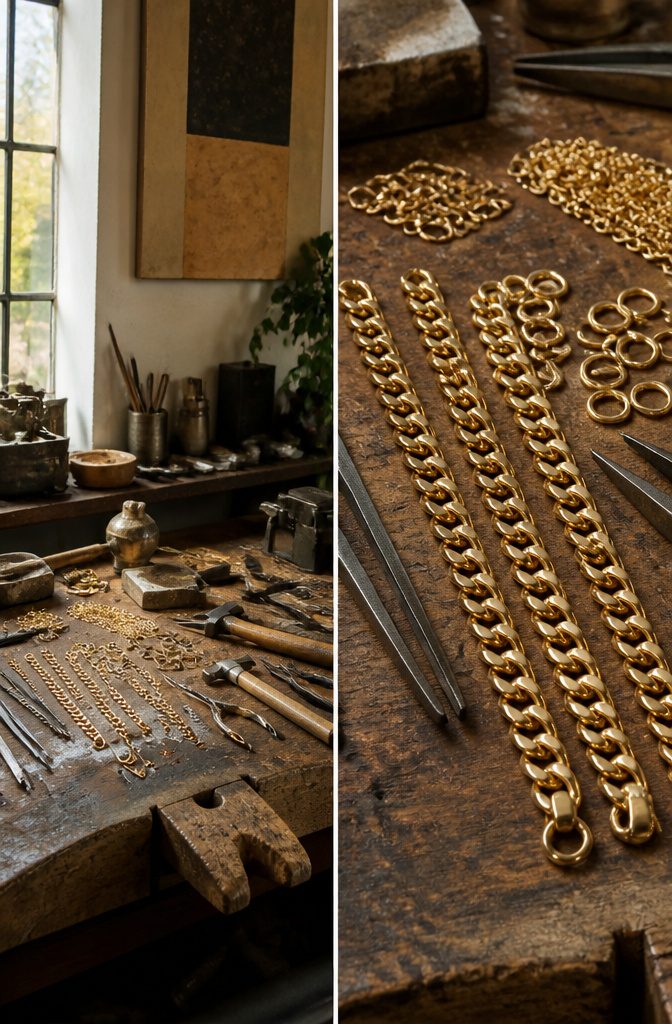
Traditional Mexican gold jewelry still carries the marks of work done by hand, and those marks are what I look for first.
Slight variation in link size on a chain, tiny tool marks inside a bezel setting, or a link closure that is not perfectly uniform all signal generations of technique passed down rather than a mold poured in volume.
Hand finishing takes longer and costs more, but it also means the piece was adjusted individually for fit and weight, which shows in how it hangs and wears.
Cast production has taken over for the bulk of chain and bracelet volume, especially in 10k and 14k rope and link styles that ship in quantity.
Casting gives you consistent weight and lower labor cost, and for everyday wear that is not a bad trade.
The durability difference is real though: hand-wrought links work-harden as they are shaped, so they resist kinking better than cast links of the same gauge.
If I am choosing a piece to wear daily, I will pay the premium for handwork.
For occasional wear or stacking, cast gets the job done at roughly half the labor cost, and the hallmark alone will not tell you which method was used.
You have to look inside the links and settings with a loupe to know what you are holding.
Spotting Authentic Mexican Work
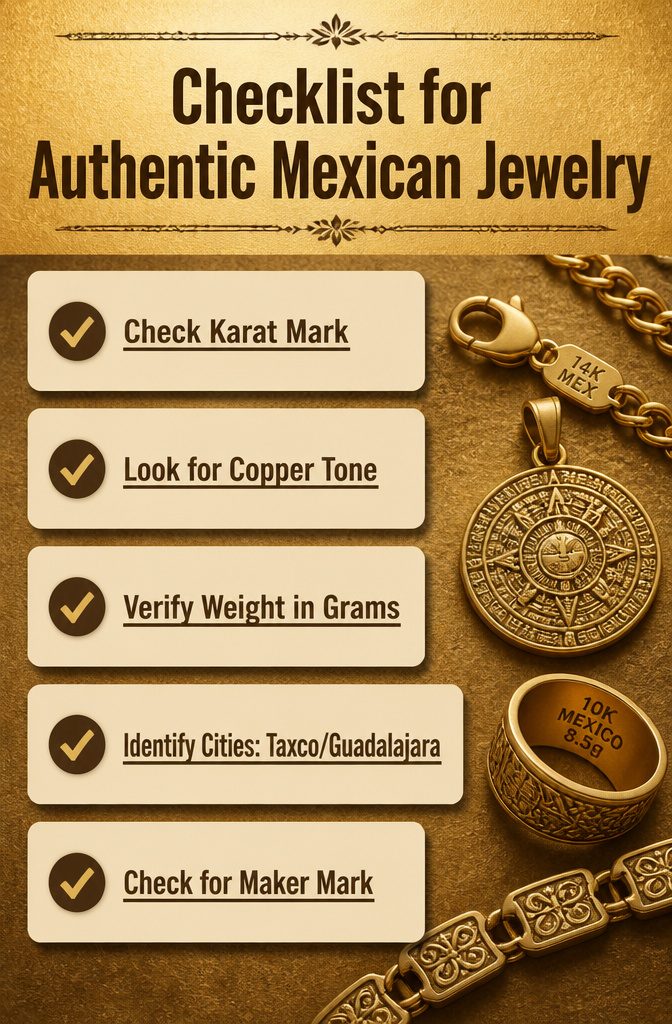
Mexican gold jewelry carries stamps that read differently from what most US shoppers expect.
The karat mark sits on the clasp or the back of a pendant, showing 10k, 14k, or occasionally 8k, but the color gives away the origin before you ever reach for a loupe.
8k Mexican pieces run darker, almost brown, because the alloy leans heavier on copper rather than the silver or palladium mix common in Italian or American 14k. That warmth is not a flaw; it is the tell.
Weight is marked in grams, not pennyweights, and the heft in your palm should match the stamp. A maker mark from Taxco or Guadalajara narrows the field further, though the absence of one does not rule authenticity out.
The real check is whether the color and the stamp agree: 14k that looks too yellow for its weight, or 8k that does not carry that copper dusk, and something in the chain of custody is off.
I would rather buy a darker 10k piece with a clear gram weight and a city mark than a bright 14k with none, because the alloy recipe is harder to fake than the stamp itself.
Frequently Asked Questions
What part of Mexico does Mexican gold come from?
Six Mexican states produce all of the country’s gold: Sonora leads with over 30% of national output, followed by Zacatecas, Chihuahua, Guerrero, Durango, and San Luis Potosi.
The Peñasquito mine is the most productive. Raw gold enters global supply chains before reaching workshops, so a piece’s origin as jewelry matters more than which state pulled the ore from the ground.
How can I tell if it’s Mexican gold or not?
Check the karat stamp on the clasp or pendant back, but color is the faster tell. Mexican 8k pieces run darker and browner because the alloy uses more copper than Italian or American 14k, which favors silver or palladium.
Weight marked in grams should match the heft in your palm, and a city mark from Taxco or Guadalajara helps confirm origin.
Can you buy Mexican gold jewelry?
Yes, both online and in Mexico itself. In Mexico City, Guadalajara, and Oaxaca you will find indie designers and street sellers with pieces that never reach US e-commerce, often at prices without import markup.
For resale value that holds, 14k from a US seller wins because 8k bought in Mexico cannot be resold as fine jewelry once you cross the border.
Does Mexico have good jewelry?
Mexican gold jewelry ranks high in quality when it comes from workshops where techniques pass through generations. The hand-finished pieces show slight variation in link size and tiny tool marks inside bezels, signs of individual attention rather than volume casting.
Religious pendants, rope chains, and Aztec- and Mayan-inspired designs all carry this craft tradition when sourced from makers with actual lineage.
What is the 2:1:1 rule in jewelry?
The piece focuses on karat percentages, link construction, and regional design traditions rather than general styling formulas.
Where can I buy Mexican jewelry online?
US-based sellers carry Mexican gold jewelry with proper karat disclosure upfront, including 10k and 14k pieces that meet American legal standards for resale.
Factory-direct operations ship eagle pendants, rope chains, and link bracelets with certificates of authenticity. For designs unavailable stateside, boutiques in Guadalajara and Oaxaca sell directly to visitors.
What are Mexican gold bracelets called?
Common styles include rope chains with twisted spiral links, curb link bracelets with flat interlocking grids, Figaro bracelets with their one-long-three-short link pattern, ID bracelets with engraved center plates, and coin bracelets bezel-set with 20 or 50 peso Mexican gold coins.
Link bracelets in particular distinguish themselves by hand-finished inner curves and substantial cast clasps rather than thin stamped hardware.