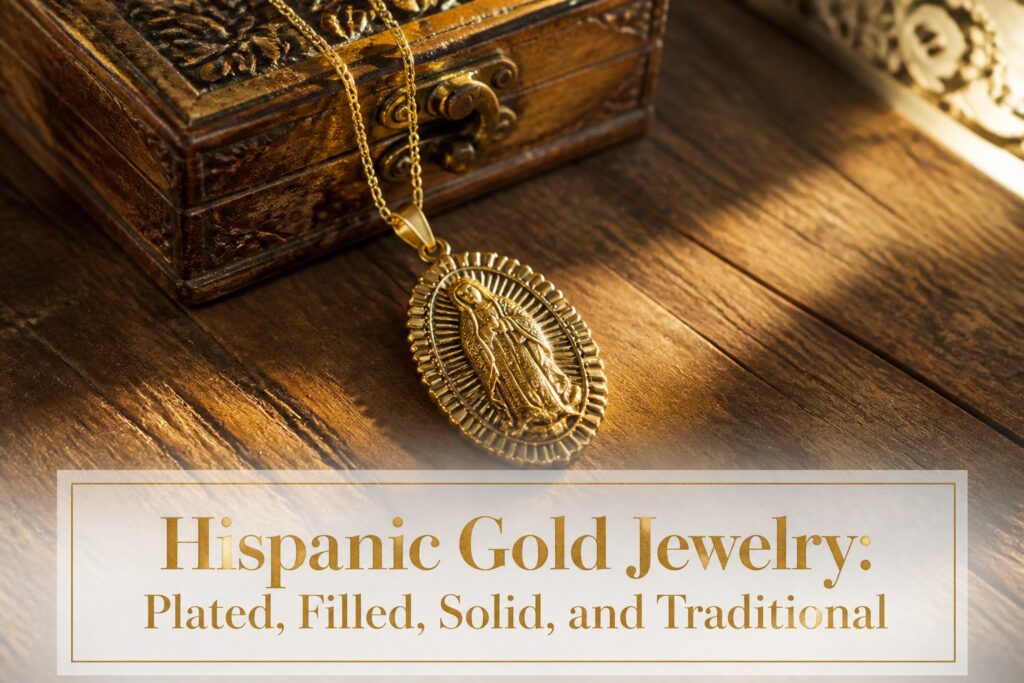
Hispanic gold jewelry is devotional and cultural goldwork shaped by Mexican and broader Latin American Catholic tradition, ranging from electroplated medals to solid 14K heirlooms.
The difference that matters most is construction: gold-plated pieces wear through in months of daily use, while gold-filled survives years and solid gold outlasts generations.
A 14K Virgen de Guadalupe pendant, stamped 585, remains the standard piece passed from grandmother to granddaughter.
Gold-Plated Jewelry
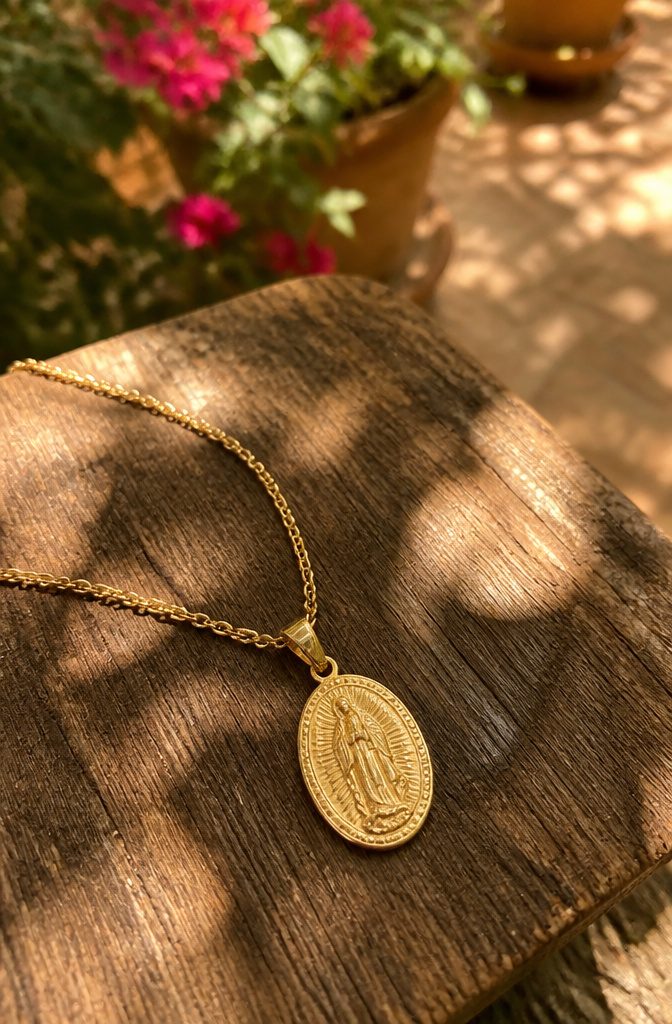
Gold-plated Hispanic jewelry gives you the color and warmth of gold through electroplating, a thin layer bonded over base metal.
The price lands low enough that gifting becomes easy: a Guadalupe medal for a quinceañera, a Saint Benedict necklace for Confirmation, a Miraculous Medal for a friend going through difficulty.
The gold layer stays thin enough that daily wear thins it further, especially at friction points like clasps and pendant edges. For pieces worn only on occasion or for someone testing whether they will wear the style, plating makes sense.
For continuous wear, the finish will not hold. I would not choose plated for a scapular or a necklace meant to stay on; the cost savings disappear when the piece needs replacing inside a year.
Gold-Filled Jewelry
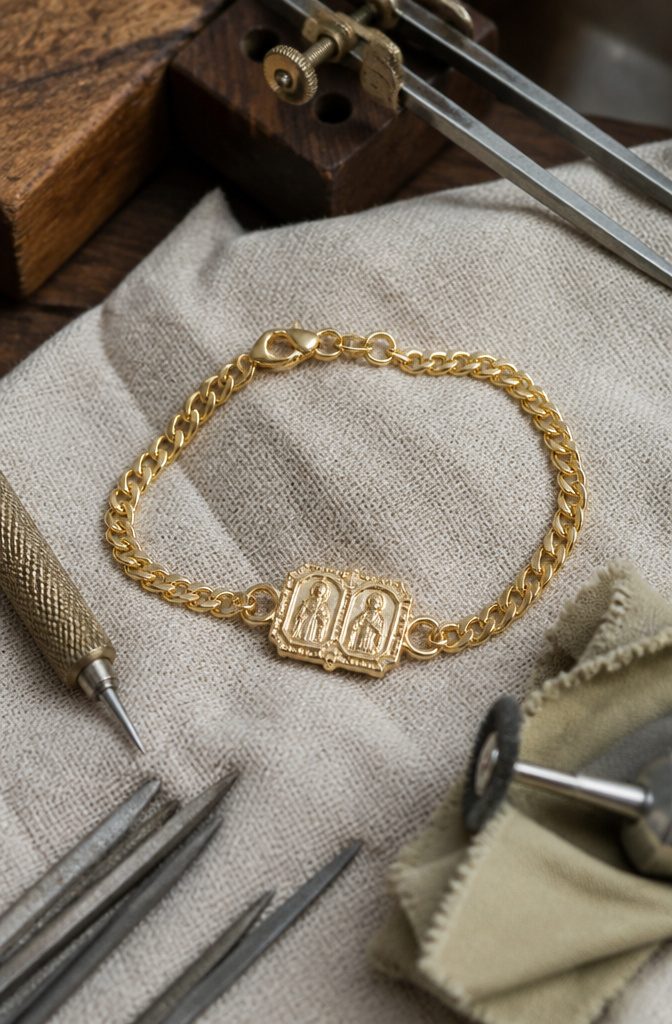
Gold-filled jewelry carries a substantially thicker layer of gold than plating, bonded to a brass or copper core through heat and pressure rather than the thin electroplated wash you find on cheaper pieces.
That difference in construction is what makes it practical for daily wear. The gold layer resists the nicks, rubs, and tarnish that eventually wear through plating to expose the base metal beneath.
For someone choosing Hispanic gold jewelry they intend to wear continuously, a gold-filled Guadalupe necklace or scapular bracelet will keep its warmth and color across years of use.
The plating option costs less upfront, but I would not count on it surviving the friction of a chain against skin day after day.
Gold-filled sits at the practical middle: the look and feel of gold without the solid-gold price, and enough durability that you are not replacing it every season.
Solid Gold Jewelry
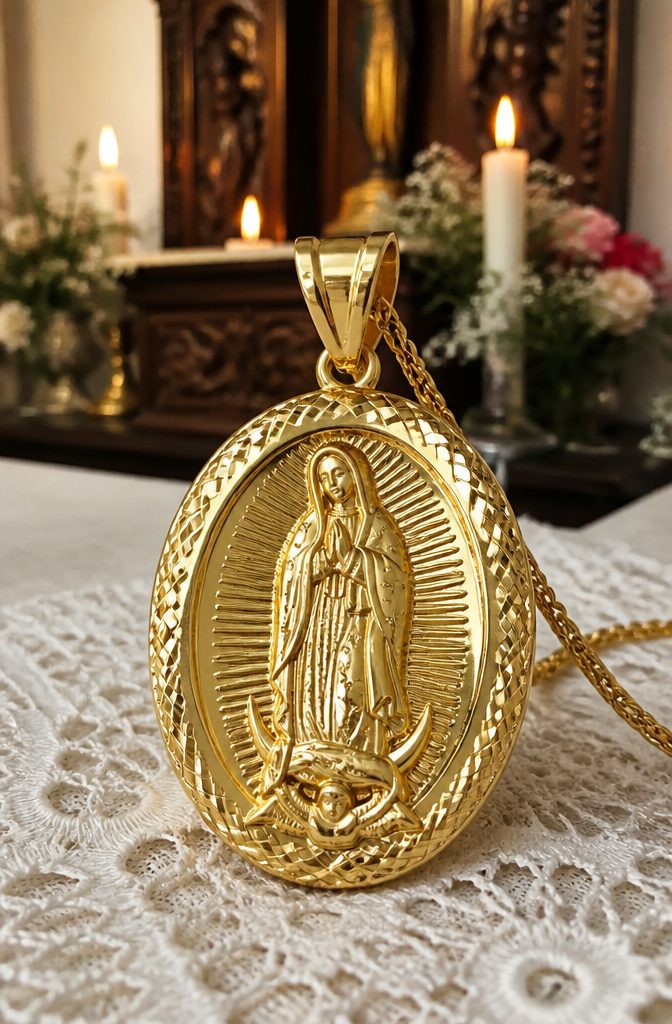
Solid gold is the highest expression of the goldsmith’s craft and the most enduring form Hispanic gold jewelry can take.
The gold runs through the entire piece, not as a surface layer but as the material itself, so it does not tarnish, fade, or change in any way that diminishes its beauty.
That permanence is why solid gold has always been reserved for the most significant pieces: the pendant given at a daughter’s quinceañera, the necklace that marks a wedding anniversary, the saint medal a grandmother passes to her granddaughter.
These are heirlooms by design, meant to outlast the first wearer and carry faith from one generation to the next.
For devotional pieces in this tradition, 14K gold is the standard.
It balances purity, durability, and the warm color the tradition demands, and each piece is stamped with its purity mark to confirm the gold content for the wearer and for whoever inherits it.
Higher karat gold exists, of course, but 14K hits the practical sweet spot: soft enough to take fine detail, hard enough to survive decades of wear.
If I am choosing one piece to become family jewelry, solid 14K is where I put my money.
Traditional Religious Jewelry
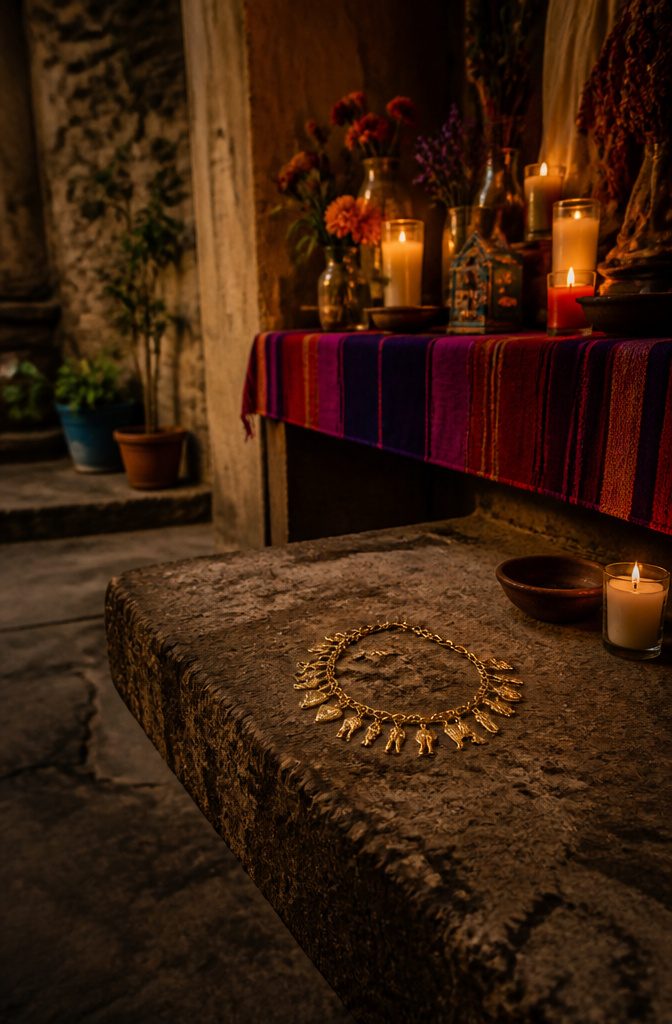
Traditional Hispanic gold jewelry carries some of the most recognizable Catholic imagery in any devotional tradition.
The Virgen de Guadalupe pendant remains the piece you will see most often, typically rendered in 14K or 18K yellow gold with her blue-green mantle picked out in enamel.
I consider this the starting point for anyone building a collection with actual spiritual use in mind, not just cultural signaling.
Milagros, those tiny stamped charms shaped like limbs, hearts, or animals, originated as offerings pinned to altar cloths or statues.
Worn on a chain or clustered into a bracelet, they function as portable petitions. A gold milagro of a leg might commemorate a healed injury; a house shape, a prayer for shelter.
The meaning stays private unless the wearer chooses to explain it, which I find more sincere than the overt display some other religious jewelry demands.
The scapular, usually two small gold plaques on a chain, represents a promise rather than mere protection. One side typically shows the Sacred Heart, the other Our Lady of Mount Carmel.
Wearing it commits the bearer to specific devotional practices, not just aesthetic affiliation. I would not gift one casually; the recipient needs to understand the obligation it carries.
Saints’ medals round out the common forms, with St. Jude for hopeless causes and St. Christopher for travelers appearing most frequently.
The metal matters less for these than the blessing they receive, though solid gold versions tend to be kept for formal occasions while plated ones handle daily wear.
Contemporary Designs
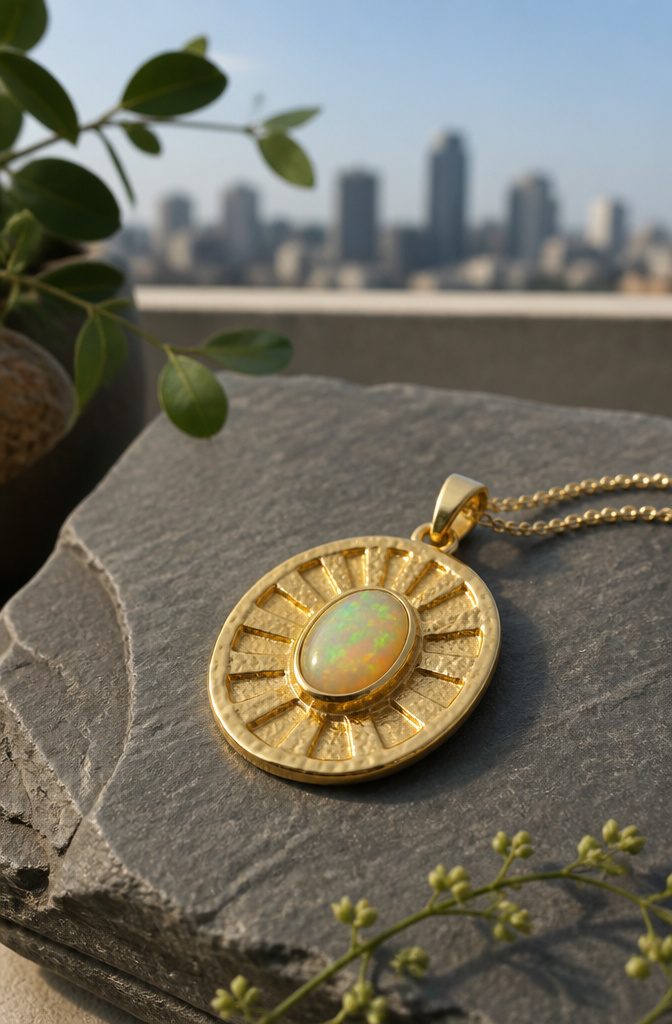
Modern Mexican gold jewelry carries two conversations at once: the indigenous shapes that still read as heritage, and the settings that place them in a present-day wardrobe.
ARetro 18K yellow gold medallion pendant with a bold oval Mexican opal roughly 11 by 8.5 mm at its center shows how—that scale and that stone arrangement feel rooted, but the piece itself is built to wear with current necklines and layering habits. contemporary piece like the Escapo ring in 24K gold-plated bronze, sized at about 4.5 cm in diameter, 2.3 cm in width and 3.5 cm in height, pushes further into gallery territory.
It is Mexico-made, materially labeled, and finished with the deliberate irregularity that marks design-objects rather than keepsakes.
What separates these from traditional Hispanic gold jewelry is the intent behind the gem. Older religious medallions or coin bracelets kept their stones, if any, subordinate to the metal’s message.
In newer work, the gem does more decorative labor: the Mexican opal’s color play becomes the reason for the pendant, not a frame for something else.
The market sorts this into two lanes—wearable heritage you buy for yourself, and statement pieces you buy as design.
Most contemporary Hispanic gold jewelry I see in US retail sits at 10K or 14K when it is solid at all; 10K stamps 417, 14K stamps 585, and much of what carries a made-in-Mexico label is plated bronze finished thick enough to read as gold.
That construction keeps price accessible but lifespan shortened, which matters if you are choosing between a single plated ring and a smaller solid piece.
I would take the solid 10K bracelet for daily wear and relegate plated work to occasional use, where the design carries the evening and the finish never sees sweat or shower.
Artisan-Made Pieces
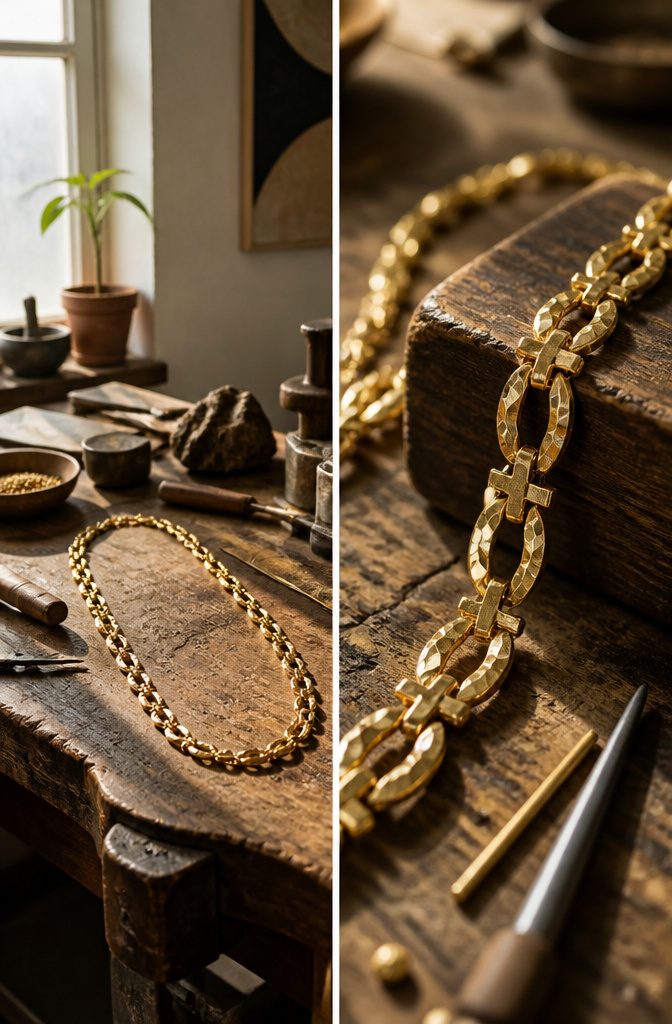
A handmade piece of Hispanic gold jewelry carries the weight of two traditions: the indigenous metalwork that predates Columbus and the Spanish colonial techniques that reshaped it.
Modern Mexican artisans still draw on both lineages, and the result is work you can distinguish from factory output if you know where to look.
The stamp is your first clue, not your last. Mexican gold is mostly 10 karat or 14 karat, marked 417 or 585, though I have handled pieces ranging from 8 karat to 18 karat.
A missing stamp does not mean a piece is inauthentic; many older or village-made items were never marked. The real test is the construction.
Hand-finished links on a rope necklace or a ID bracelet will show slight variation under magnification, and religious pendants like crosses or Virgen de Guadalupe images often retain tool marks from chasing and repoussé work that machines would polish away.
I favor buying from the artisan or a direct importer when possible.
The markup through middlemen rarely improves the piece, and the money reaches the maker intact. Custom work from a Oaxacan or Taxco smith can take weeks, and you must verify karat weight yourself if there is no hallmark.
For Centenarios, the 50 peso gold coins set into bracelets or pendants, I treat the coin itself as the certificate; its weight and purity are standardized, so the craft lies in the mount.
What Gold Meant Then and Now
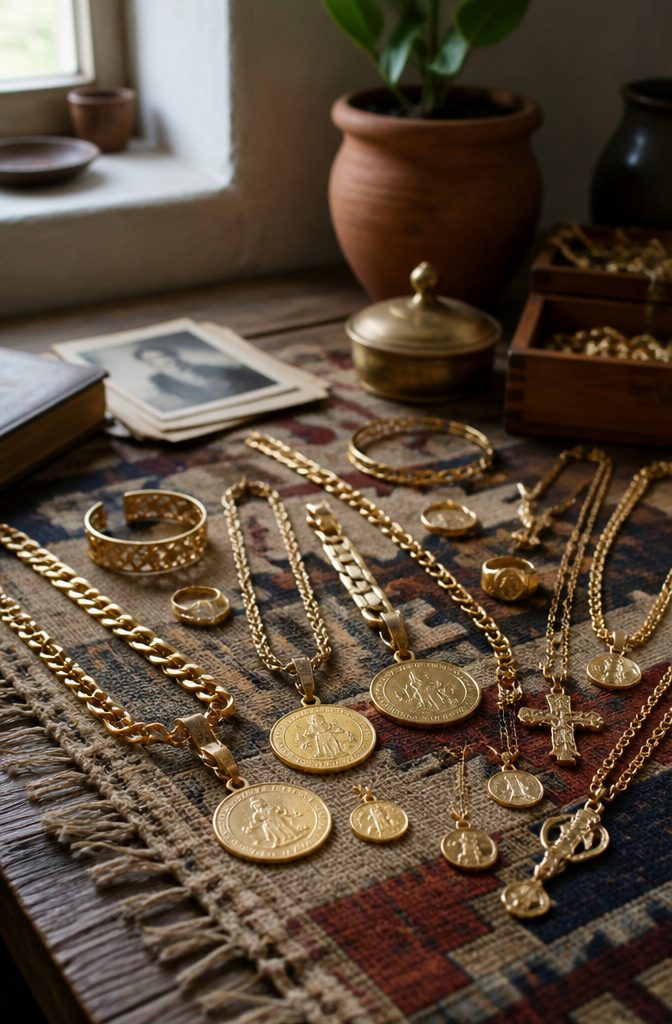
Mesoamerican goldwork served two masters long before Spanish contact: wealth and worship. The Aztec and Maya elite wore it as status; priests brought it to ceremonies as offering.
That dual purpose never really left. After colonization, indigenous metalwork merged with Spanish Catholic iconography, and the same piece could signal standing in the plaza and devotion at the altar.
Contemporary Mexican gold jewelry still carries both signatures. You see it in the 10 karat and 14 karat pieces that dominate the market, stamped 417 or 585, where rope necklaces and link bracelets sit beside crosses, Virgins, and Christ pendants.
The Centenario 50 Peso coin, reimagined as pendant or bracelet centerpiece, bridges the two worlds outright: state prestige on one face, national patroness on the other.
The karat range runs wider than typical U.S. stock. I have seen Mexican-made pieces at 8 karat and at 18 karat, though 10 and 14 remain the practical standard for daily wear.
Lower karat means harder metal, less denting, more tolerance for the bump of ordinary life. For a buyer comparing against American 14 karat, the difference is not just origin but alloy recipe and the hand that forged it.
How the Karat Affects What You Get
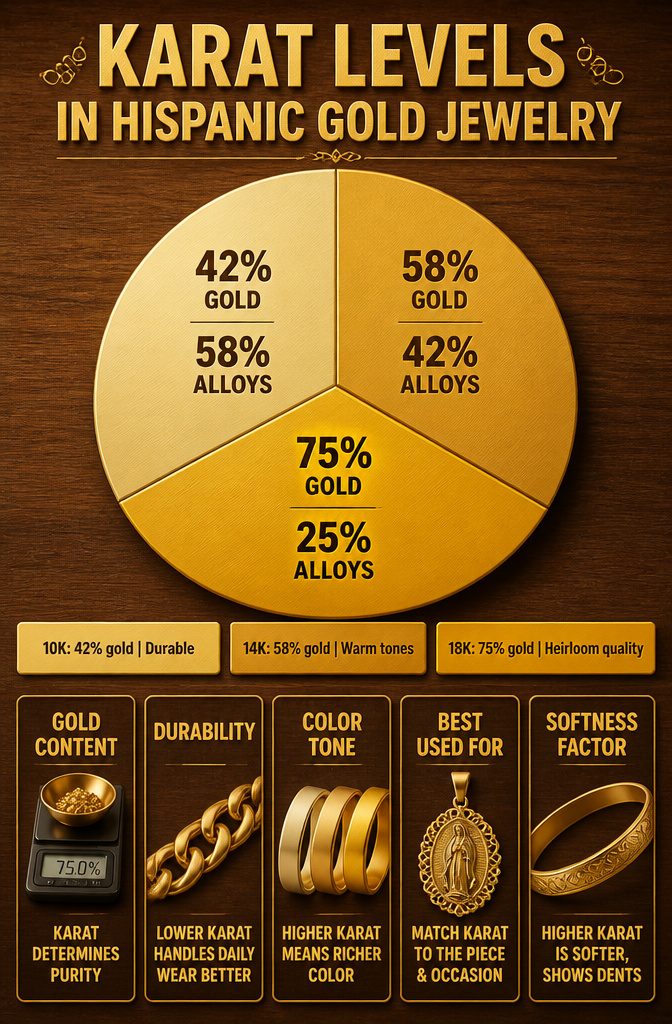
Most Hispanic gold jewelry you will encounter sits at 10K, 14K, or 18K, and the karat number tells you exactly how much actual gold is in the mix.
10K carries the least, at roughly 42 percent gold, with the rest made up of harder alloys like copper and zinc.
That lower gold content means 10K scratches less and holds its shape through daily knocks, so you will see it in heavier chain links and rings that take a beating.
The color runs paler, sometimes almost brassy, which is why I tend to pass on it for pieces meant to stand alone as a statement.
14K lands near the middle at about 58 percent gold.
It keeps enough warmth to read as genuine yellow gold while still tolerating regular wear without turning mushy. Mexican artisans reach for 14K often, especially in filigree work and religious pendants where fine detail needs some structural backbone.
This is the karat I usually recommend for someone buying their first solid piece, since it does not demand babying but still looks rich against most skin tones.
18K pushes up to 75 percent gold, and the color deepens into that saturated, almost orange-yellow people associate with heirloom quality.
The gold is softer. An 18K bangle or cuff will show dents if you wear it while typing or lifting, and the price jumps accordingly.
You will find 18K reserved for special-occasion pieces, wedding bands, or the kind of earrings that come out for Sunday mass rather than daily commutes.
If the piece is meant to last generations but sit in a box between wearings, 18K earns its place.
Plated, Filled, or Solid
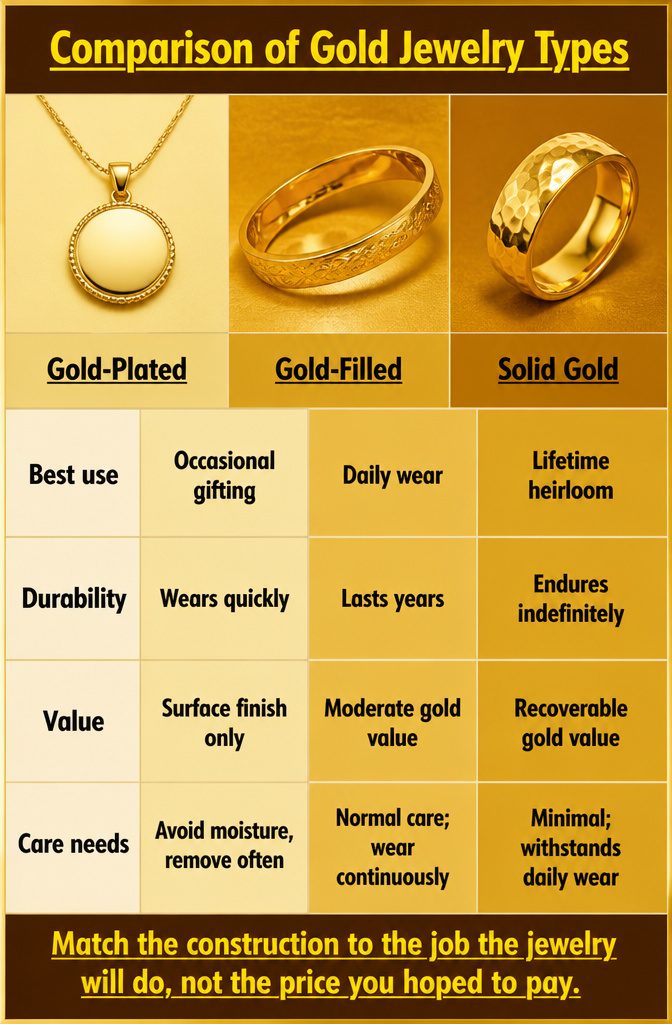
Gold-plated, gold-filled, and solid gold can look identical under store lights, but the construction decides how long that look lasts and what the piece is actually worth.
Gold-filled is the practical minimum for daily wear; the gold layer is bonded thick enough through heat and pressure that normal use won’t expose the base metal beneath, and it resists tarnishing far better than plating.
Gold-plated works for occasional pieces or gifts you don’t expect to outlast the season.
Solid gold is the only choice if you want a medal or ring to become an heirloom; it endures decades of continuous wear without wearing through, and it carries the intrinsic value that plated and filled pieces simply do not.
| Attribute | Gold-Plated | Gold-Filled | Solid Gold |
|---|---|---|---|
| Best use | Occasional gifting | Daily devotional wear | Lifetime heirloom |
| Durability | Wears through with regular use | Maintains appearance over years | Endures indefinitely |
| Value | Surface finish only | Moderate; gold content measurable | Intrinsic, recoverable gold value |
| Care needs | Avoid moisture, remove often | Normal care; wear continuously | Minimal; withstands daily wear |
Match the construction to the job the jewelry will do, not the price you hoped to pay.
Frequently Asked Questions
What is the difference between gold-plated and gold-filled jewelry?
Gold-filled jewelry carries a substantially thicker layer of gold bonded to a metal core through heat and pressure, while gold-plated pieces get only a thin electroplated wash.
That thicker construction lets gold-filled pieces survive daily wear for years without exposing the base metal beneath, where plating thins at friction points and may need replacing inside a year.
What types of gold are used in Mexican jewelry?
Mexican gold jewelry is mostly 10 karat and 14 karat gold, stamped 417 or 585, though the range runs from 8 karat to 18 karat.
Ten karat handles daily knocks without denting; 14 karat balances warmth and durability for filigree and religious pendants; 18 karat reserves itself for special-occasion pieces and wedding bands due to its softness.
What is the significance of gold in Mexican culture?
Gold served wealth and worship in Mesoamerica long before Spanish contact, worn by elites as status and offered by priests in ceremony.
That dual purpose persisted after colonization, when indigenous metalwork merged with Spanish Catholic iconography so the same piece could signal standing in the plaza and devotion at the altar.
Is Mexican gold real gold?
Yes, Mexican gold jewelry is real gold, typically 10K or 14K and stamped 417 or 585 to confirm content.
Some older or village-made pieces lack stamps, but the gold itself is genuine, with karat weights running as low as 8K and as high as 18K.
What are Mexican gold bracelets called?
Common forms include rope necklaces, link bracelets, ID bracelets, and coin bracelets set with Centenarios, the 50 peso gold coins. Religious motifs appear frequently: crosses, Jesus and Virgin Mary pendants, and scapulars with small gold plaques on chain.
Is Mexican gold cheaper than American gold?
That construction keeps price accessible while shortening lifespan, so buyers face a trade between a larger plated piece and a smaller solid one.
What is a famous Mexican jewelry brand?
It emphasizes buying from the artisan or direct importer when possible, since middlemen markup rarely improves the piece.