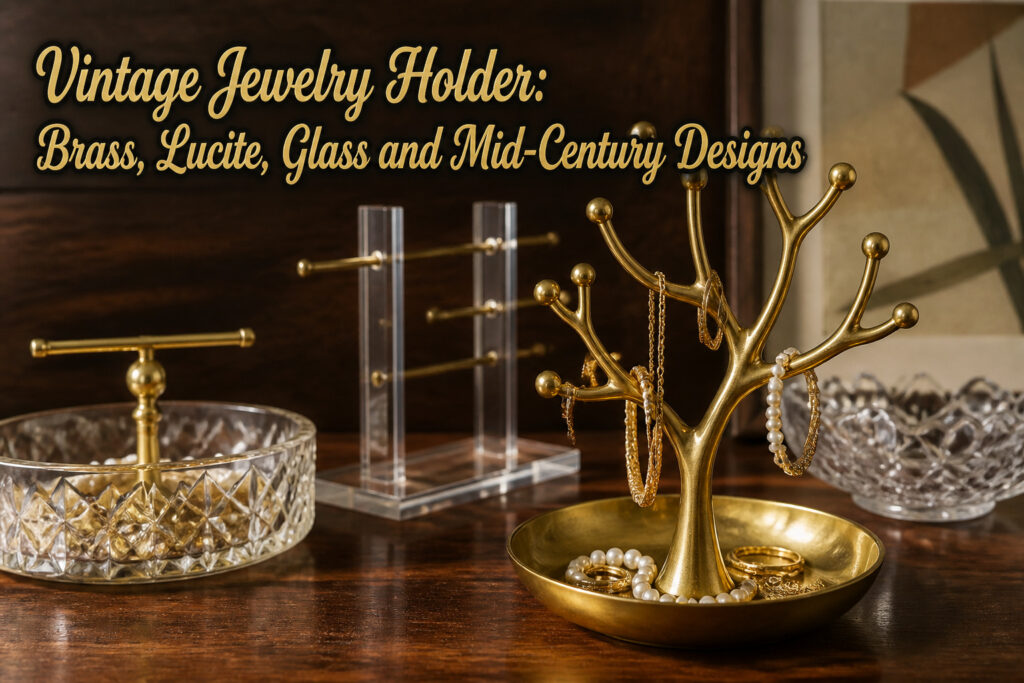
A vintage jewelry holder is a functional storage piece that doubles as sculpture, with mid-century examples in brass, Lucite, or crystal glass commanding prices from roughly $211 to $2,950 depending on condition and designer attribution.
The market distinguishes sharply between unsigned mass-production and documented work by makers like Charles Hollis Jones, whose 1960s brass pieces now trade at a widening premium above equivalent unmarked holders.
Vintage Brass Jewelry or Tie Holder by Charles Hollis Jones

Brass pieces from the 1960s carry a warmth that newer metals rarely match, and Charles Hollis Jones built his reputation on exactly that quality.
His vintage brass jewelry or tie holder, manufactured in Los Angeles during that decade, shows how functional storage can double as sculpture.
The aged patina on the brass develops naturally over sixty years, darkening at edges and high-touch spots in ways no factory finish replicates.
Jones occupies a distinct place in the vintage jewelry holder market. Where many mid-century designers worked in wood or chrome, he specialized in brass and Lucite, materials that read as luxurious without the formality of silver or crystal.
Collectors now hunt his pieces for that reason: they slot into contemporary bedrooms and closets without looking like reproductions.
Condition on surviving examples runs from good to excellent, with the patina itself becoming a selling point rather than a flaw. The piece measures compactly enough for dresser-top use, though exact dimensions vary by listing.
For anyone weighing a Jones holder against mass-produced alternatives, the difference sits in the metal weight and the joinery. His brass has heft; it does not slide when you pull a tie free.
The market recognizes this. Prices climb above equivalent unsigned brass holders, and the gap has widened as his work has been collected more aggressively.
Buy for the designer name if you respect the object, but buy the object itself if you plan to use it daily.

Elegant Catchall: Round clawfoot pedestal dish for jewelry, candles, and trinkets.
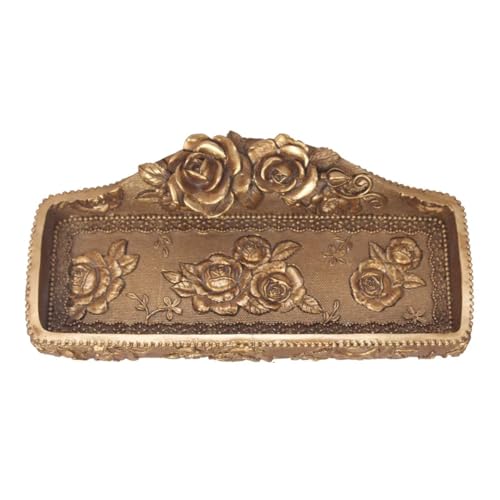
Unique Gift: This tray serves as a decorative piece, capable of enhancing the aesthetic appeal of a space. It adds a unique and charming touch, infusing the environment with a sense of fun and warmth, and can also spark conversations and bring a smile to viewers' faces. Moreover, it can also serve as a unique gift to give to important family and friends on special occasions such as Father's Day, Mother's Day, Valentine's Day, anniversaries, Thanksgiving, Christmas, New Year, and more.
Vintage Lucite and Nickel Jewelry Holder by Charles Hollis Jones
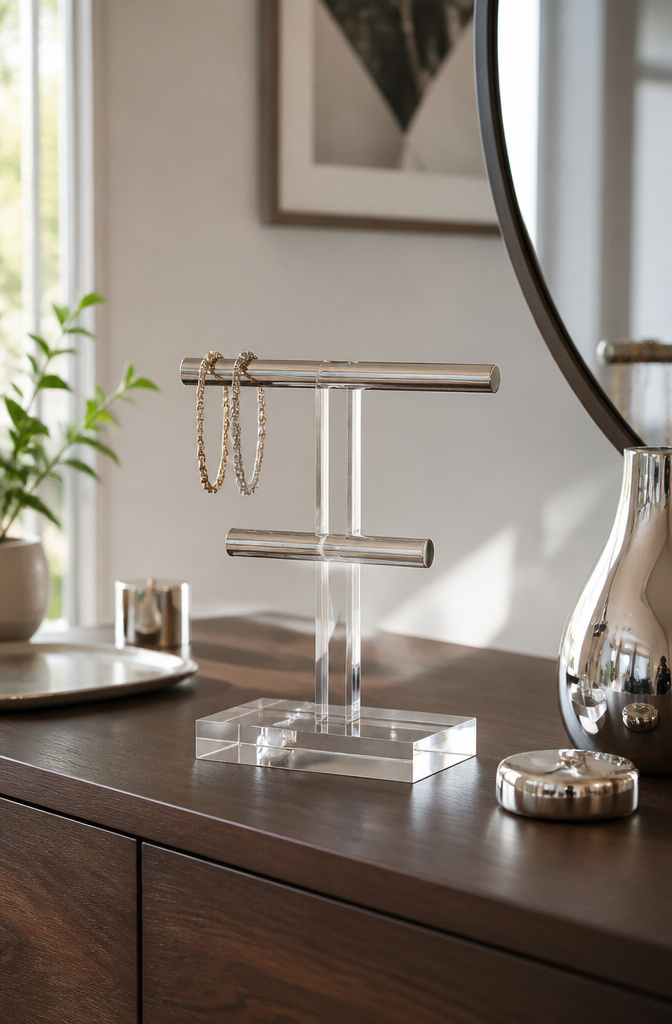
The Lucite and nickel jewelry holder Charles Hollis Jones designed in the 1960s sits at a different temperature than his brass work. Polished nickel against clear acrylic reads cooler, more clinical, where brass warms a room immediately.
That contrast matters when you are choosing which version lives on a vanity or in a display case.
Jones moved between materials with something like fluency.
The same decade that produced this piece also saw him working in brass, and the range suggests a designer less attached to a signature finish than to solving the same problem, stand after stand, with whatever surface suited the moment.
Lucite and nickel together catch light differently than brass does, throwing sharper reflections, demanding a cleaner backdrop so they do not look busy.
For a collector, the choice between the two versions is finally a question of what else sits nearby. The nickel piece plays well with chrome, with mirror, with the pale woods of mid-century case goods.
The brass version needs richer company to avoid looking stranded. Both carry the same structural intelligence, the same proportions, but the materials rewrite the mood entirely.

Keep Jewelry Oorganized: Jewelry stand can keep your jewelry organized, saves space. You can find jewelry quickly and easily, no more searching through jewelry box or messy drawers, all of your jewelry. Necklace holder suitable for your vanity table or countertop, easy to put and also match the great for rooms of all color or theme
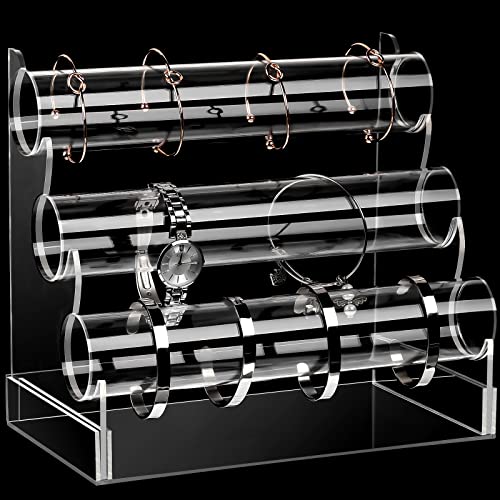
You will get: there is 1 piece of clear acrylic bracelet holder, which is consists of 3 tier racks, a base stand and 2 side panels, you need to assemble it by yourself, easy to assemble and detach

Overall Dimensions: 8.5”W x 11”H x 4”D Ideal jewelry organizer and display solution in both home and retail settings Holds and displays up to two necklaces and one pair of earrings Freestanding and portable; display on counters, shelves, tables and display cases Angled, slant back design provides stability and optimal view of jewelry
Vintage Crystal Glass Hanger Ring Stand

Crystal glass carries a different kind of weight than metal or resin, and the Italian pieces from the 1960s prove it.
A vintage crystal glass hanger ring stand made in Italy during that decade sits on a vanity with the clarity and heft of a small sculpture, the facets catching morning light in ways that make the rings stored there read as display pieces rather than clutter.
The manufacturing origin matters here. Italian glasswork of this period, particularly from regions with established crystal traditions, applied techniques honed on tableware and decorative objects to domestic accessories.
The result is a ring stand with the formal precision of a champagne flute but scaled to a task that demands daily access.
Design-wise, the 1960s influence shows in the restraint. No excess ornament, just the geometry of the hanger form and the material doing the work.
The specific design for ring storage, a vertical hanger rather than a flat tray, keeps bands visible and separated.
For anyone building a collection of vintage jewelry holders, this piece represents a midpoint between the utilitarian brass holders of the period and the more theatrical Lucite designs. It holds its own without shouting.
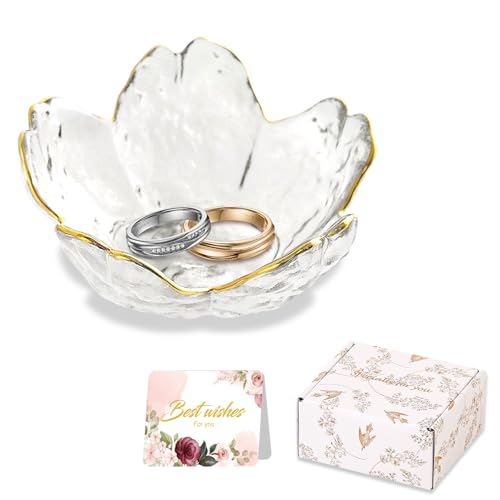
Birthday Gifts For Women: Cute flower trinket tray at about only 9cm(3.5 inches)in diameter, approximately 4cm(1.6)inches high, comes with floral gift box. If you don't know what to give as a present, this flower jewellery tray will be a great choice for you. It is a special and meaningful present to your friends and family. Decorations and presents for birthday, valentine's day, wedding, christmas and new year.

1 Pack in package. Very small size: 3”x3”x1.5” inches (Length x Width x Height).

Compact Size: The size of jewelry trinket dish is about 3.1"x 3.1". The crystal ring stand has an exquisite shape and can be placed anywhere you want
Vintage Hexagonal Modern Glass Retail Jewelry Tall Display Case

A vintage hexagonal modern glass retail jewelry tall display case commands attention the moment you walk into a room. Six flat glass panels meet at sharp angles, creating a shape that catches light differently from every vantage point.
Unlike the soft curves of mid-century Lucite or the warm weight of brass stands, this piece reads as architectural, almost gallery-like in its restraint.
The height is what shifts it from personal accessory to statement furniture. Standing well above standard tabletop holders, it was built for retail floors where necklaces and earrings needed elevation above a crowd.
Glass shelves inside multiply the effect, so a single strand of pearls becomes six strands in reflection. That transparency is the whole point: nothing hides the metalwork or the stones, yet the case itself still occupies visual space.
Modern design here means minimal hardware. Slim metal joins at the edges, sometimes chrome, sometimes barely visible at all.
The frame does not decorate; it holds. In a home setting, this scale can overwhelm a dresser top.
What convinced me, looking at how collectors actually use these, is that they work best as room anchors: placed on a low credenza, lit from above, treated as a vitrine for a rotating selection rather than daily storage.
The glass demands curation. Leave it half empty and it looks abandoned; fill every shelf and it becomes cluttered.
The sweet spot sits somewhere in between, changed seasonally.

Sleek Gold Tie Clip: 2.36" tie clips for men is designed for 3.1" to 3.5" wide ties, offering a refined and polished finish. The sophisticated gold tie bar finish elevates any outfit, making it ideal for business, weddings, and formal events

Rhodium Plated Base Copper Antique Sword Tie Clip for Man Necktie Accessories

Sleek Gold Tie Clip: 2.36" tie clips for men is designed for 3.1" to 3.5" wide ties, offering a refined and polished finish. The sophisticated gold tie bar finish elevates any outfit, making it ideal for business, weddings, and formal events
Mid-Century Modern, Art Deco, and Folk Art Jewelry Stands

Mid-Century Modern jewelry stands favor clean lines and organic curves in brass and nickel, the kind of pieces Charles Hollis Jones and Aldo Tura produced that still read as contemporary seven decades later.
Art Deco stands lean harder into geometry: stepped forms, sunburst motifs, the glamour of the 1920s and 30s rendered in polished metal and occasionally glass.
Folk Art pieces carry a different energy entirely, hand-worked and asymmetrical, often from unnamed makers whose regional traditions matter more than any signature.
When you’re browsing for the right vintage jewelry stand, those designed in Mid-Century Modern, Art Deco and Folk Art styles are of considerable interest.
— 1stdibs
That range matters for collectors because each style anchors a different room.
Mid-Century pieces sit comfortably beside teak dressers and Nelson clocks; Art Deco stands hold their own against lacquered furniture and velvet; Folk Art pieces soften minimalist spaces with visible human touch.
The 20th Century editions 1stDibs lists span from older decades through later reproductions, so dating by construction details, not style alone, separates the valuable from the merely decorative.

FUNCTIONAL - Maximize drawer space with the iDesign Clarity Clear Drawer Organizer; These clear plastic trays are ideal for organizing makeup, skincare, office supplies, or small bathroom essentials on your vanity, dresser, or desk

Elegant Design: available in 1-compartment, 3-compartment, 6-compartment and 8-compartment keeps your makeup organized and within easy reach; perfect choice for adding storage space on bathroom countertop, vanity and so on

PORTABLE: Measures: 7.80 x 3.90 x 0.70 inches, the vanity tray is small enough to fit your most used vanity items. And the acrylic material makes it easy to clean, just wipe with a clean damp cloth or wash with water
Styles That Define Vintage Holders

The three styles worth tracking down in a vintage jewelry holder each carry a different mood and a different moment in twentieth-century design.
Mid-Century Modern pieces read clean and optimistic, the kind of object that sat on a dresser in 1962 and still looks forward-thinking now.
Art Deco holders bring geometry and glamour, the stepped forms and mirror-bright surfaces of the 1920s and 1930s translated into something small enough for a vanity.
Folk Art sits at the other pole entirely, handmade and idiosyncratic, the sort of piece a dealer might pull from a box with no maker’s mark but plenty of personality.
Charles Hollis Jones, MAIO, and Aldo Tura each produced at least one stand worth considering, and the material tells you which style you’re holding.
Brass and nickel lean Mid-Century or Deco depending on the silhouette, while the more experimental Lucite pieces belong to that postwar moment when plastic suddenly carried prestige. Metal, brass, and nickel are the most common constructions you’ll find.
The historical significance is practical, not just academic. A Mid-Century Modern holder from the twentieth century was designed for a different kind of jewelry, lighter and more delicate than most contemporary pieces.
Art Deco stands were built for display, for the long necklaces and brooches that filled a 1930s jewelry case. Folk Art pieces, being one-offs, are harder to match to a collection but easier to love for their own sake.

LARGE 10-INCH CLAWFOOT TRAY—The spacious 10-inch round surface offers more room than small trinket dishes, making this decorative tray ideal for candles, perfume bottles, jewelry, rings and everyday display pieces.

Designer Style: This small stylish 5" jewelry bowl features an embossed rose design with decorative edges. The shiny brass adds a touch of style, elegance, and sophistication to any room in your home. Brass has that timeless vintage feel combined with this modern, contemporary style.

✔ 100% Solid Brass Construction – Crafted from genuine solid brass, this dish is durable, heavy, and built to last. No lightweight or plated material.
Brass, Nickel, and Crystal Glass Construction

Brass and nickel gave vintage jewelry holders their modern edge. The warm gold tone of brass caught light in a way that made even inexpensive pieces feel deliberate, while nickel’s cooler, silvery finish read as restrained and industrial.
Both metals held up to daily handling, though brass darkens over time in a way some collectors chase and others polish away.
Crystal glass brought the elegance. A glass rod or finial caught and scattered light across a vanity, turning stored jewelry into something displayed rather than hidden.
The weight felt substantial, and the transparency kept visual clutter low, which mattered in the smaller bedrooms of mid-century homes.
What convinced me, looking through enough of these pieces, is how rarely they mixed all three materials in one holder. A brass-and-crystal pairing leaned glamorous; nickel with glass read more Danish Modern and quiet.
The metal determines the era as much as the form does. Spotting which dominates a piece tells you faster than any stamp whether you’re looking at 1950s glamour or 1960s restraint.

Came Fully Assembled - No installation is required. Simply remove the protective stickers, and you will obtain a transparent container. Built-in mirror design allows you to try on necklaces that match your outfit

Organize your space: these ring display cones support holders are designed to display, which can not only place ring neatly on the table to effectively organize your desktop, but also prevent the loss of jewelry and make it easy to find ring you want to wear

Elegant & Functional Design – This stylish jewelry organizer features a sleek acrylic double-cylinder design with a golden T-bar metal center, offering a luxurious and modern way to display your bracelets, necklaces, watches, and long earrings
Designers Who Shaped the Market

Charles Hollis Jones built his name on brass and acrylic furniture in 1960s Los Angeles, and his jewelry holders carry that same polished weight.
A brass piece from that era, still showing its aged patina, sits at the intersection of storage and sculpture: the metal warms over time, the lines stay crisp.
Brass jewelry holders by Jones age better when the patina stays intact; stripping it down to shine erases half the point.
MAIO worked in cleaner territory, pairing Lucite with nickel for holders that disappear against mid-century dressing tables. The material reads as glass until you lift it, and that lightness mattered in smaller postwar bedrooms where every surface counted.
Where Jones leaned into heft, MAIO let the jewelry become the visual event.
Aldo Tura took a different risk entirely. His holders wrapped goatskin parchment around wood bases, dyed in saturated colors that feel closer to Italian couture than to hardware.
The surface scratches if you are careless, which is the trade: Tura pieces ask for maintenance in exchange for warmth no metal achieves.
Three ways to play this. Jones wins if your space already holds other brass period pieces and you want continuity.
MAIO fits when the holder needs to read as barely there. Tura works only if you will commit to the upkeep; the parchment cracks in dry climates, and a neglected Tura holder looks neglected fast.

Elegant Pretty and Practical Tray - With such a minimalist look, this tray can give an added touch of glamour and prestige to any environment. Its design is the perfect balance between modesty and allure. Gorgeously display on the dresser, bathroom, table, countertop,Keep your item organized and make your items looks more fancy in this tray

Birthday Gifts For Women: Cute flower trinket tray at about only 9cm(3.5 inches)in diameter, approximately 4cm(1.6)inches high, comes with floral gift box. If you don't know what to give as a present, this flower jewellery tray will be a great choice for you. It is a special and meaningful present to your friends and family. Decorations and presents for birthday, valentine's day, wedding, graduation, retirement, christmas and new year.

Versatile: Flower-shaped glass dish for holding jewelry, trinkets, keys, and more.
What Vintage Holders Cost

Prices for a vintage jewelry holder span from about $211 at the entry level up to $2,950 for the rarest mid-century pieces, with most transactions settling near the $750 mark.
That average masks a wide spread, and where a particular stand lands depends on three things that are easy to spot once you know to look.
Condition is the first filter. A brass tree with its original patina intact and no solder repairs commands more than the same model with pitting or a wobbly base.
Rarity runs second. Production pieces from major manufacturers turn up regularly at estate sales; one-offs or small runs from studio craft jewelers almost never do, and the asking price reflects that scarcity.
Designer attribution closes the gap between good and exceptional.
Unsigned mid-century modern stands sell on form alone, but a documented piece by a known maker, one whose work collectors track, will pull from the top of the range even in merely decent condition.
I have watched the same unsigned Lucite stand list at $340, sell, and reappear six months later at $680 because the second seller led with era and condition rather than burying both. The holder had not changed.
The story attached to it had.

Sleek Gold Tie Clip: 2.36" tie clips for men is designed for 3.1" to 3.5" wide ties, offering a refined and polished finish. The sophisticated gold tie bar finish elevates any outfit, making it ideal for business, weddings, and formal events

No Drilling – Secure curtains instantly with powerful magnets, no tools, no holes, zero wall/fabric damage. Ideal for daily use, adjust or reposition in seconds without permanent marks.
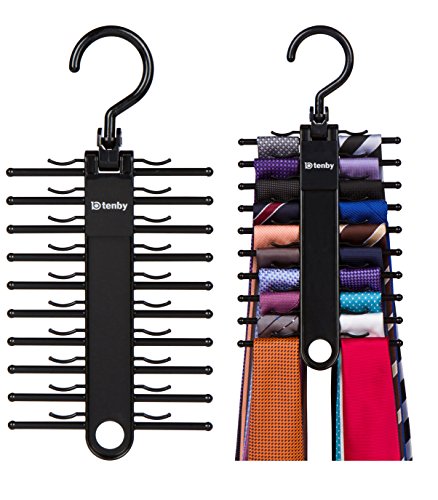
Holds securely up to 20 ties, space-saving and tidying up your closet
Frequently Asked Questions
What styles are available for vintage jewelry holders?
Vintage jewelry holders come in three main styles: Mid-Century Modern with clean lines and organic curves, Art Deco with stepped geometry and glamour, and Folk Art with hand-worked asymmetry.
Mid-Century pieces fit contemporary bedrooms easily, Art Deco stands hold their own against lacquered furniture, and Folk Art pieces add visible human touch to minimalist spaces.
What materials are commonly used in vintage jewelry holders?
Brass, nickel, and crystal glass are the most common materials. Brass warms a room and develops a valued patina over decades; nickel reads cooler and more restrained; crystal glass brings weight and transparency that turns stored jewelry into display.
The metal usually determines the era as much as the form does.
Who are notable designers of vintage jewelry holders?
Charles Hollis Jones, MAIO, and Aldo Tura each produced significant pieces.
Jones built his reputation on brass and Lucite in 1960s Los Angeles; MAIO paired Lucite with nickel for lighter, quieter holders; Tura wrapped goatskin parchment around wood bases in saturated colors that demand more maintenance but deliver unmatched warmth.